Nowakowska Karina, Sakellarios Antonis, Kaźmierski Jakub, Fotiadis Dimitrios I, Pezoulas Vasileios C
Department of Old Age Psychiatry and Psychotic Disorders, Medical University of Lodz, 90-419 Lodz, Poland.
Laboratory of Biomechanics and Biomedical Engineering, Department of Mechanical and Aeronautics Engineering, University of Patras, 26504 Patras, Greece.
Diagnostics (Basel). 2023 Dec 27;14(1):67. doi: 10.3390/diagnostics14010067.
Several studies have demonstrated a critical association between cardiovascular disease (CVD) and mental health, revealing that approximately one-third of individuals with CVD also experience depression. This comorbidity significantly increases the risk of cardiac complications and mortality, a risk that persists regardless of traditional factors. Addressing this issue, our study pioneers a straightforward, explainable, and data-driven pipeline for predicting depression in CVD patients.
Our study was conducted at a cardiac surgical intensive care unit. A total of 224 participants who were scheduled for elective coronary artery bypass graft surgery (CABG) were enrolled in the study. Prior to surgery, each patient underwent psychiatric evaluation to identify major depressive disorder (MDD) based on the DSM-5 criteria. An advanced data curation workflow was applied to eliminate outliers and inconsistencies and improve data quality. An explainable AI-empowered pipeline was developed, where sophisticated machine learning techniques, including the AdaBoost, random forest, and XGBoost algorithms, were trained and tested on the curated data based on a stratified cross-validation approach.
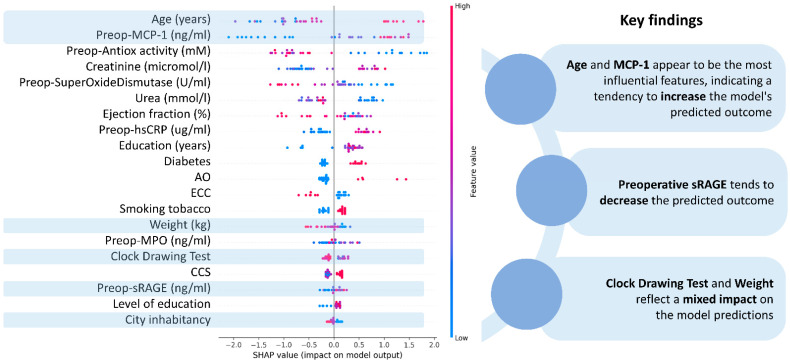
Our findings identified a significant correlation between the biomarker "sRAGE" and depression (r = 0.32, = 0.038). Among the applied models, the random forest classifier demonstrated superior accuracy in predicting depression, with notable scores in accuracy (0.62), sensitivity (0.71), specificity (0.53), and area under the curve (0.67).
This study provides compelling evidence that depression in CVD patients, particularly those with elevated "sRAGE" levels, can be predicted with a 62% accuracy rate. Our AI-driven approach offers a promising way for early identification and intervention, potentially revolutionizing care strategies in this vulnerable population.
多项研究表明心血管疾病(CVD)与心理健康之间存在关键关联,显示约三分之一的CVD患者也患有抑郁症。这种共病显著增加了心脏并发症和死亡率的风险,且无论传统因素如何,该风险都持续存在。为解决这一问题,我们的研究开创了一种简单、可解释且数据驱动的流程,用于预测CVD患者的抑郁症。
我们的研究在心脏外科重症监护病房进行。共有224名计划接受择期冠状动脉搭桥手术(CABG)的参与者纳入研究。手术前,每位患者均接受精神科评估,根据《精神疾病诊断与统计手册》第5版(DSM-5)标准确定是否患有重度抑郁症(MDD)。应用先进的数据整理工作流程来消除异常值和不一致性,并提高数据质量。开发了一种可解释的人工智能驱动流程,其中包括AdaBoost、随机森林和XGBoost算法在内的复杂机器学习技术,基于分层交叉验证方法在整理后的数据上进行训练和测试。
我们的研究结果确定生物标志物“sRAGE”与抑郁症之间存在显著相关性(r = 0.32,P = 0.038)。在所应用的模型中,随机森林分类器在预测抑郁症方面表现出更高的准确性,在准确率(0.62)、敏感性(0.71)、特异性(0.53)和曲线下面积(0.67)方面得分显著。
本研究提供了有力证据,表明CVD患者,尤其是“sRAGE”水平升高的患者,抑郁症的预测准确率可达62%。我们的人工智能驱动方法为早期识别和干预提供了一种有前景的方式,可能会彻底改变这一弱势群体的护理策略。