Graduate Institute of Pharmaceutical Science and Technology, College of Health Science, Central Taiwan University of Science and Technology, No.666, Buzih Road, Beitun District, Taichung 40601, Taiwan.
Molecules. 2013 Mar 1;18(3):2726-53. doi: 10.3390/molecules18032726.
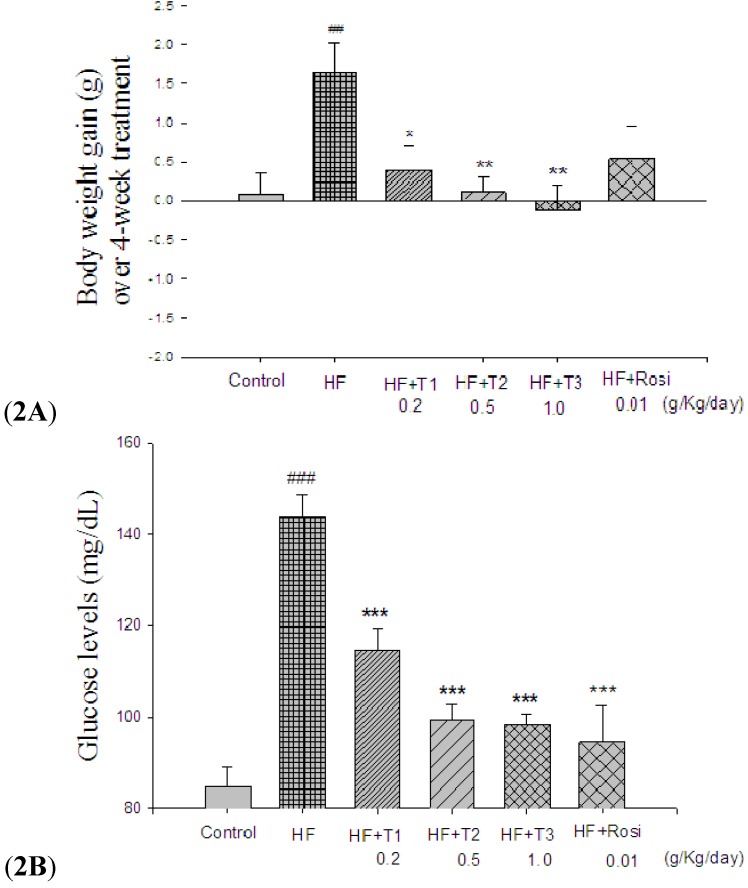
The present study investigates the anti-hyperlipidemic and antihyperglycemic effects and mechanism in high-fat (HF)-fed mice of cell suspension culture of Eriobotrya japonica (TA), which contains a great number of pentacyclic terpenoids. Firstly, C57BL/6J mice were randomly divided into two groups: the control (CON) group was fed with a low-fat diet (n = 9), whereas the experimental group was fed a 45% HF diet for 8 weeks. Afterwards, the CON group was treated with vehicle, whereas the HF group was subdivided into five groups and was orally given TA or rosiglitazone or not for 4 weeks. Blood and visceral adipose tissue, liver tissue and skeletal muscle were examined. Treatment with TA reduced body weight gain, weights of white adipose tissue (WAT) (including epididymal, perirenal, mesenteric WAT and visceral fat), and hepatic triacylglycerol content significantly without affecting food intake in diet-induced diabetic mice. TA effectively prevented HF diet-induced increases in the levels of blood glucose, insulin, leptin and HOMA-IR index (p < 0.001, p < 0.05, p < 0.05, p < 0.01, respectively) and attenuated insulin resistance. Treatment with TA, adipocytes in the visceral depots showed a reduction in size. TA effectively significantly increased the protein contents of phosphorylation of AMPK-α (Thr172) both in liver and adipose tissue. It is shown that TA exhibits hypolipidemic effect in HF-fed mice by decreasing gene expressions of fatty acid synthesis, including acyl-coenzyme A: diacylglycerol acyltransferase (DGAT) 2, which catalyzes the final step in the synthesis of triglycerides, and antidiabetic properties occurred as a result of decreased hepatic glucose production via phosphenolpyruvate carboxykinase (PEPCK) down- regulation, improved insulin sensitization and TA (at 1.0 g/kg dose) decreased expression of hepatic and adipose 11-β-hydroxysteroid dehydroxygenase (11β-HSD1) gene, which contributed in attenuating diabetic state. Futhermore, TA at doses of 0.5 and 1.0 g/kg had serum lipid-lowering action characterized by the inhibition of DGAT 1 expression. Thus, amelioration of diabetic and dyslipidemic state by TA in HF-fed mice occurred by regulation of PEPCK, DGAT2 and AMPK phosphorylation.
本研究旨在探讨含有大量五环三萜的枇杷细胞悬浮培养物(TA)对高脂(HF)喂养小鼠的降血脂和降血糖作用及其机制。首先,将 C57BL/6J 小鼠随机分为两组:对照组(CON)给予低脂饮食(n = 9),实验组给予 45%HF 饮食 8 周。随后,CON 组给予载体处理,而 HF 组再分为五组,分别给予 TA 或罗格列酮或不给予药物治疗 4 周。检测血液、内脏脂肪组织、肝组织和骨骼肌。结果显示,TA 治疗可显著降低糖尿病小鼠体重增加、白色脂肪组织(WAT)重量(包括附睾、肾周、肠系膜 WAT 和内脏脂肪)和肝三酰甘油含量,同时不影响饮食摄入。TA 还能有效预防 HF 饮食诱导的血糖、胰岛素、瘦素和 HOMA-IR 指数升高(p < 0.001,p < 0.05,p < 0.05,p < 0.01),并减轻胰岛素抵抗。TA 治疗还可使内脏脂肪组织中的脂肪细胞体积减小。TA 还可有效显著增加肝脏和脂肪组织中 AMPK-α(Thr172)磷酸化的蛋白含量。以上结果表明,TA 通过降低脂肪酸合成基因的表达,包括催化甘油三酯合成最后一步的酰基辅酶 A:二酰基甘油酰基转移酶(DGAT)2,发挥其在 HF 喂养小鼠中的降血脂作用,同时通过下调磷酸烯醇丙酮酸羧激酶(PEPCK)降低肝葡萄糖生成,改善胰岛素敏感性以及降低肝脏和脂肪组织 11-β-羟甾脱氢酶(11β-HSD1)基因表达,减轻糖尿病状态,从而发挥其降糖作用。此外,TA(1.0 g/kg 剂量)还可降低血清脂质水平,其作用机制可能与抑制 DGAT1 表达有关。因此,TA 通过调节 PEPCK、DGAT2 和 AMPK 磷酸化改善 HF 喂养小鼠的糖尿病和血脂异常状态。