Department of Organismic and Evolutionary Biology, Harvard University, Cambridge, Massachusetts, USA.
PLoS Genet. 2013;9(2):e1003265. doi: 10.1371/journal.pgen.1003265. Epub 2013 Feb 14.
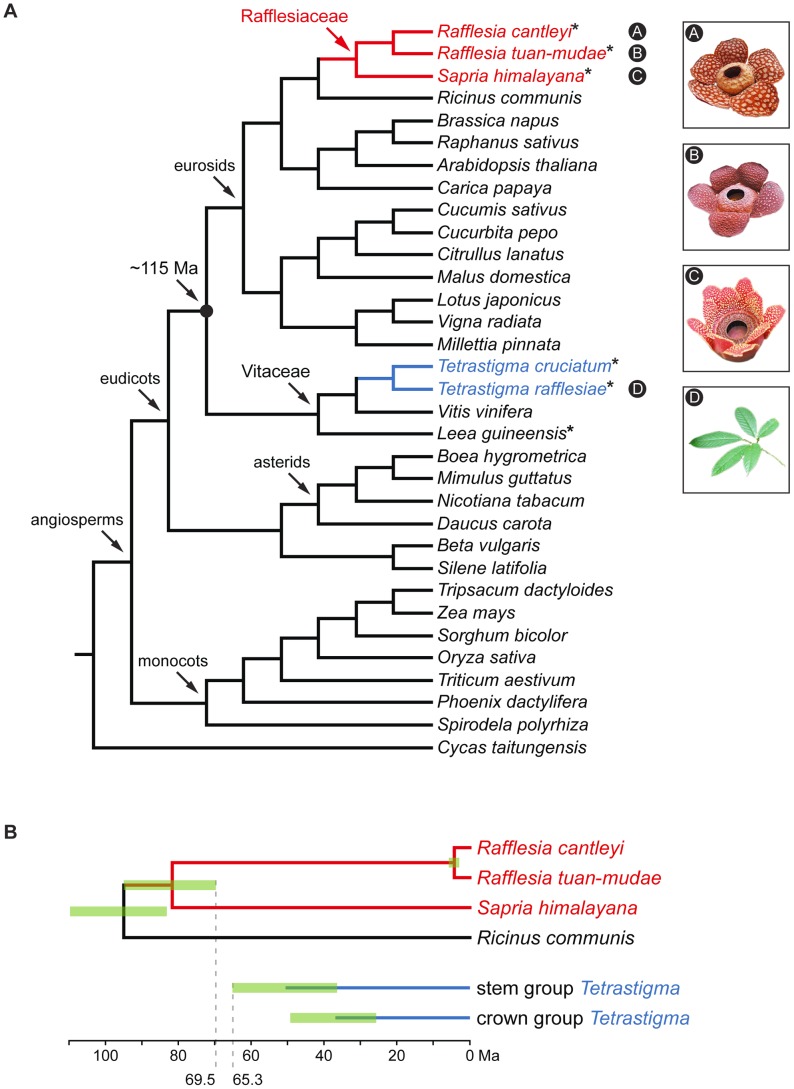
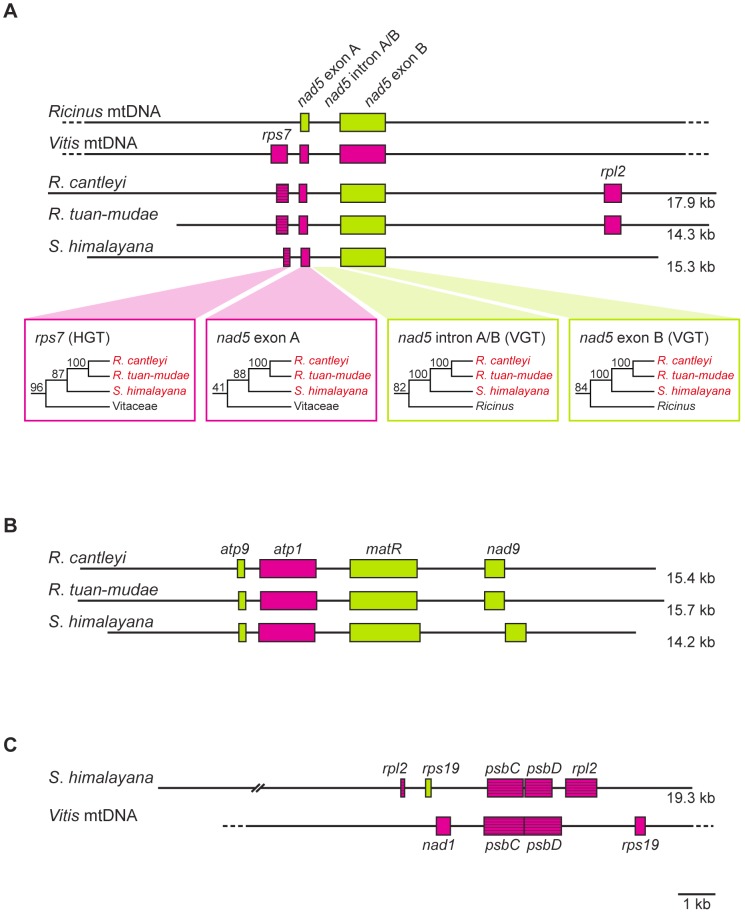
Recent studies have suggested that plant genomes have undergone potentially rampant horizontal gene transfer (HGT), especially in the mitochondrial genome. Parasitic plants have provided the strongest evidence of HGT, which appears to be facilitated by the intimate physical association between the parasites and their hosts. A recent phylogenomic study demonstrated that in the holoparasite Rafflesia cantleyi (Rafflesiaceae), whose close relatives possess the world's largest flowers, about 2.1% of nuclear gene transcripts were likely acquired from its obligate host. Here, we used next-generation sequencing to obtain the 38 protein-coding and ribosomal RNA genes common to the mitochondrial genomes of angiosperms from R. cantleyi and five additional species, including two of its closest relatives and two host species. Strikingly, our phylogenetic analyses conservatively indicate that 24%-41% of these gene sequences show evidence of HGT in Rafflesiaceae, depending on the species. Most of these transgenic sequences possess intact reading frames and are actively transcribed, indicating that they are potentially functional. Additionally, some of these transgenes maintain synteny with their donor and recipient lineages, suggesting that native genes have likely been displaced via homologous recombination. Our study is the first to comprehensively assess the magnitude of HGT in plants involving a genome (i.e., mitochondria) and a species interaction (i.e., parasitism) where it has been hypothesized to be potentially rampant. Our results establish for the first time that, although the magnitude of HGT involving nuclear genes is appreciable in these parasitic plants, HGT involving mitochondrial genes is substantially higher. This may represent a more general pattern for other parasitic plant clades and perhaps more broadly for angiosperms.
最近的研究表明,植物基因组可能经历了猖獗的水平基因转移(HGT),尤其是在线粒体基因组中。寄生植物为 HGT 提供了最强有力的证据,这种转移似乎是由寄生虫与其宿主之间的密切物理联系所促成的。最近的一项系统基因组学研究表明,在全寄生植物肉苁蓉(肉苁蓉科)中,其近亲拥有世界上最大的花朵,大约 2.1%的核基因转录本可能是从其专性宿主中获得的。在这里,我们使用下一代测序技术从肉苁蓉和另外五个物种(包括两个近亲物种和两个宿主物种)的线粒体基因组中获得了 38 个常见的蛋白质编码和核糖体 RNA 基因。引人注目的是,我们的系统发育分析保守地表明,这些基因序列中有 24%-41%在肉苁蓉科中显示出 HGT 的证据,这取决于物种。这些转基因序列的大部分都具有完整的阅读框并被积极转录,表明它们具有潜在的功能。此外,其中一些转基因序列与供体和受体谱系保持着同线性,表明它们可能通过同源重组发生了基因置换。我们的研究首次全面评估了涉及基因组(即线粒体)和物种相互作用(即寄生)的植物中 HGT 的程度,在这些情况下,HGT 可能是猖獗的。我们的研究结果首次确立,尽管这些寄生植物中核基因的 HGT 程度相当可观,但线粒体基因的 HGT 程度要高得多。这可能代表了其他寄生植物类群的更普遍模式,也许更广泛地代表了被子植物。