Laboratory of Cardiovascular Science, Gerontology Research Center, Intramural Research Program, National Institute on Aging, National Institutes of Health, Baltimore, Maryland, United States of America.
PLoS One. 2013;8(2):e57079. doi: 10.1371/journal.pone.0057079. Epub 2013 Feb 25.
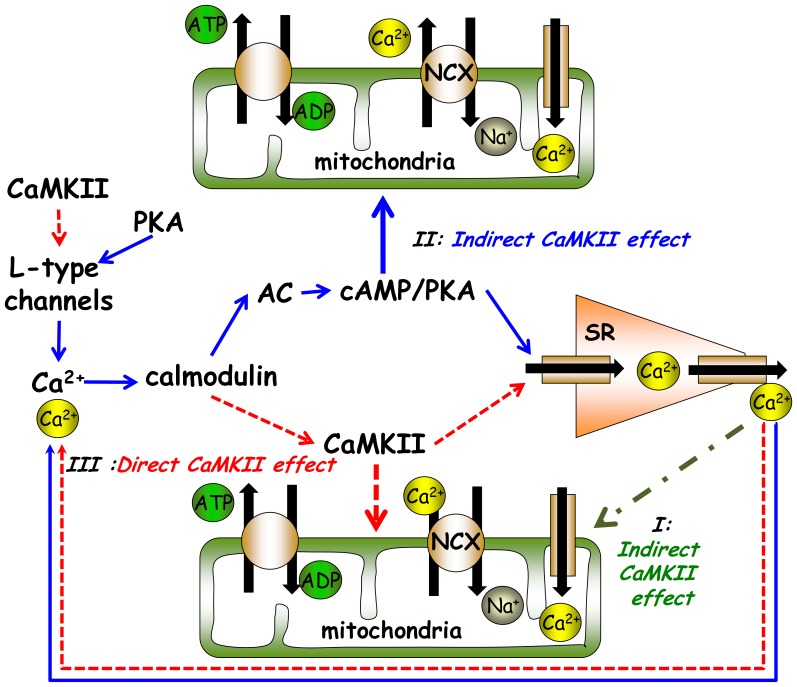
: Ca(2+)-activated basal adenylate cyclase (AC) in rabbit sinoatrial node cells (SANC) guarantees, via basal cAMP/PKA-calmodulin/CaMKII-dependent protein phosphorylation, the occurrence of rhythmic, sarcoplasmic-reticulum generated, sub-membrane Ca(2+) releases that prompt rhythmic, spontaneous action potentials (APs). This high-throughput signaling consumes ATP.
We have previously demonstrated that basal AC-cAMP/PKA signaling directly, and Ca(2+) indirectly, regulate mitochondrial ATP production. While, clearly, Ca(2+)-calmodulin-CaMKII activity regulates ATP consumption, whether it has a role in the control of ATP production is unknown.
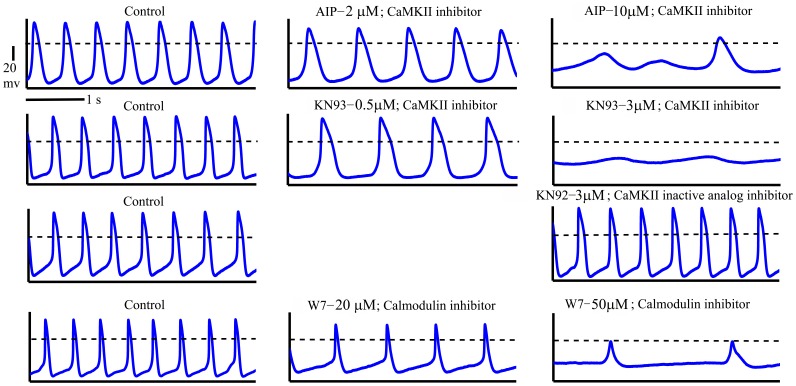
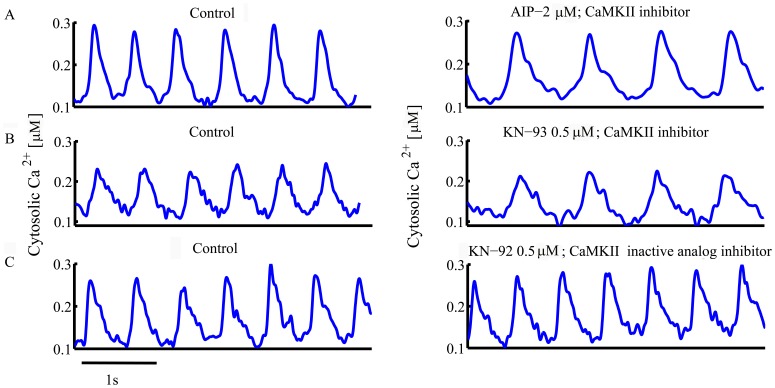
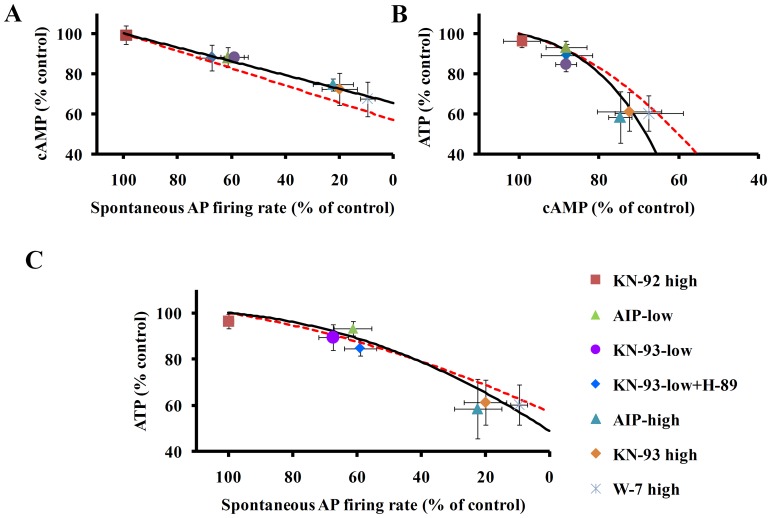
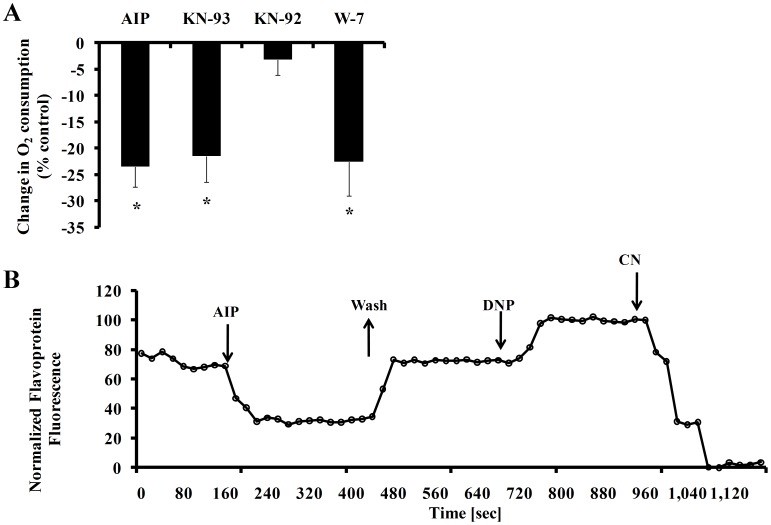
We superfused single, isolated rabbit SANC at 37°C with physiological saline containing CaMKII inhibitors, (KN-93 or autocamtide-2 Related Inhibitory Peptide (AIP)), or a calmodulin inhibitor (W-7) and measured cytosolic Ca(2+), flavoprotein fluorescence and spontaneous AP firing rate. We measured cAMP, ATP and O2 consumption in cell suspensions. Graded reductions in basal CaMKII activity by KN-93 (0.5-3 µmol/L) or AIP (2-10 µmol/L) markedly slow the kinetics of intracellular Ca(2+) cycling, decrease the spontaneous AP firing rate, decrease cAMP, and reduce O2 consumption and flavoprotein fluorescence. In this context of graded reductions in ATP demand, however, ATP also becomes depleted, indicating reduced ATP production.
CaMKII signaling, a crucial element of normal automaticity in rabbit SANC, is also involved in SANC bioenergetics.
兔窦房结细胞(SANC)中的钙激活基础腺苷酸环化酶(AC)通过基础 cAMP/PKA-钙调蛋白/CaMKII 依赖性蛋白磷酸化,保证了节律性的、肌浆网产生的、亚膜钙离子释放,从而引发节律性的、自发性动作电位(AP)。这种高通量信号传递会消耗 ATP。
我们之前已经证明,基础 AC-cAMP/PKA 信号直接调节,而钙离子间接调节线粒体 ATP 的产生。虽然 Ca2+-钙调蛋白-CaMKII 活性显然调节 ATP 的消耗,但它是否在控制 ATP 产生中发挥作用尚不清楚。
我们在 37°C 下用含有 CaMKII 抑制剂(KN-93 或自噬肽-2 相关抑制肽(AIP))或钙调蛋白抑制剂(W-7)的生理盐水对单个分离的兔 SANC 进行超流,测量胞质钙离子、黄素蛋白荧光和自发性 AP 放电率。我们测量了细胞悬浮液中的 cAMP、ATP 和 O2 消耗。KN-93(0.5-3 µmol/L)或 AIP(2-10 µmol/L)逐渐降低基础 CaMKII 活性显著减缓细胞内钙离子循环动力学,降低自发性 AP 放电率,降低 cAMP,并减少 O2 消耗和黄素蛋白荧光。然而,在这种逐渐降低 ATP 需求的情况下,ATP 也会被耗尽,表明 ATP 产生减少。
CaMKII 信号转导是兔 SANC 正常自动性的关键组成部分,也参与了 SANC 的生物能学。