School of Aquatic and Fishery Sciences, University of Washington Seattle, WA, USA.
Evol Appl. 2013 Feb;6(2):165-79. doi: 10.1111/j.1752-4571.2012.00271.x. Epub 2012 Jun 11.
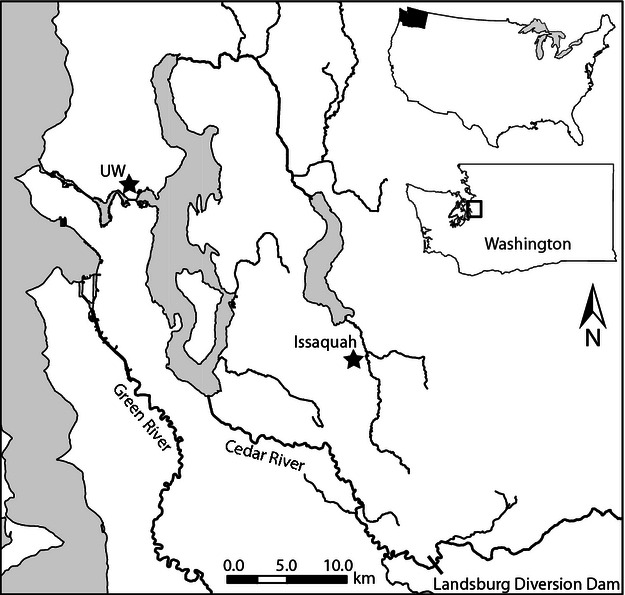
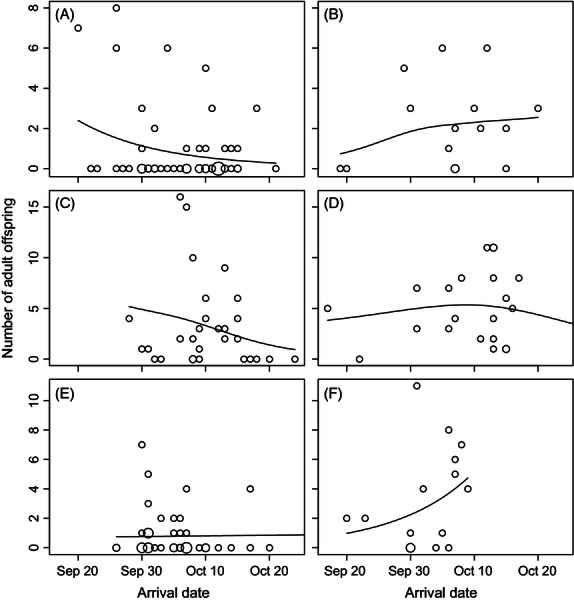
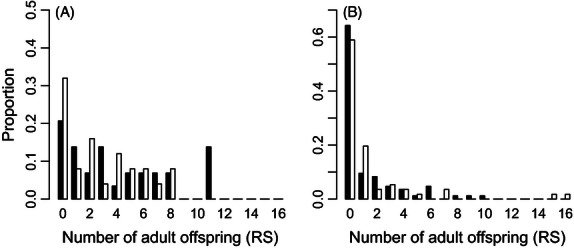
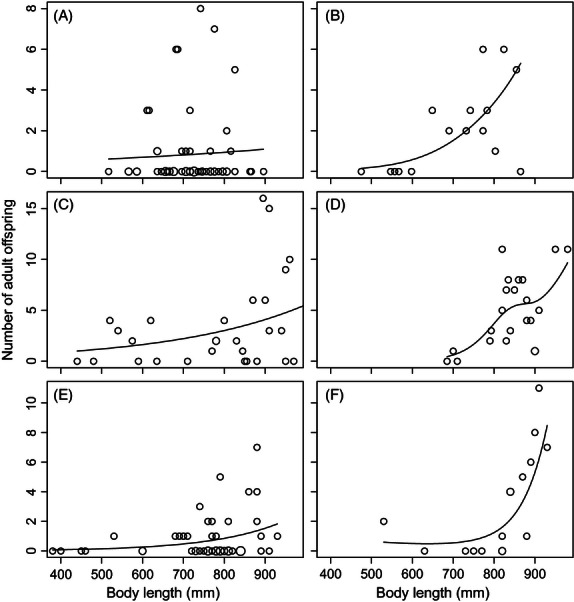
Captively reared animals can provide an immediate demographic boost in reintroduction programs, but may also reduce the fitness of colonizing populations. Construction of a fish passage facility at Landsburg Diversion Dam on the Cedar River, WA, USA, provided a unique opportunity to explore this trade-off. We thoroughly sampled adult Chinook salmon (Oncorhynchus tshawytscha) at the onset of colonization (2003-2009), constructed a pedigree from genotypes at 10 microsatellite loci, and calculated reproductive success (RS) as the total number of returning adult offspring. Hatchery males were consistently but not significantly less productive than naturally spawned males (range in relative RS: 0.70-0.90), but the pattern for females varied between years. The sex ratio was heavily biased toward males; therefore, inclusion of the hatchery males increased the risk of a genetic fitness cost with little demographic benefit. Measurements of natural selection indicated that larger salmon had higher RS than smaller fish. Fish that arrived early to the spawning grounds tended to be more productive than later fish, although in some years, RS was maximized at intermediate dates. Our results underscore the importance of natural and sexual selection in promoting adaptation during reintroductions.
圈养动物可以在重新引入计划中立即提供人口增长,但也可能降低殖民种群的适应性。在美国华盛顿州雪松河的兰兹堡分流坝建造鱼类通道设施,为探索这种权衡提供了一个独特的机会。我们在殖民开始时(2003-2009 年)对成年奇努克鲑鱼(Oncorhynchus tshawytscha)进行了全面采样,从 10 个微卫星基因座的基因型中构建了一个家系,并将繁殖成功率(RS)计算为返回的成年后代总数。人工养殖的雄性鲑鱼的繁殖力始终略低于自然繁殖的雄性鲑鱼(相对 RS 范围:0.70-0.90),但雌性鲑鱼的模式在不同年份有所不同。性别比例严重偏向雄性;因此,引入人工养殖的雄性鲑鱼增加了遗传适应性成本的风险,而对人口增长的益处很小。自然选择的测量表明,较大的鲑鱼比小鲑鱼的 RS 更高。较早到达产卵场的鱼往往比后来的鱼更有生产力,尽管在某些年份,RS 在中期达到最大值。我们的结果强调了自然和性选择在促进重新引入过程中的适应性的重要性。