Institute of Chemistry, The Hebrew University of Jerusalem, Givat Ram, Jerusalem, Israel.
PLoS One. 2013;8(3):e58470. doi: 10.1371/journal.pone.0058470. Epub 2013 Mar 5.
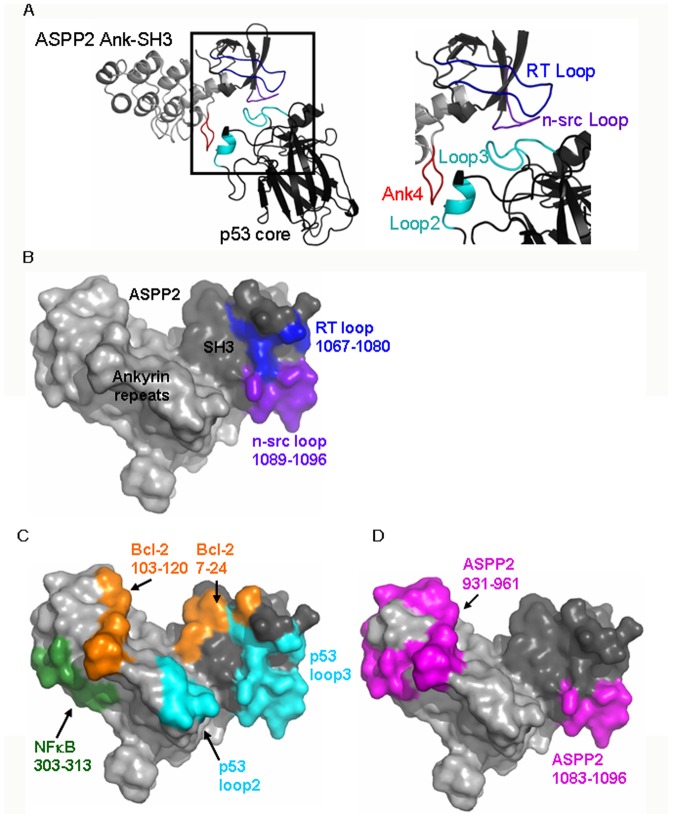
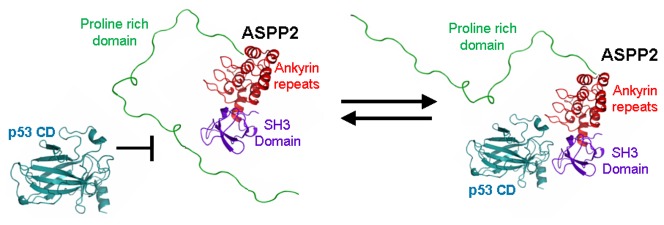
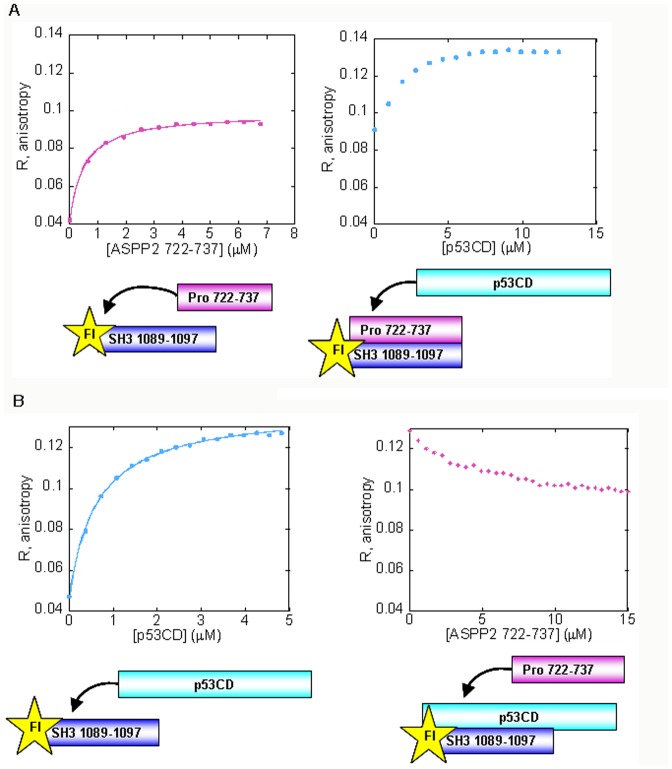
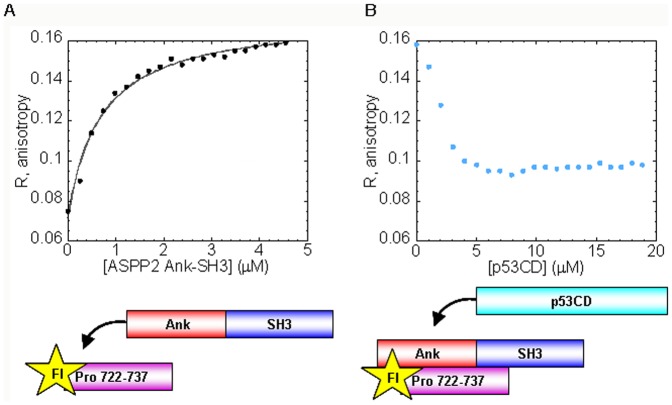
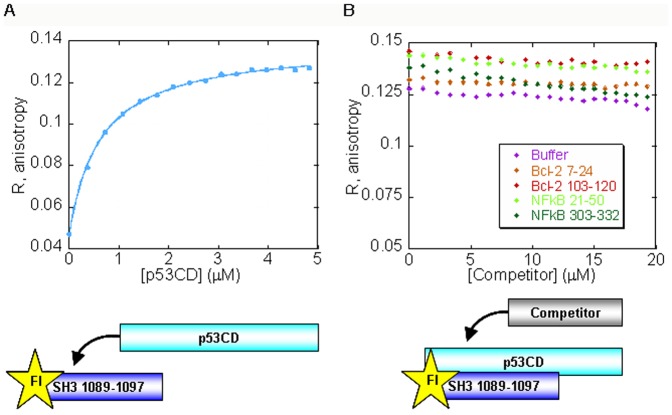
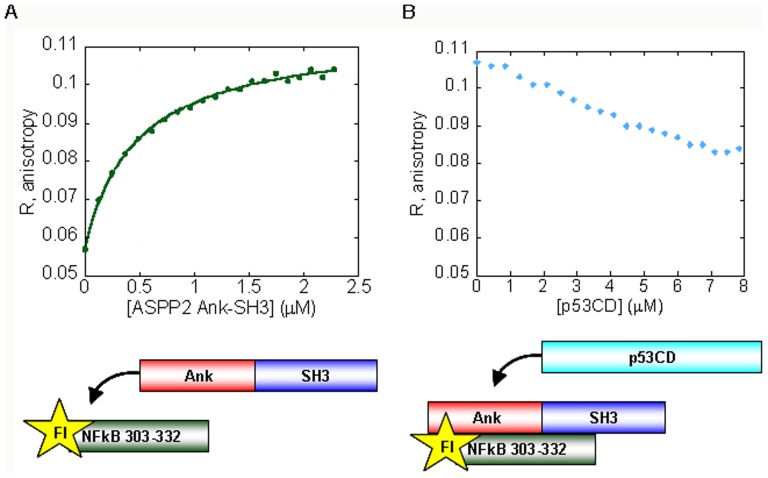
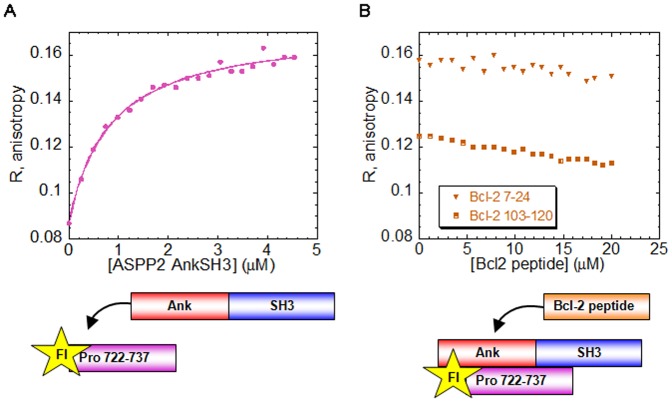
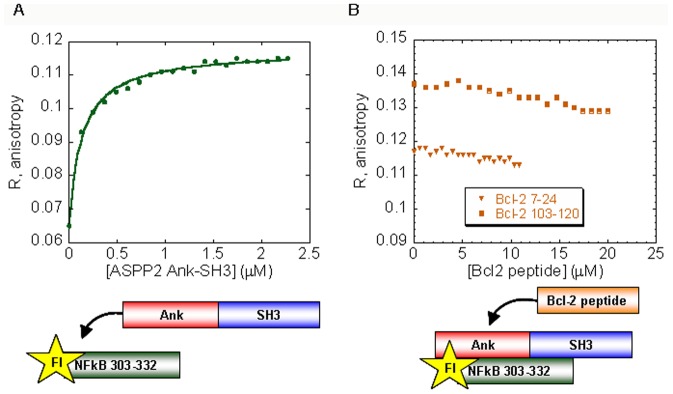
ASPP2 is a key protein in regulating apoptosis both in p53-dependent and-independent pathways. The C-terminal part of ASPP2 contains four ankyrin repeats and an SH3 domain (Ank-SH3) that mediate the interactions of ASPP2 with apoptosis related proteins such as p53, Bcl-2 and the p65 subunit of NFκB. p53 core domain (p53CD) binds the n-src loop and the RT loop of ASPP2 SH3. ASPP2 contains a disordered proline rich domain (ASPP2 Pro) that forms an intramolecular autoinhibitory interaction with the Ank-SH3 domains. Here we show how this intramolecular interaction affects the intermolecular interactions of ASPP2 with p53, Bcl-2 and NFkB. We used biophysical methods to obtain better understanding of the relationship between ASPP2 and its partners for getting a comprehensive view on ASPP2 pathways. Fluorescence anisotropy competition experiments revealed that both ASPP2 Pro and p53CD competed for binding the n-src loop of the ASPP2 SH3, indicating regulation of p53CD binding to this loop by ASPP2 Pro. Peptides derived from the ASPP2-binding interface of Bcl-2 did not compete with p53CD or NFkB peptides for binding the ASPP2 n-src loop. However, p53CD displaced the NFκB peptide (residues 303-332) from its complex with ASPP2 Ank-SH3, indicating that NFκB 303-332 and p53CD bind a partly overlapping site in ASPP2 SH3, mostly in the RT loop. These results are in agreement with previous docking studies, which showed that ASPP2 Ank-SH3 binds Bcl-2 and NFκB mostly via distinct sites from p53. However they show some overlap between the binding sites of p53CD and NFkB in ASPP2 Ank-SH3. Our results provide experimental evidence that the intramolecular interaction in ASPP2 regulates its binding to p53CD and that ASPP2 Ank-SH3 binds Bcl-2 and NFκB via distinct sites.
ASPP2 是一种在 p53 依赖和非依赖途径中调节细胞凋亡的关键蛋白。ASPP2 的 C 末端包含四个锚蛋白重复序列和一个 SH3 结构域(Ank-SH3),介导 ASPP2 与凋亡相关蛋白如 p53、Bcl-2 和 NFκB 的 p65 亚基的相互作用。p53 核心结构域(p53CD)结合 ASPP2 SH3 的 n-src 环和 RT 环。ASPP2 包含一个无序的富含脯氨酸的结构域(ASPP2 Pro),该结构域与 Ank-SH3 结构域形成分子内自动抑制相互作用。在这里,我们展示了这种分子内相互作用如何影响 ASPP2 与 p53、Bcl-2 和 NFkB 之间的分子间相互作用。我们使用生物物理方法来更好地了解 ASPP2 与其伴侣之间的关系,以全面了解 ASPP2 途径。荧光各向异性竞争实验表明,ASPP2 Pro 和 p53CD 都竞争结合 ASPP2 SH3 的 n-src 环,表明 ASPP2 Pro 调节 p53CD 与该环的结合。来自 Bcl-2 与 ASPP2 结合界面的肽段不会与 p53CD 或 NFkB 肽段竞争结合 ASPP2 n-src 环。然而,p53CD 将 NFκB 肽(残基 303-332)从其与 ASPP2 Ank-SH3 的复合物中置换出来,表明 NFκB 303-332 和 p53CD 结合 ASPP2 SH3 的部分重叠位点,主要在 RT 环。这些结果与先前的对接研究一致,该研究表明 ASPP2 Ank-SH3 主要通过与 p53 不同的位点结合 Bcl-2 和 NFκB。然而,它们显示了 p53CD 和 NFkB 在 ASPP2 Ank-SH3 中的结合位点之间存在一些重叠。我们的结果提供了实验证据,表明 ASPP2 中的分子内相互作用调节其与 p53CD 的结合,并且 ASPP2 Ank-SH3 通过不同的位点结合 Bcl-2 和 NFκB。