Silver School of Social Work, New York University, 1 Washington Square North, New York, NY 10003-6654 R321, United States.
Drug Alcohol Depend. 2013 Sep 1;132(1-2):238-43. doi: 10.1016/j.drugalcdep.2013.02.010. Epub 2013 Mar 9.
Tourism areas represent ecologies of heightened HIV vulnerability characterized by a disproportionate concentration of alcohol venues. Limited research has explored how alcohol venues facilitate HIV transmission.
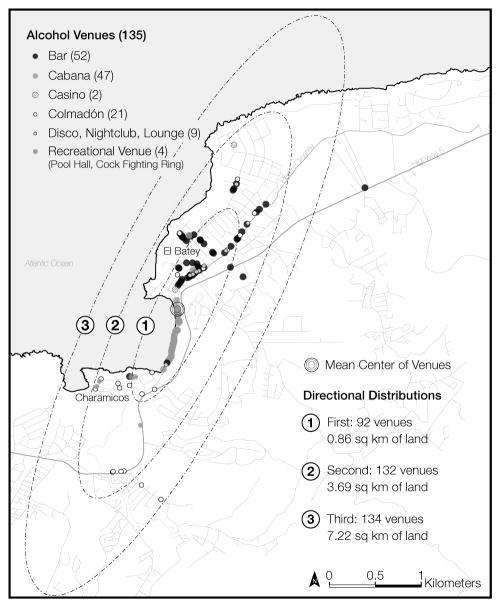
We spatially mapped locations of alcohol venues in a Dominican tourism town and conducted a venue-based survey of key informants (n=135) focused on three facets of alcohol venues: structural features, type of patrons, and HIV risk behaviors. Using latent class analysis, we identified evidence-based typologies of alcohol venues for each of the three facets. Focused contrasts identified the co-occurrence of classes of structural features, classes of types of patrons, and classes of HIV risk behavior, thus elaborating the nature of high risk venues.
We identified three categories of venue structural features, three for venue patrons, and five for HIV risk behaviors. Analysis revealed that alcohol venues with the greatest structural risks (e.g. sex work on-site with lack of HIV prevention services) were most likely frequented by the venue patron category characterized by high population-mixing between locals and foreign tourists, who were in turn most likely to engage in the riskiest behaviors.
Our results highlight the stratification of venue patrons into groups who engage in behaviors of varying risk in structural settings that vary in risk. The convergence of high-risk patron groups in alcohol venues with the greatest structural risk suggests these locations have potential for HIV transmission. Policymakers and prevention scientists can use these methods and data to target HIV prevention resources to identified priority areas.
旅游区是艾滋病毒易感染生态系统,其特点是酒精场所的集中程度不成比例。有限的研究探讨了酒精场所如何促进艾滋病毒的传播。
我们在多米尼加旅游城镇的空间上绘制了酒精场所的位置,并对 135 名关键知情者进行了基于场所的调查,重点关注酒精场所的三个方面:结构特征、顾客类型和艾滋病毒风险行为。使用潜在类别分析,我们为三个方面的每个方面确定了基于证据的酒精场所类型。重点对比确定了结构特征、顾客类型和艾滋病毒风险行为的类别的共同出现,从而详细阐述了高风险场所的性质。
我们确定了三种类型的场所结构特征,三种类型的顾客,以及五种类型的艾滋病毒风险行为。分析表明,具有最大结构风险的酒精场所(例如现场性工作且缺乏艾滋病毒预防服务)最有可能被以下顾客群体光顾,这些顾客群体的特点是本地人和外国游客之间高度混合,而这些顾客最有可能从事最危险的行为。
我们的研究结果强调了顾客群体在结构上存在分层,他们的行为风险不同,而结构风险也不同。高风险顾客群体在具有最大结构风险的酒精场所中的汇聚,表明这些地点具有艾滋病毒传播的潜力。政策制定者和预防科学家可以使用这些方法和数据将艾滋病毒预防资源瞄准到确定的优先领域。