Department of Chemistry, Oakland University, Rochester, Michigan 48309, USA.
Photochem Photobiol Sci. 2013 Aug;12(8):1328-40. doi: 10.1039/c3pp25430e.
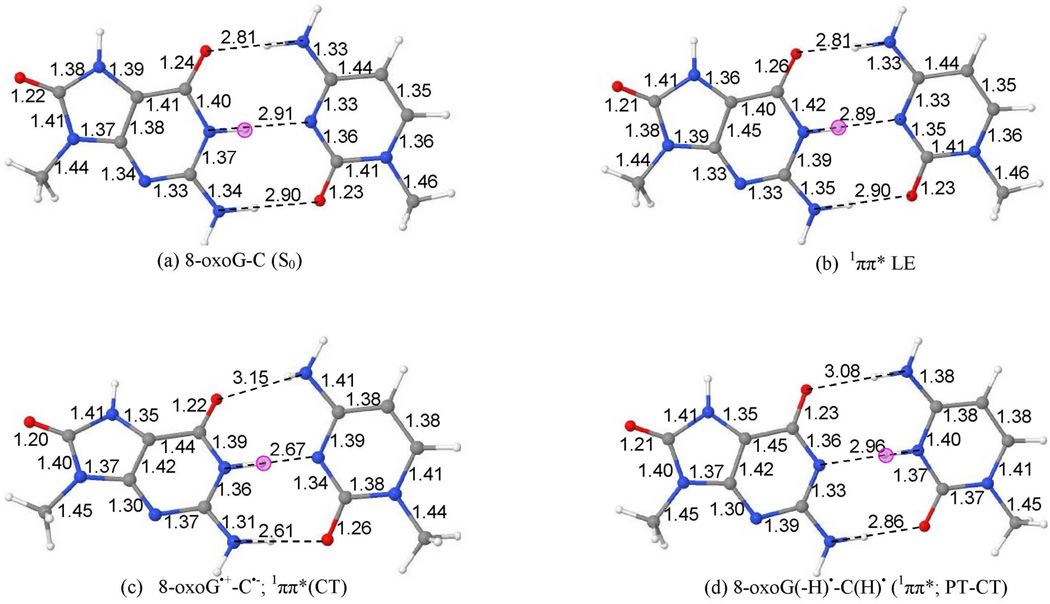
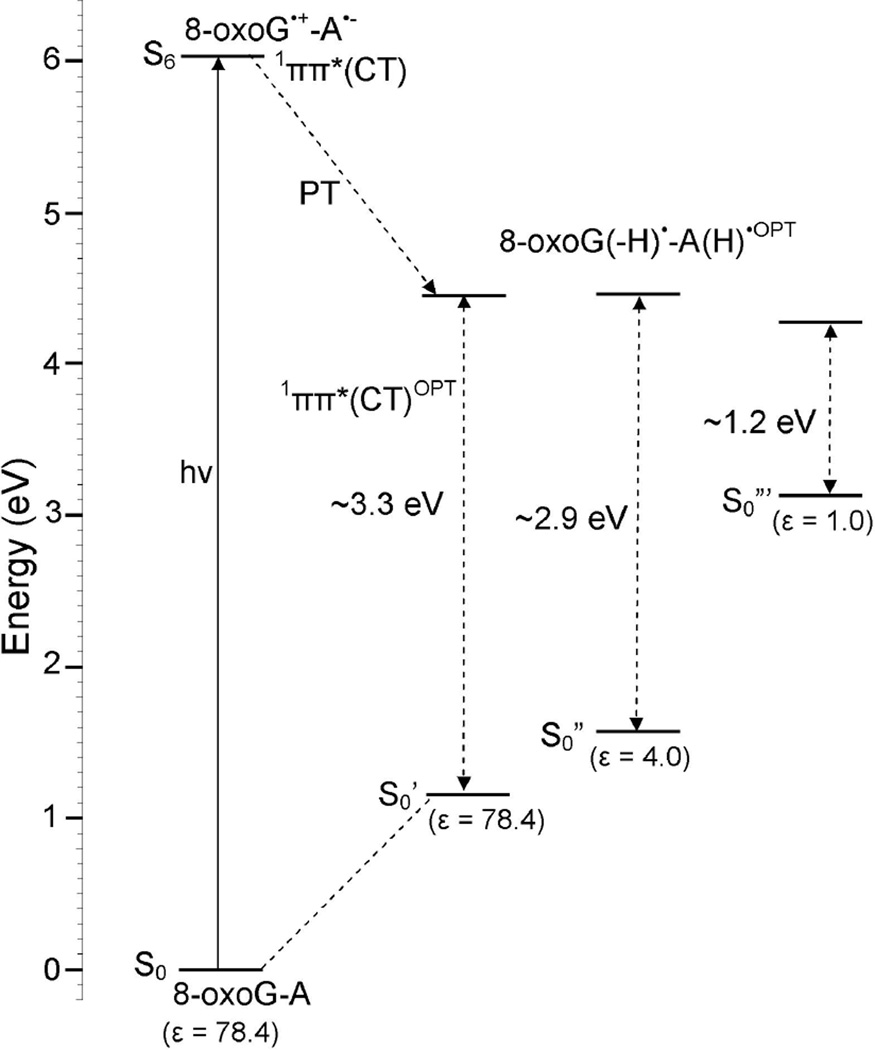
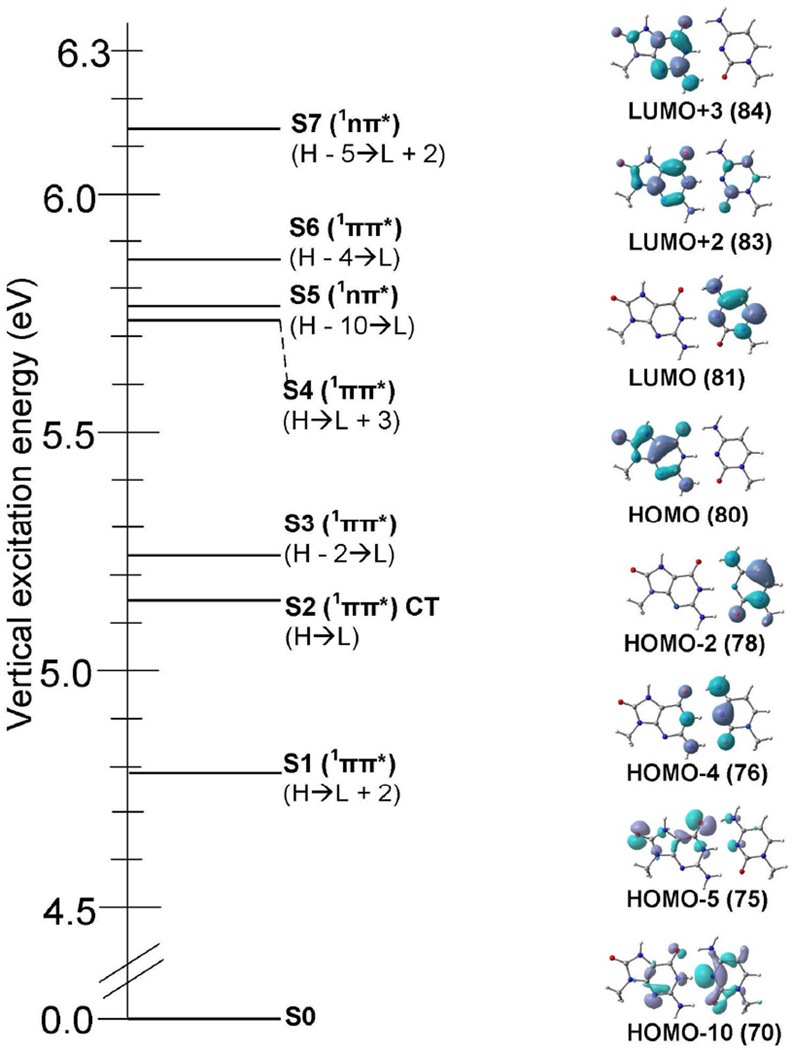
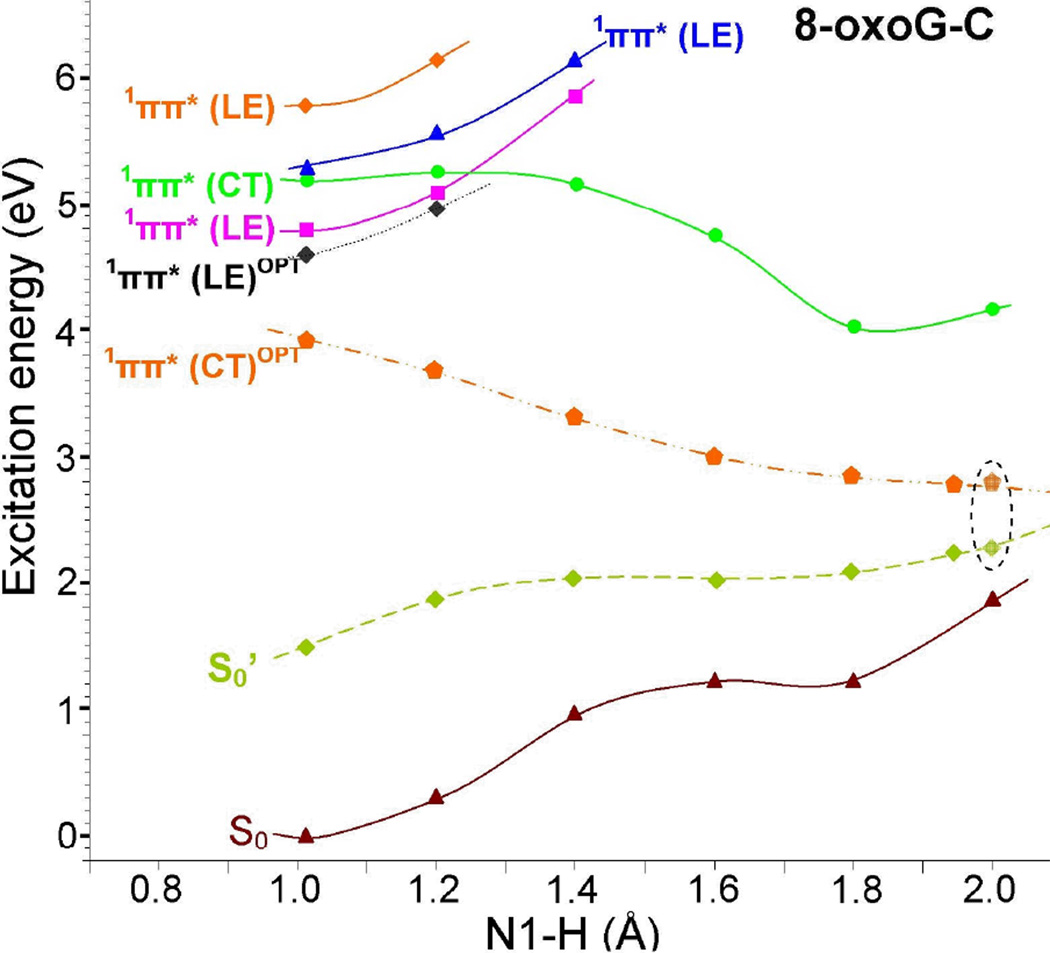
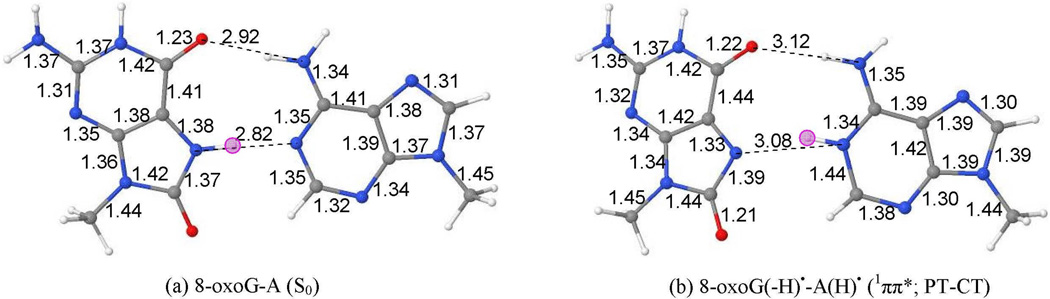
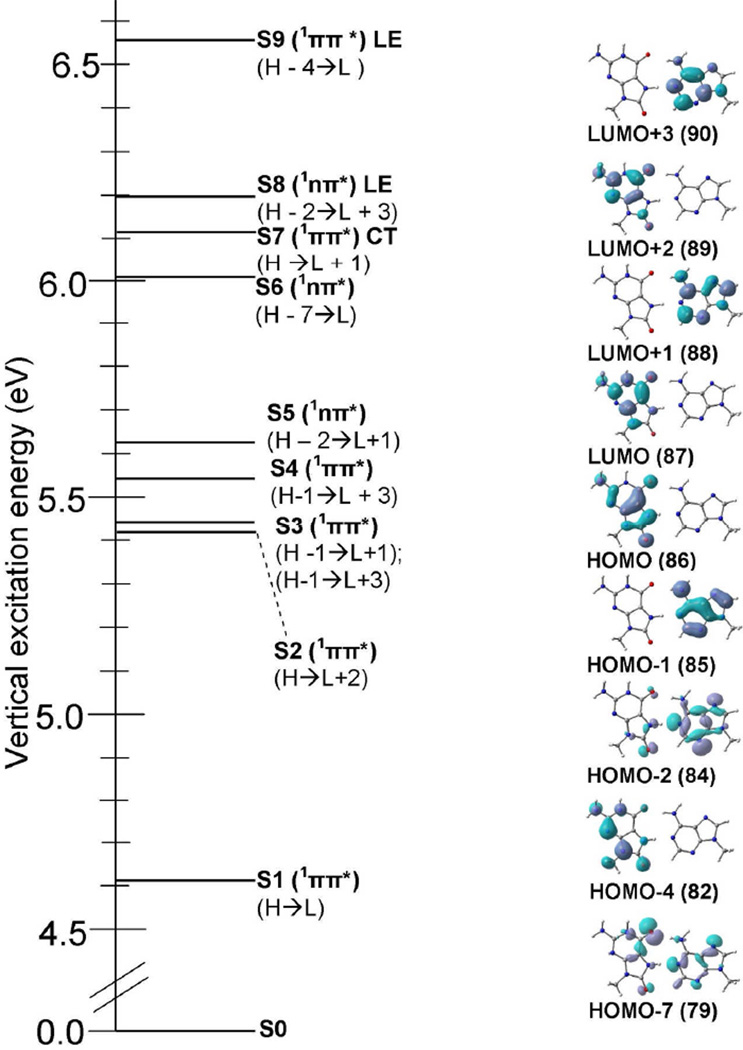
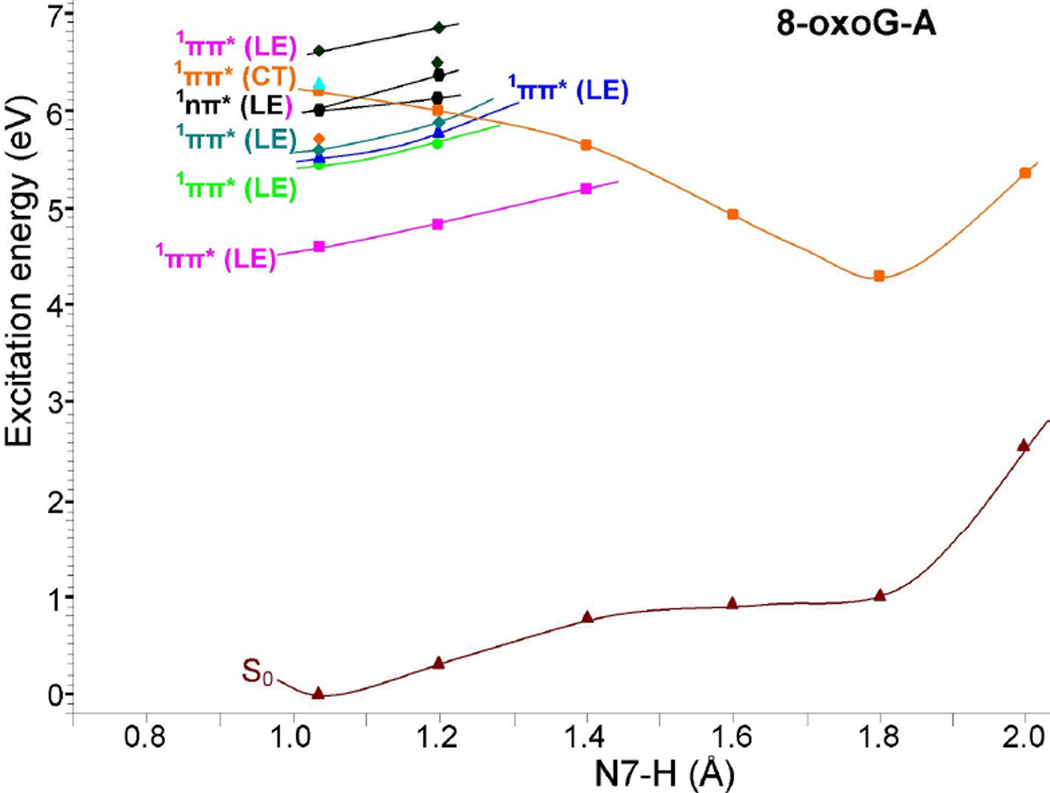
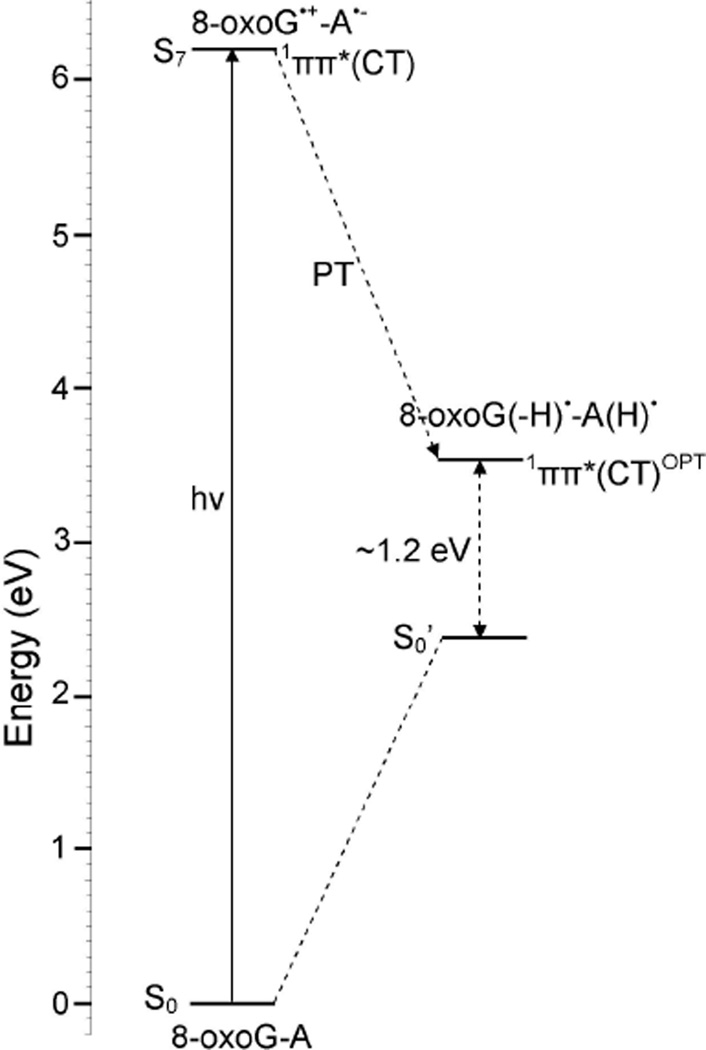
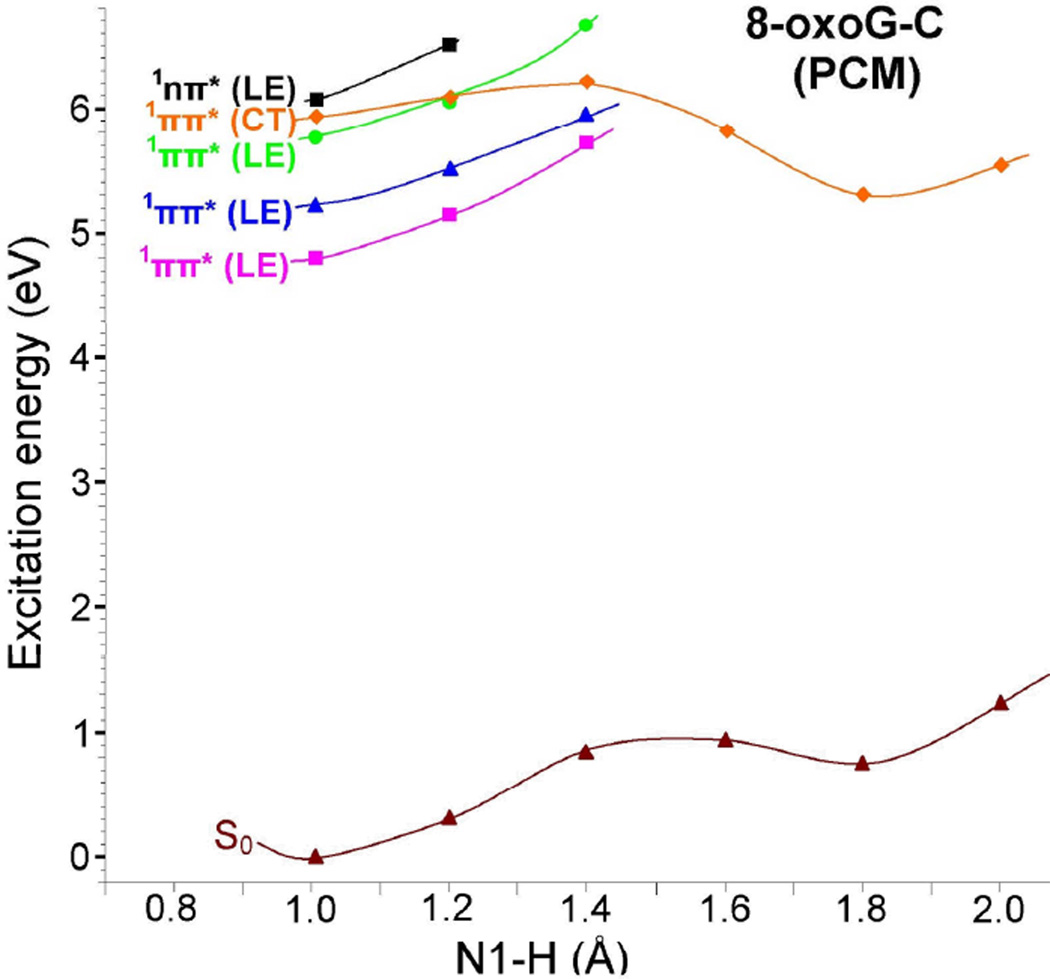
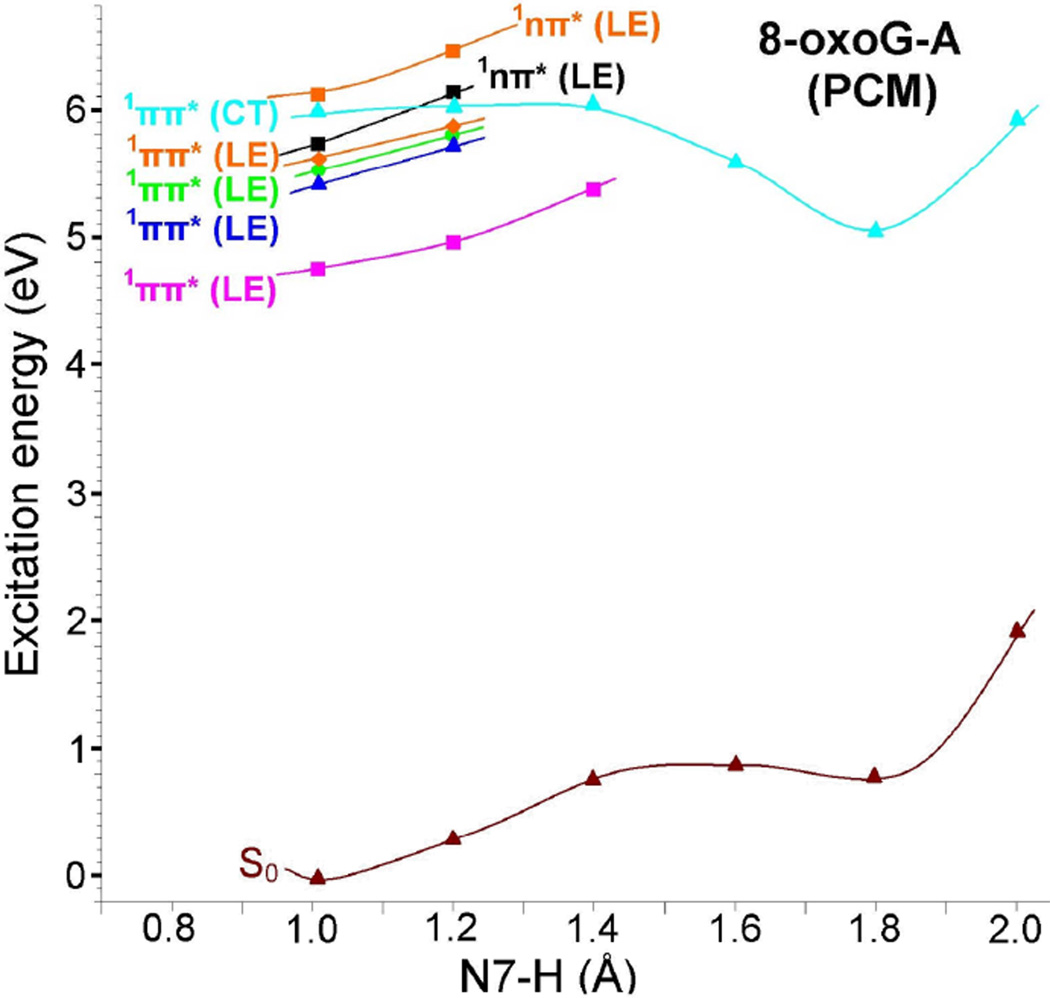
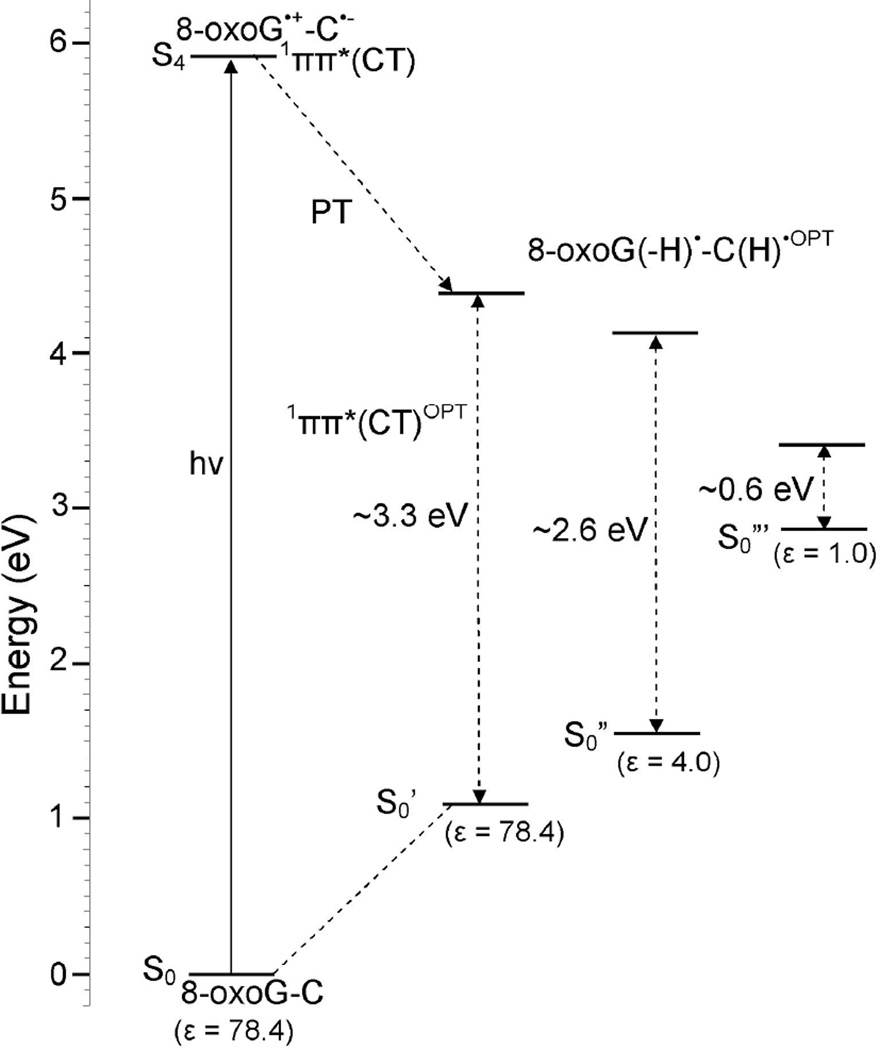
In a recent experiment, the repair efficiency of DNA thymine cyclobutane dimers (T<>T) on UV excitation of 8-oxoG base paired either to C or A was reported. An electron transfer mechanism from an excited charge transfer state of 8-oxoG-C (or 8-oxoG-A) to T<>T was proposed and 8-oxoG-A was found to be 2-3 times more efficient than 8-oxoG-C in repair of T<>T. Intra base pair proton transfer (PT) in charge transfer (CT) excited states of the base pairs was proposed to quench the excited state and prevent T<>T repair. In this work, we investigate this process with TD-DFT calculations of the excited states of 8-oxoG-C and 8-oxoG-A base pairs in the Watson-Crick and Hoogsteen base pairs using long-range corrected density functional, ωB97XD/6-31G* method. Our gas phase calculations showed that CT excited state ((1)ππ*(CT)) of 8-oxoG-C appears at lower energy than the 8-oxoG-A. For 8-oxoG-C, TD-DFT calculations show the presence of a conical intersection (CI) between the lowest (1)ππ*(PT-CT) excited state and the ground state which likely deactivates the CT excited state via a proton-coupled electron transfer (PCET) mechanism. The (1)ππ*(PT-CT) excited state of 8-oxoG-A base pair lies at higher energy and its crossing with ground state is inhibited because of a high energy gap between (1)ππ*(PT-CT) excited state and ground state. Thus the gas phase calculations suggest the 8-oxoG-A would have longer excited state lifetimes. When the effect of solvation is included using the PCM model, both 8-oxoG-A and 8-oxoG-C show large energy gaps between the ground state and both the excited CT and PT-CT states and suggest little difference would be found between the two base pairs in repair of the T<>T lesion. However, in the FC region the solvent effect is greatly diminished owing to the slow dielectric response time and smaller gaps would be expected.
在最近的一项实验中,报告了在 UV 激发下,8-氧代鸟嘌呤碱基与 C 或 A 配对时,修复 DNA 胸腺嘧啶环丁烷二聚体(T<>T)的修复效率。提出了从 8-氧代鸟嘌呤-C(或 8-氧代鸟嘌呤-A)的激发电荷转移态到 T<>T 的电子转移机制,并发现 8-氧代鸟嘌呤-A 在修复 T<>T 方面比 8-氧代鸟嘌呤-C 效率高 2-3 倍。在碱基对的电荷转移(CT)激发态中,碱基对内质子转移(PT)被提出可以猝灭激发态并防止 T<>T 修复。在这项工作中,我们使用长程校正密度泛函方法 ωB97XD/6-31G*,通过 TD-DFT 计算来研究这个过程,计算了 Watson-Crick 和 Hoogsteen 碱基对中 8-氧代鸟嘌呤-C 和 8-氧代鸟嘌呤-A 碱基对的激发态。我们的气相计算表明,8-氧代鸟嘌呤-C 的 CT 激发态((1)ππ*(CT))出现在比 8-氧代鸟嘌呤-A 更低的能量。对于 8-氧代鸟嘌呤-C,TD-DFT 计算表明,在最低(1)ππ*(PT-CT)激发态和基态之间存在一个锥形交叉(CI),这可能通过质子耦合电子转移(PCET)机制使 CT 激发态失活。8-氧代鸟嘌呤-A 碱基对的(1)ππ*(PT-CT)激发态位于更高的能量,由于(1)ππ*(PT-CT)激发态和基态之间的能隙较高,其与基态的交叉被抑制。因此,气相计算表明 8-氧代鸟嘌呤-A 将具有更长的激发态寿命。当使用 PCM 模型包含溶剂效应时,8-氧代鸟嘌呤-A 和 8-氧代鸟嘌呤-C 基态与激发态 CT 和 PT-CT 态之间都存在较大的能量间隙,这表明在修复 T<>T 损伤方面,这两种碱基对之间几乎没有差异。然而,在 FC 区域,由于慢介电响应时间和较小的间隙,溶剂效应大大减弱。