Adler Adam J, Vella Anthony T
Department of Immunology; University of Connecticut Health Center; Farmington, CT USA.
Oncoimmunology. 2013 Jan 1;2(1):e22837. doi: 10.4161/onci.22837.
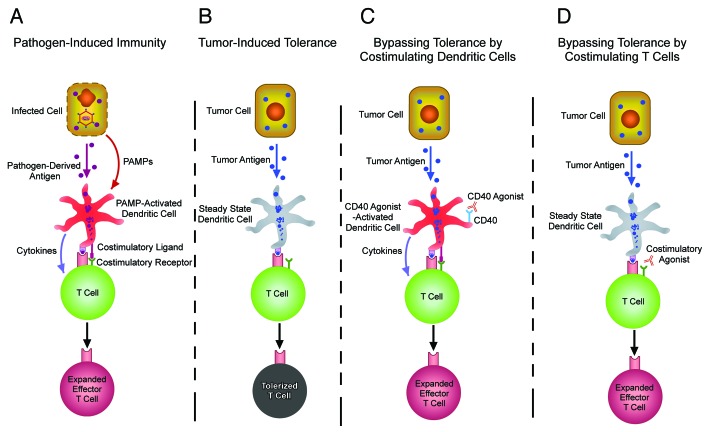
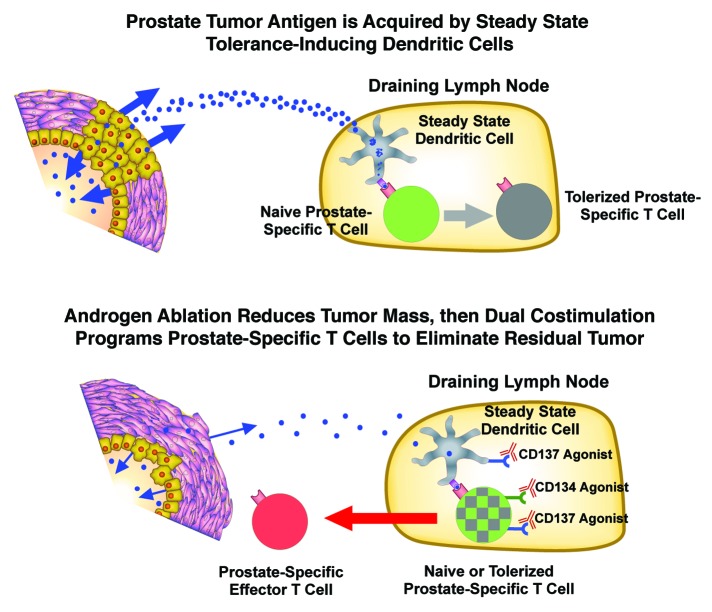
The ability of T cells to recognize a vast array of antigens enables them to destroy tumor cells while inflicting minimal collateral damage. Nevertheless, tumor antigens often are a form of self-antigen, and thus tumor immunity can be dampened by tolerance mechanisms that evolved to prevent autoimmunity. Since tolerance can be induced by steady-state antigen-presenting cells that provide insufficient co-stimulation, the exogenous administration of co-stimulatory agonists can favor the expansion and tumoricidal functions of tumor-specific T cells. Agonists of the co-stimulatory tumor necrosis factor receptor (TNFR) family members CD134 and CD137 exert antitumor activity in mice, and as monotherapies have exhibited encouraging results in clinical trials. This review focuses on how the dual administration of CD134 and CD137 agonists synergistically boosts T-cell priming and elaborates a multi-pronged antitumor immune response, as well as how such dual co-stimulation might be translated into effective anticancer therapies.
T细胞识别大量抗原的能力使其能够在造成最小附带损害的同时破坏肿瘤细胞。然而,肿瘤抗原通常是自身抗原的一种形式,因此肿瘤免疫可能会受到为预防自身免疫而进化出的耐受机制的抑制。由于耐受性可由提供不足共刺激的稳态抗原呈递细胞诱导,因此共刺激激动剂的外源性给药可促进肿瘤特异性T细胞的扩增和杀瘤功能。共刺激肿瘤坏死因子受体(TNFR)家族成员CD134和CD137的激动剂在小鼠中发挥抗肿瘤活性,并且作为单一疗法在临床试验中已显示出令人鼓舞的结果。本综述重点关注CD134和CD137激动剂的双重给药如何协同增强T细胞启动并阐述多方面的抗肿瘤免疫反应,以及这种双重共刺激如何转化为有效的抗癌疗法。