Department of Infectious Diseases, The First Affiliated Hospital of Anhui Medical University, Hefei, Anhui, China.
Ann Lab Med. 2013 Mar;33(2):111-5. doi: 10.3343/alm.2013.33.2.111. Epub 2013 Feb 21.
Shigella is a frequent cause of bacterial dysentery in the developing world. Treatment with antibiotics is recommended for shigellosis, but the options are limited due to globally emerging resistance. This study was conducted to determine the frequency and pattern of antimicrobial susceptibility of Shigella in China.
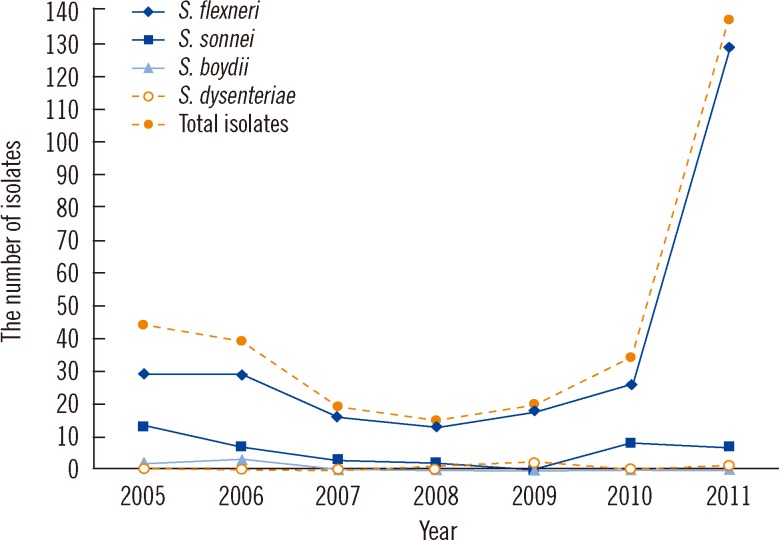
We studied the antimicrobial resistance profiles of 308 Shigella spp. strains (260 S. flexneri, 40 S. sonnei, 5 S. boydii, and 3 S. dysenteriae) isolated from fecal samples of patients (age, from 3 months to 92 yr) presenting with diarrhea in different districts of Anhui, China. The antimicrobial resistance of strains was determined by the agar dilution method according to the CSLI guidelines.
The most common serogroup in the Shigella isolates was S. flexneri (n=260, 84.4%), followed by S. sonnei (n=40, 13.0%). The highest resistance rate was found for nalidixic acid (96.4%), followed by ampicillin (93.2%), tetracycline (90.9%), and trimethoprim/sulfamethoxazole (80.8%). Among the isolates tested, 280 (91.0%) were multidrug resistant (resistant to ≥2 agents). The most common resistance pattern was the combination of ampicillin, tetracycline, and trimethoprim/sulfamethoxazole (70.8%). Resistance to ampicillin and tetracycline were more common among S. flexneri than among S. sonnei isolates.
S. flexneri is predominant in Anhui, China, and its higher antimicrobial resistance rate compared with that of S. sonnei is a cause for concern. Continuous monitoring of resistance patterns is necessary to control the spread of resistance in Shigella. The recommendations for antimicrobial treatment must be updated regularly based on surveillance results.
志贺菌是发展中国家细菌性痢疾的常见病因。对志贺菌病推荐使用抗生素治疗,但由于全球范围内出现耐药性,选择有限。本研究旨在确定中国志贺菌的抗菌药物敏感性频率和模式。
我们研究了来自中国安徽省不同地区腹泻患者(年龄 3 个月至 92 岁)粪便样本中分离的 308 株志贺菌属(260 株 S. flexneri、40 株 S. sonnei、5 株 S. boydii 和 3 株 S. dysenteriae)的抗菌药物耐药谱。根据 CSLI 指南,采用琼脂稀释法测定菌株的抗菌药物耐药性。
志贺菌分离株中最常见的血清型是 S. flexneri(n=260,84.4%),其次是 S. sonnei(n=40,13.0%)。耐药率最高的是萘啶酸(96.4%),其次是氨苄西林(93.2%)、四环素(90.9%)和甲氧苄啶/磺胺甲噁唑(80.8%)。在所测试的分离株中,280 株(91.0%)为多药耐药(对≥2 种药物耐药)。最常见的耐药模式是氨苄西林、四环素和甲氧苄啶/磺胺甲噁唑的组合(70.8%)。与 S. sonnei 分离株相比,S. flexneri 对氨苄西林和四环素的耐药性更为常见。
S. flexneri 在安徽占优势,其抗菌药物耐药率高于 S. sonnei,令人担忧。需要持续监测耐药模式,以控制志贺菌耐药性的传播。必须根据监测结果定期更新抗菌药物治疗建议。