International Ph. D. Program in Neuropharmacology, University of Catania, 95123 Catania, Italy.
Biomed Res Int. 2013;2013:650989. doi: 10.1155/2013/650989. Epub 2012 Dec 30.
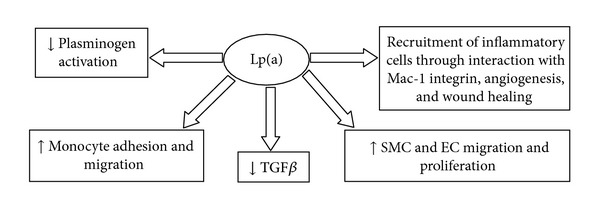
Lipoprotein(a) (Lp(a)) is an LDL-like molecule consisting of an apolipoprotein B-100 (apo(B-100)) particle attached by a disulphide bridge to apo(a). Many observations have pointed out that Lp(a) levels may be a risk factor for cardiovascular diseases. Lp(a) inhibits the activation of transforming growth factor (TGF) and contributes to the growth of arterial atherosclerotic lesions by promoting the proliferation of vascular smooth muscle cells and the migration of smooth muscle cells to endothelial cells. Moreover Lp(a) inhibits plasminogen binding to the surfaces of endothelial cells and decreases the activity of fibrin-dependent tissue-type plasminogen activator. Lp(a) may act as a proinflammatory mediator that augments the lesion formation in atherosclerotic plaques. Elevated serum Lp(a) is an independent predictor of coronary artery disease and myocardial infarction. Furthermore, Lp(a) levels should be a marker of restenosis after percutaneous transluminal coronary angioplasty, saphenous vein bypass graft atherosclerosis, and accelerated coronary atherosclerosis of cardiac transplantation. Finally, the possibility that Lp(a) may be a risk factor for ischemic stroke has been assessed in several studies. Recent findings suggest that Lp(a)-lowering therapy might be beneficial in patients with high Lp(a) levels. A future therapeutic approach could include apheresis in high-risk patients in order to reduce major coronary events.
脂蛋白(a)(Lp(a))是一种 LDL 样分子,由载脂蛋白 B-100(apo(B-100))颗粒通过二硫键与 apo(a)连接而成。许多观察结果指出,Lp(a)水平可能是心血管疾病的一个危险因素。Lp(a)抑制转化生长因子(TGF)的激活,并通过促进血管平滑肌细胞的增殖和平滑肌细胞向内皮细胞的迁移,促进动脉粥样硬化病变的生长。此外,Lp(a)抑制纤溶酶原与内皮细胞表面的结合,并降低纤维蛋白依赖性组织型纤溶酶原激活物的活性。Lp(a)可能作为一种促炎介质,增强动脉粥样硬化斑块中的病变形成。血清 Lp(a)升高是冠心病和心肌梗死的独立预测因子。此外,Lp(a)水平应该是经皮腔内冠状动脉成形术、大隐静脉旁路移植动脉粥样硬化和心脏移植加速冠状动脉粥样硬化后再狭窄的标志物。最后,一些研究评估了 Lp(a)是否可能是缺血性中风的危险因素。最近的研究结果表明,降低 Lp(a)水平的治疗可能对高 Lp(a)水平的患者有益。未来的治疗方法可能包括在高危患者中进行血浆置换,以减少主要冠状动脉事件。