Institute of Medicinal Plant Development, Chinese Academy of Medical Sciences and Peking Union Medical College, Beijing 100094, China.
Biomed Res Int. 2013;2013:741476. doi: 10.1155/2013/741476. Epub 2013 Jan 17.
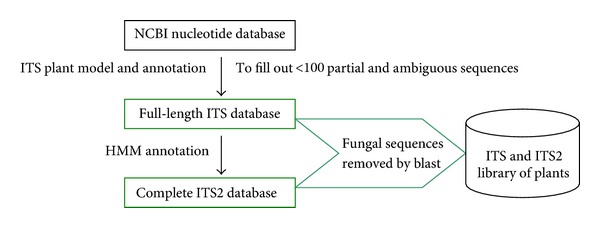
An ideal DNA barcoding region should be short enough to be amplified from degraded DNA. In this paper, we discuss the possibility of using a short nuclear DNA sequence as a barcode to identify a wide range of medicinal plant species. First, the PCR and sequencing success rates of ITS and ITS2 were evaluated based entirely on materials from dry medicinal product and herbarium voucher specimens, including some samples collected back to 90 years ago. The results showed that ITS2 could recover 91% while ITS could recover only 23% efficiency of PCR and sequencing by using one pair of primer. Second, 12861 ITS and ITS2 plant sequences were used to compare the identification efficiency of the two regions. Four identification criteria (BLAST, inter- and intradivergence Wilcoxon signed rank tests, and TaxonDNA) were evaluated. Our results supported the hypothesis that ITS2 can be used as a minibarcode to effectively identify species in a wide variety of specimens and medicinal materials.
一个理想的 DNA 条形码区域应该足够短,以便从降解的 DNA 中扩增。在本文中,我们讨论了使用短的核 DNA 序列作为条形码来识别广泛的药用植物物种的可能性。首先,根据来自干燥药用产品和标本标本的材料,评估了 ITS 和 ITS2 的 PCR 和测序成功率,包括一些可追溯到 90 年前的样本。结果表明,使用一对引物,ITS2 可以恢复 91%的 PCR 和测序效率,而 ITS 只能恢复 23%。其次,使用 12861 个 ITS 和 ITS2 植物序列比较了两个区域的鉴定效率。评估了四个鉴定标准(BLAST、种间和种内差异 Wilcoxon 符号秩检验和 TaxonDNA)。我们的结果支持了这样的假设,即 ITS2 可以用作一个小条形码,有效地识别各种标本和药用材料中的物种。