Laboratory of motor evaluation of Federal University of Juiz de Fora, Brazil.
J Hum Kinet. 2011 Sep;29A:75-82. doi: 10.2478/v10078-011-0062-5. Epub 2011 Oct 4.
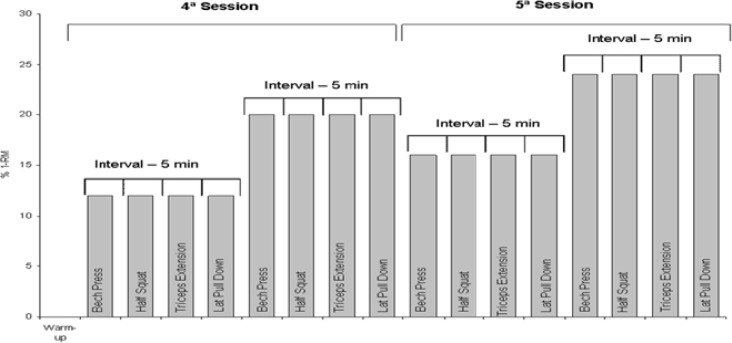
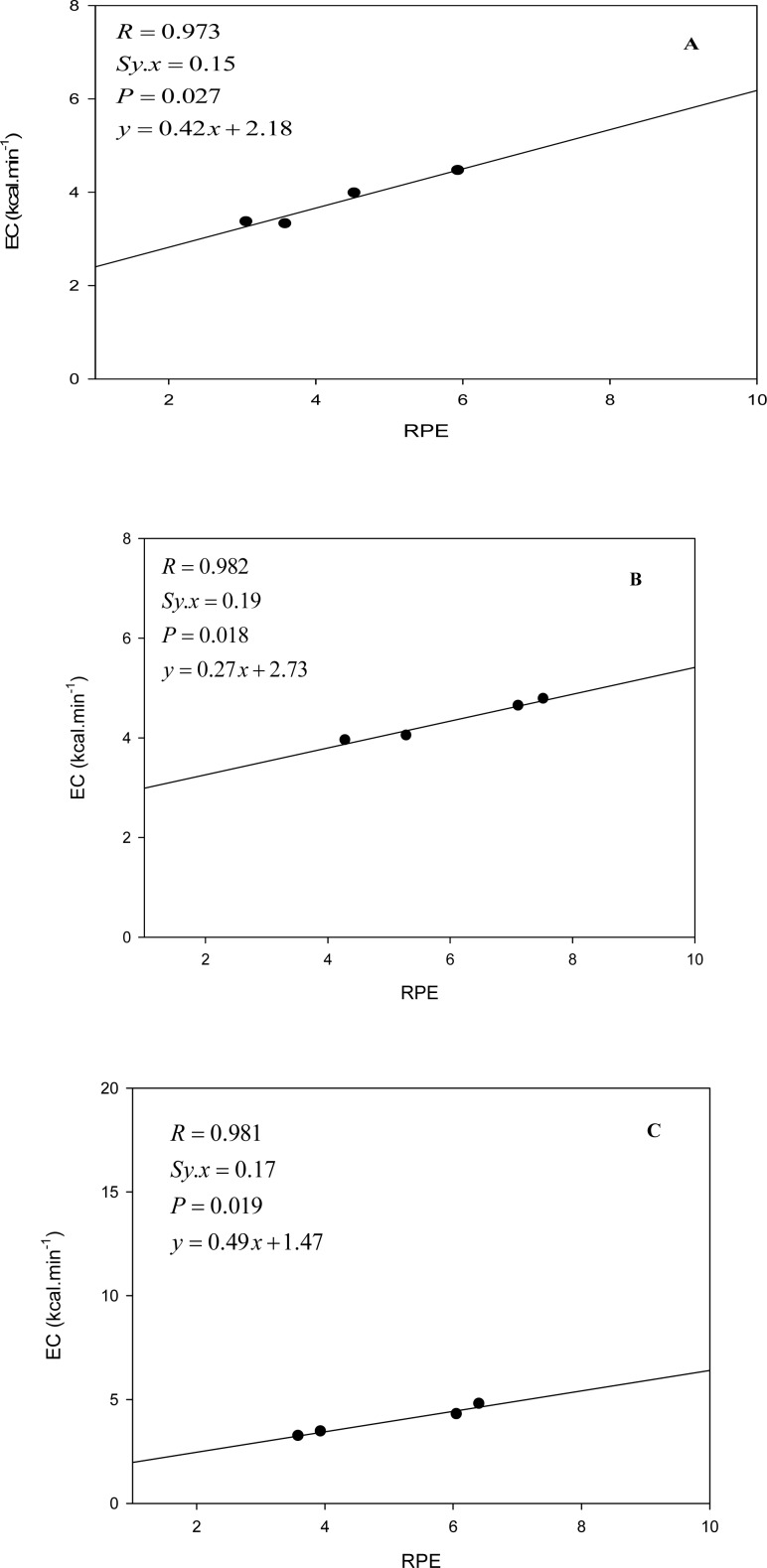
The aim of the present study was to assess the precision of the OMNI-RES scale to predict energy cost (EC) at low intensity in four resistance exercises (RE). 17 male recreational body builders (age = 26.6 ± 4.9 years; height = 177.7 ± 0.1 cm; body weight = 79.0 ± 11.1 kg and percent body fat = 10.5 ± 4.6%) served as subjects. Initially tests to determine 1RM for four resistance exercises (bench press, half squat, lat pull down and triceps extension) were administered. Subjects also performed resistance exercise at 12, 16, 20, and 24% of 1RM at a rate of 40 bpm until volitional exhaustion. Oxygen uptake (VO2) and rate of perceived exertion (RPE) using the OMNI-RES were obtained during and after all RE. EC was calculated using VO2 and the caloric values of VO2 for non-protein RER. Regression analyses were performed for every RE, using EC as the dependent and RPE as the predictor variable. The triceps extension, lat pull down and bench press, RPE correlated strongly with EC (R > 0.97) and predicted EC with a error of less than 0.2 kcal.min(-1). In conclusion, RPE using the OMNI-RES scale can be considered as an accurate indicator of EC in the bench press, lat pull down and triceps extension performed by recreational bodybuilders, provided lower intensities are used (up to 24% of 1-RM) and provided each set of exercise is performed for the maximal sustainable duration. It would be interesting in future studies to consider having the subjects exercise at low intensities for longer durations than those in the present study.
本研究旨在评估 OMNI-RES 量表在预测四种阻力运动(RE)低强度下能量消耗(EC)时的精确性。17 名男性娱乐性健美运动员(年龄=26.6±4.9 岁;身高=177.7±0.1cm;体重=79.0±11.1kg,体脂百分比=10.5±4.6%)作为研究对象。首先进行了四项阻力运动(卧推、半蹲、下拉和三头肌伸展)的 1RM 测试。受试者还以 40bpm 的速度在 12%、16%、20%和 24%的 1RM 下进行阻力运动,直到达到自愿性疲劳。在所有 RE 期间和之后,使用 OMNI-RES 测量了耗氧量(VO2)和感知用力程度(RPE)。使用 VO2 和非蛋白 RER 的 VO2 热量值计算 EC。对每种 RE 进行回归分析,以 EC 为因变量,RPE 为预测变量。三头肌伸展、下拉和卧推的 RPE 与 EC 高度相关(R>0.97),并且以低于 0.2kcal.min(-1)的误差预测 EC。结论:在由娱乐性健美运动员进行的卧推、下拉和三头肌伸展等低强度运动中,使用 OMNI-RES 量表的 RPE 可以被视为 EC 的准确指标,前提是使用较低的强度(低于 1-RM 的 24%),并且每一组运动都以最大可持续持续时间进行。在未来的研究中,考虑让受试者进行比本研究更长时间的低强度运动将是有趣的。