
磁性纳米粒子加热增强顺铂的高热效应与细胞膜流动性的增加相关。
Hyperthermic potentiation of cisplatin by magnetic nanoparticle heaters is correlated with an increase in cell membrane fluidity.
机构信息
Department of Chemical Engineering, University of Puerto Rico, Mayagüez, Puerto Rico.
出版信息
Int J Nanomedicine. 2013;8:1003-13. doi: 10.2147/IJN.S38842. Epub 2013 Mar 6.
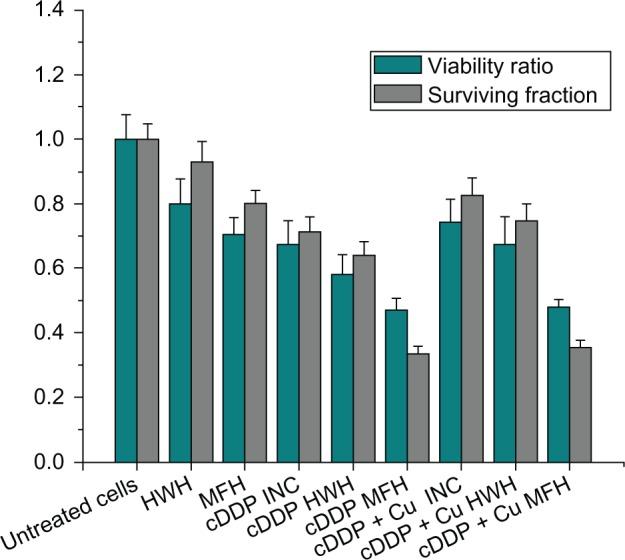
Magnetic fluid hyperthermia as a cancer treatment method is an attractive alternative to other forms of hyperthermia. It is based on the heat released by magnetic nanoparticles subjected to an alternating magnetic field. Recent studies have shown that magnetic fluid hyperthermia-treated cells respond significantly better to chemotherapeutic treatment compared with cells treated with hot water hyperthermia under the same temperature conditions. We hypothesized that this synergistic effect is due to an additional stress on the cellular membrane, independent of the thermal heat dose effect that is induced by nanoparticles exposed to an alternating magnetic field. This would result in an increase in Cis-diammine-dichloroplatinum (II) (cDDP, cisplatin) uptake via passive transport. To test this hypothesis, we exposed cDDP-treated cells to extracellular copper in order to hinder the human cell copper transporter (hCTR1)-mediated active transport of cDDP. This, in turn, can increase the passive transport of the drug through the cell membrane. Our results did not show statistically significant differences in surviving fractions for cells treated concomitantly with magnetic fluid hyperthermia and cDDP, in the presence or absence of copper. Nonetheless, significant copper-dependent variations in cell survival were observed for samples treated with combined cDDP and hot water hyperthermia. These results correlated with platinum uptake studies, which showed that cells treated with magnetic fluid hyperthermia had higher platinum uptake than cells treated with hot water hyperthermia. Changes in membrane fluidity were tested through fluorescence anisotropy measurements using trimethylamine-diphenylhexatriene. Additional uptake studies were conducted with acridine orange and measured by flow cytometry. These studies indicated that magnetic fluid hyperthermia significantly increases cell membrane fluidity relative to hot water hyperthermia and untreated cells, and hence this could be a factor contributing to the increase of cDDP uptake in magnetic fluid hyperthermia-treated cells. Overall, our data provide convincing evidence that cell membrane permeability induced by magnetic fluid hyperthermia is significantly greater than that induced by hot water hyperthermia under similar temperature conditions, and is at least one of the mechanisms responsible for potentiation of cDDP by magnetic fluid hyperthermia in Caco-2 cells.
磁流体热疗作为一种癌症治疗方法,是其他热疗形式的一种有吸引力的替代方法。它基于在交变磁场中受到加热的磁性纳米粒子释放的热量。最近的研究表明,与在相同温度条件下用热水热疗处理的细胞相比,磁流体热疗处理的细胞对化疗治疗的反应明显更好。我们假设这种协同效应是由于细胞膜受到额外的压力,而这种压力与暴露在交变磁场中的纳米粒子所诱导的热剂量效应无关。这将导致顺铂(cDDP,顺铂)通过被动转运的摄取增加。为了验证这一假设,我们将 cDDP 处理的细胞暴露于细胞外铜中,以阻止人细胞铜转运蛋白(hCTR1)介导的 cDDP 的主动转运。反过来,这可以增加药物通过细胞膜的被动转运。我们的结果表明,在存在或不存在铜的情况下,同时用磁流体热疗和 cDDP 处理的细胞的存活分数没有统计学上的显著差异。尽管如此,对于同时用 cDDP 和热水热疗处理的样品,观察到与铜依赖性显著变化的细胞存活。这些结果与铂摄取研究相关,该研究表明,用磁流体热疗处理的细胞比用热水热疗处理的细胞具有更高的铂摄取。通过使用三甲基胺-二苯基己三烯进行荧光各向异性测量来测试膜流动性的变化。还进行了用吖啶橙的额外摄取研究,并通过流式细胞术进行测量。这些研究表明,与热水热疗和未处理的细胞相比,磁流体热疗显著增加了细胞膜的流动性,因此这可能是增加磁流体热疗处理的细胞中 cDDP 摄取的一个因素。总的来说,我们的数据提供了令人信服的证据,表明在相似的温度条件下,磁流体热疗诱导的细胞膜通透性明显大于热水热疗诱导的细胞膜通透性,并且至少是磁流体热疗增强 Caco-2 细胞中 cDDP 作用的机制之一。




 Zotero 插件