Alden March Bioethics Institute, Albany Medical College, 47 New Scotland Avenue, MC 153, Albany, NY 12208-3478, USA.
BMC Med Genomics. 2013 Mar 8;6:8. doi: 10.1186/1755-8794-6-8.
Understanding the perception of patients on research ethics issues related to biobanking is important to enrich ethical discourse and help inform policy.
We examined the views of leukemia patients undergoing treatment in clinics located in the Princess Margaret Hospital in Toronto, Ontario, Canada. An initial written survey was provided to 100 patients (64.1% response rate) followed by a follow-up survey (62.5% response rate) covering the topics of informed consent, withdrawal, anonymity, incidental findings and the return of results, ownership, and trust.
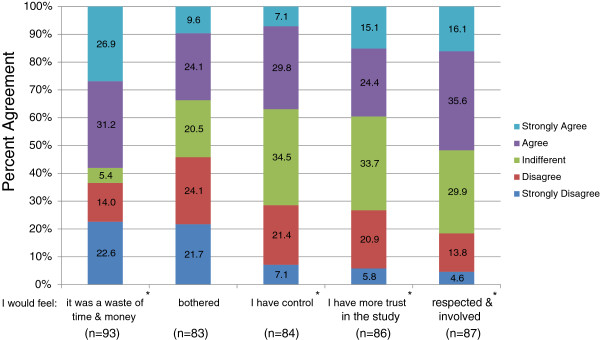
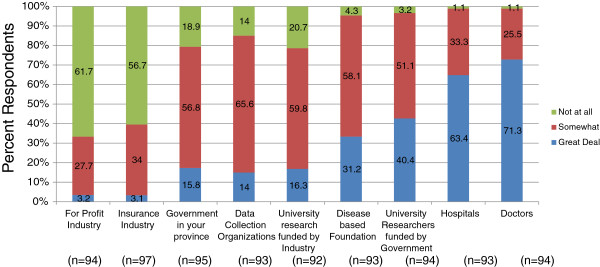
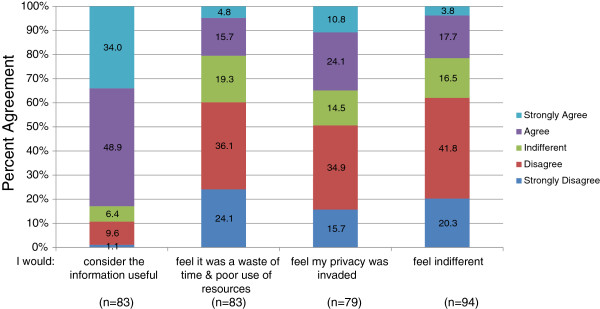
The majority (59.6%) preferred one-time consent, 30.3% desired a tiered consent approach that provides multiple options, and 10.1% preferred re-consent for future research. When asked different questions on re-consent, most (58%) reported that re-consent was a waste of time and money, but 51.7% indicated they would feel respected and involved if asked to re-consent. The majority of patients (62.2%) stated they had a right to withdraw their consent, but many changed their mind in the follow-up survey explaining that they should not have the right to withdraw consent. Nearly all of the patients (98%) desired being informed of incidental health findings and explained that the information was useful. Of these, 67.3% of patients preferred that researchers inform them and their doctors of the results. The majority of patients (62.2%) stated that the research institution owns the samples whereas 19.4% stated that the participants owned their samples. Patients had a great deal of trust in doctors, hospitals and government-funded university researchers, moderate levels of trust for provincial governments and industry-funded university researchers, and low levels of trust towards industry and insurance companies.
Many cancer patients surveyed preferred a one-time consent although others desired some form of control. The majority of participants wanted a continuing right to withdraw consent and nearly all wanted to be informed of incidental findings related to their health. Patients had a great deal of trust in their medical professionals and publically-funded researchers as opposed to profit-based industries and insurance companies.
了解患者对与生物库相关的研究伦理问题的看法对于丰富伦理讨论和为政策提供信息非常重要。
我们调查了在加拿大安大略省多伦多玛格丽特公主医院诊所接受治疗的白血病患者的观点。向 100 名患者(64.1%的回复率)提供了初步的书面调查,随后进行了后续调查(62.5%的回复率),涵盖了知情同意、退出、匿名、偶然发现和结果返还、所有权和信任等主题。
大多数患者(59.6%)倾向于一次性同意,30.3%希望采用分层同意方法提供多种选择,10.1%希望对未来研究进行重新同意。当被问及不同的重新同意问题时,大多数患者(58%)表示重新同意是浪费时间和金钱,但 51.7%的患者表示如果被要求重新同意,他们会感到受到尊重和参与。大多数患者(62.2%)表示他们有权撤回同意,但在后续调查中,许多患者改变了主意,解释说他们不应该有权撤回同意。几乎所有患者(98%)都希望被告知偶然的健康发现,并表示这些信息是有用的。在这些患者中,67.3%的患者希望研究人员告知他们和他们的医生结果。大多数患者(62.2%)表示研究机构拥有样本,而 19.4%的患者表示参与者拥有自己的样本。患者对医生、医院和政府资助的大学研究人员非常信任,对省政府和行业资助的大学研究人员有一定程度的信任,对行业和保险公司的信任度较低。
许多接受调查的癌症患者倾向于一次性同意,尽管其他人希望有某种形式的控制。大多数参与者希望有继续撤回同意的权利,几乎所有人都希望被告知与健康相关的偶然发现。患者对他们的医疗专业人员和公共资助的研究人员非常信任,而对营利性行业和保险公司则信任度较低。