Stanford Center for Sleep Sciences and Medicine, Stanford University of Medicine, 1050 A, Arastradero Road, Palo Alto, CA 94034, USA.
J Autoimmun. 2013 Jun;43:26-31. doi: 10.1016/j.jaut.2013.02.003. Epub 2013 Mar 13.
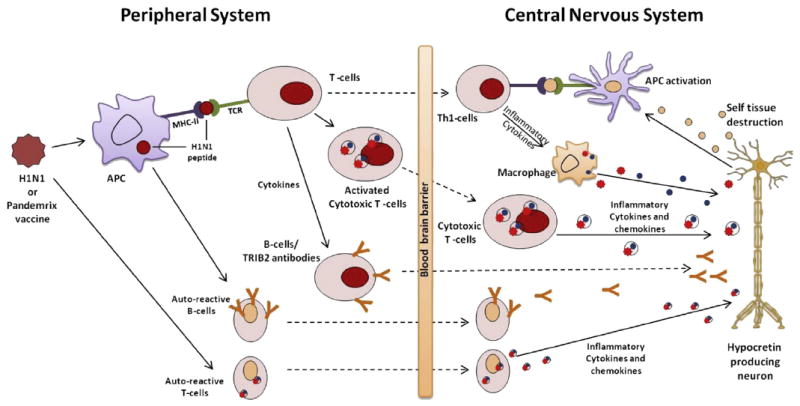
In recent years, a growing number of potential autoimmune disorders affecting neurons in the central nervous system have been identified, including narcolepsy. Narcolepsy is a lifelong sleep disorder characterized by excessive daytime sleepiness with irresistible sleep attacks, cataplexy (sudden bilateral loss of muscle tone), hypnagogic hallucinations, and abnormalities of Rapid Eye Movement sleep. Narcolepsy is generally a sporadic disorder and is caused by the loss of hypocretin (orexin)-producing neurons in the hypothalamus region of the brain. Studies have established that more than 90% of patients have a genetic association with HLA DQB1*06:02. Genome-wide association analysis shows a strong association between narcolepsy and polymorphisms in the TCRα locus and weaker associations within TNFSF4 (also called OX40L), Cathepsin H and the P2RY11-DNMT1 (purinergic receptor subtype P2Y11 to DNMT1, a DNA methytransferase) loci, suggesting an autoimmune basis. Mutations in DNMT1 have also been reported to cause narcolepsy in association with a complex neurological syndrome, suggesting the importance of DNA methylation in the pathology. More recently, narcolepsy was identified in association with seasonal streptococcus, H1N1 infections and following AS03-adjuvanted pH1N1 influenza vaccination in Northern Europe. Potential immunological pathways responsible for the loss of hypocretin producing neurons in these cases may be molecular mimicry or bystander activation. Specific autoantibodies or T cells cross-reactive with hypocretin neurons have not yet been identified, however, thus narcolepsy does not meet Witebsky's criteria for an autoimmune disease. As the brain is not an easily accessible organ, mechanisms of disease initiation and progression remain a challenge to researchers.
近年来,越来越多潜在的影响中枢神经系统神经元的自身免疫性疾病被发现,包括嗜睡症。嗜睡症是一种终身性睡眠障碍,其特征是白天过度嗜睡伴有无法抗拒的睡眠发作、猝倒(突发性双侧肌肉张力丧失)、催眠幻觉和快速眼动睡眠异常。嗜睡症通常是一种散发性疾病,由脑下丘脑区域的下丘脑分泌素(食欲素)产生神经元丧失引起。研究已经证实,超过 90%的患者与 HLA DQB1*06:02 存在遗传关联。全基因组关联分析显示,嗜睡症与 TCRα 基因座的多态性之间存在强烈关联,与 TNFSF4(也称为 OX40L)、组织蛋白酶 H 和 P2RY11-DNMT1(嘌呤能受体亚型 P2Y11 到 DNMT1,一种 DNA 甲基转移酶)基因座之间的关联较弱,提示存在自身免疫基础。DNMT1 突变也与与复杂神经综合征相关的嗜睡症有关,提示 DNA 甲基化在发病机制中的重要性。最近,在北欧,嗜睡症与季节性链球菌、H1N1 感染以及 AS03 佐剂 pH1N1 流感疫苗接种有关。在这些情况下,导致下丘脑分泌素产生神经元丧失的潜在免疫途径可能是分子模拟或旁观者激活。然而,尚未鉴定出与下丘脑分泌素神经元交叉反应的特异性自身抗体或 T 细胞,因此嗜睡症不符合 Witebsky 对自身免疫性疾病的标准。由于大脑不是一个容易接近的器官,疾病的发病机制和进展仍然是研究人员的一个挑战。