Department of Medical Statistics, Shiga University of Medical Science, Otsu, Shiga, Japan.
BMJ Open. 2013 Mar 15;3(3):e002234. doi: 10.1136/bmjopen-2012-002234.
The clustering of cardiovascular disease (CVD) risk factors is a serious threat for increasing medical expenses. The age-specific proportion and distribution of medical expenditure attributable to CVD risk factors, especially focused on the elderly, is thus indispensable for formulating public health policy given the extent of the ageing population in developed countries.
Cost analysis using individuals' medical expenses and their corresponding health examination measures.
Shiga prefecture, Japan, from April 2000 to March 2006.
33 213 participants aged 40 years and over.
Mean medical expenditure per year.
Gamma regression models were applied to examine how the number of CVD risk factors affects mean medical expenditure. The four CVD risk factors analysed in this study were defined as follows: hypertension (systolic blood pressure ≥140 mm Hg or diastolic blood pressure ≥90 mm Hg), hypercholesterolaemia (serum total cholesterol ≥240 mg/dl), high blood glucose (casual blood glucose ≥200 mg/dl) and smoking (current smoker). Sex-specific and age-specific investigations were carried out on the elderly (aged 65 and over) and non-elderly (aged 40-64) populations.
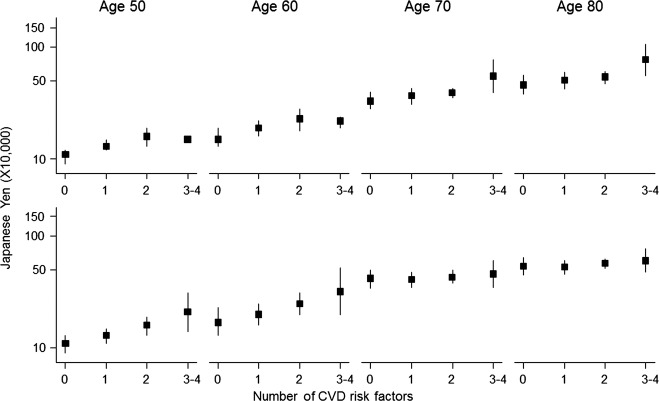
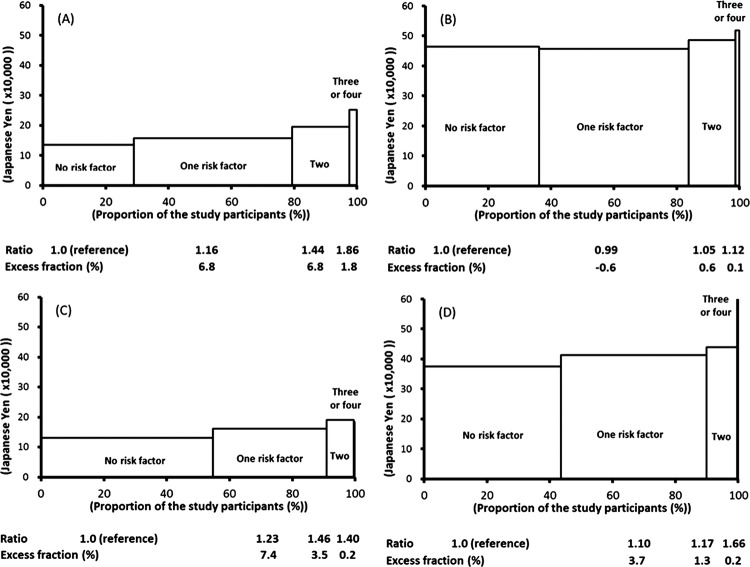
The mean medical expenditure (per year) for the no CVD risk-factor group was only 110 000 yen at age 50 (men, 110 708 yen; women, 107 109 yen), but this expenditure was 6-7 times higher for 80-year-olds who have three or four CVD risk factors (men, 603 351 yen; women, 765 673 yen). The total overspend (excess fraction) was larger for the non-elderly (men, 15.4%; women, 11.1%) than that for the elderly (men, 0.1%; women, 5.2%) and largely driven by people with one or two CVD risk factors, except for elderly men.
The age-specific proportion and distribution of medical expenditure attributable to CVD risk factors showed that a high-risk approach for the elderly and a population approach for the majority are both necessary to reduce total medical expenditure in Japan.
心血管疾病(CVD)危险因素的聚集是增加医疗费用的严重威胁。鉴于发达国家人口老龄化的程度,对于制定公共卫生政策而言,特定年龄组 CVD 危险因素所致医疗支出的比例和分布(尤其是针对老年人)是不可或缺的。
使用个体的医疗支出及其相应的健康检查措施进行成本分析。
日本滋贺县,2000 年 4 月至 2006 年 3 月。
33213 名年龄在 40 岁及以上的参与者。
每年的平均医疗支出。
应用伽马回归模型来研究 CVD 危险因素的数量如何影响平均医疗支出。本研究分析的 4 种 CVD 危险因素定义如下:高血压(收缩压≥140mmHg 或舒张压≥90mmHg)、高胆固醇血症(血清总胆固醇≥240mg/dl)、高血糖(随机血糖≥200mg/dl)和吸烟(当前吸烟者)。对老年人(≥65 岁)和非老年人(40-64 岁)进行了性别特异性和年龄特异性研究。
无 CVD 危险因素组的 50 岁人群的平均医疗支出(每年)仅为 110000 日元(男性为 110708 日元,女性为 107109 日元),但 80 岁时有 3 或 4 个 CVD 危险因素的人群的医疗支出则高达 6-7 倍(男性为 603351 日元,女性为 765673 日元)。非老年人(男性为 15.4%,女性为 11.1%)的总超额支出(超额部分)大于老年人(男性为 0.1%,女性为 5.2%),这主要是由有 1 或 2 个 CVD 危险因素的人群驱动的,除了老年男性。
CVD 危险因素所致医疗支出的年龄特异性比例和分布表明,对于老年人采取高风险策略,对于大多数人采取人群策略,对于降低日本的总医疗支出都是必要的。