Bangladesh Institute of Health Sciences (BIHS), Dhaka, Bangladesh.
Ministry of Health and Population (MoHP), Kathmandu, Nepal.
BMC Public Health. 2018 May 31;18(1):677. doi: 10.1186/s12889-018-5600-9.
Cardiovascular diseases (CVD) are the main cause of mortality in low- and middle-income countries like Nepal. Different risk factors usually cluster and interact multiplicatively to increase the risk of developing acute cardiovascular events; however, information related to clustering of CVD risk factors is scarce in Nepal. Therefore, we aimed to determine the prevalence of CVD risk factors with a focus on their clustering pattern in a rural Nepalese population.
A community-based cross-sectional study was conducted among residents aged 40 to 80 years in Lamjung District of Nepal in 2014. A clustered sampling technique was used in steps. At first, four out of 18 wards were chosen at random. Then, one person per household was selected randomly (n = 388). WHO STEPS questionnaires (version 2.2) were used to collect data. Chi-square and independent t-test were used to test significance at the level of p < 0.05.
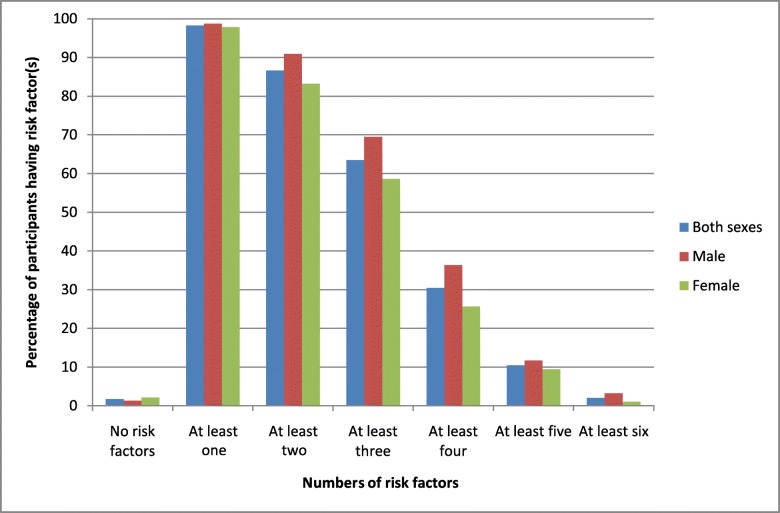
A total 345 samples with complete data were analyzed. Smoking [24.1% (95% CI: 19.5-28.6)], harmful use of alcohol [10.7% (7.4-13.9)], insufficient intake of fruit and vegetable [72% (67.1-76.6)], low physical activity [10.1% (6.9-13.2)], overweight and obesity [59.4% (54.2-64.5)], hypertension [42.9% (37.6-48.1)], diabetes [16.2% (14.0-18.3)], and dyslipidemia [56.0% (53.0-58.7)] were common risk factors among the study population. Overall, 98.2% had at least one risk factor, while 2.0% exhibited six risk factors. Overall, more than a half (63.4%) of participants had at least three risk factors (male: 69.4%, female: 58.5%). Age [OR: 2.3 (95% CI: 1.13-4.72)] and caste/ethnicity [2.0 (95% CI: 1.28-3.43)] were significantly associated with clustering of at least three risk factors.
Cardiovascular risk factors and their clustering were common in the rural population of Nepal. Therefore, comprehensive interventions against all risk factors should be immediately planned and implemented to reduce the future burden of CVD in the rural population of Nepal.
心血管疾病(CVD)是尼泊尔等中低收入国家的主要死亡原因。不同的风险因素通常会聚集并相互作用,从而增加急性心血管事件的风险;然而,尼泊尔有关 CVD 风险因素聚集的信息很少。因此,我们旨在确定 CVD 风险因素的流行情况,重点关注尼泊尔农村人口的聚集模式。
2014 年在尼泊尔拉姆琼区进行了一项以社区为基础的横断面研究,研究对象为 40 至 80 岁的居民。采用分阶段的聚类抽样技术。首先,随机选择 18 个区中的 4 个区。然后,从每个家庭中随机选择一个人(n=388)。采用世卫组织 STEPS 问卷(第 2.2 版)收集数据。采用卡方检验和独立 t 检验检验 p 值<0.05 的显著性。
对 345 份完整数据进行了分析。吸烟[24.1%(95%置信区间:19.5-28.6)]、有害饮酒[10.7%(7.4-13.9)]、水果和蔬菜摄入不足[72%(67.1-76.6)]、身体活动不足[10.1%(6.9-13.2)]、超重和肥胖[59.4%(54.2-64.5)]、高血压[42.9%(37.6-48.1)]、糖尿病[16.2%(14.0-18.3)]和血脂异常[56.0%(53.0-58.7)]是研究人群中常见的风险因素。总体而言,98.2%的人至少有一种风险因素,而 2.0%的人有六种风险因素。总体而言,超过一半(63.4%)的参与者至少有三种风险因素(男性:69.4%,女性:58.5%)。年龄[OR:2.3(95%置信区间:1.13-4.72)]和种姓/种族[2.0(95%置信区间:1.28-3.43)]与至少三种风险因素的聚集显著相关。
心血管风险因素及其聚集在尼泊尔农村人口中很常见。因此,应立即计划和实施针对所有风险因素的综合干预措施,以降低尼泊尔农村人口未来 CVD 的负担。