Department of Physics, Hong Kong Baptist University, Kowloon Tong, Hong Kong, China.
PLoS Comput Biol. 2013;9(3):e1002937. doi: 10.1371/journal.pcbi.1002937. Epub 2013 Mar 7.
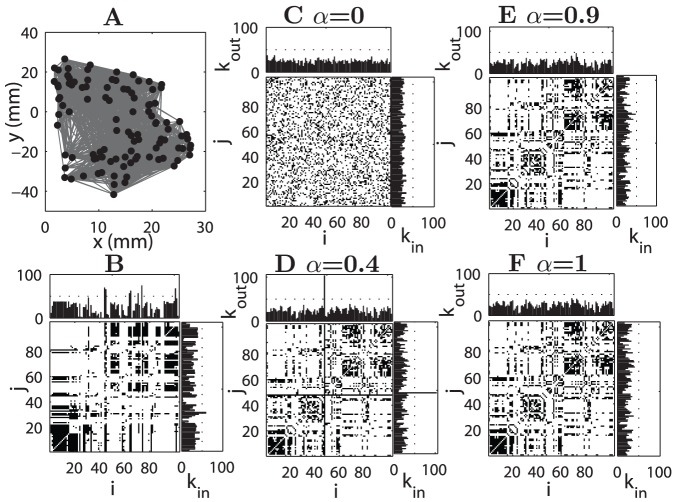
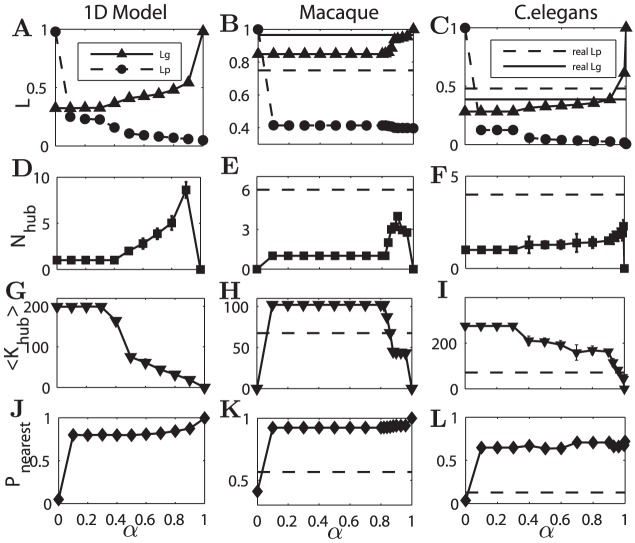
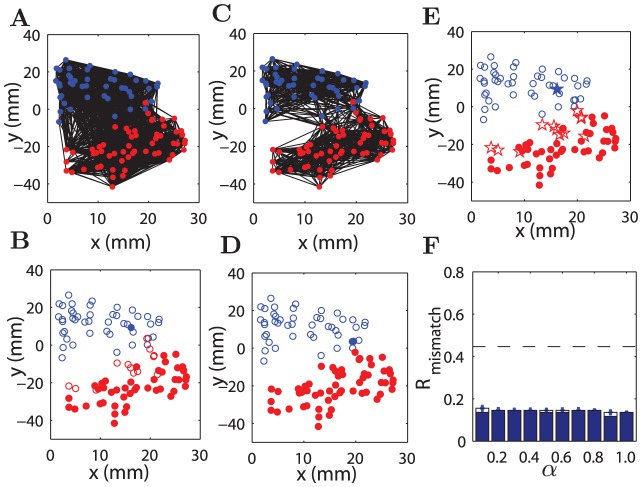
The formation of the complex network architecture of neural systems is subject to multiple structural and functional constraints. Two obvious but apparently contradictory constraints are low wiring cost and high processing efficiency, characterized by short overall wiring length and a small average number of processing steps, respectively. Growing evidence shows that neural networks are results from a trade-off between physical cost and functional value of the topology. However, the relationship between these competing constraints and complex topology is not well understood quantitatively. We explored this relationship systematically by reconstructing two known neural networks, Macaque cortical connectivity and C. elegans neuronal connections, from combinatory optimization of wiring cost and processing efficiency constraints, using a control parameter α, and comparing the reconstructed networks to the real networks. We found that in both neural systems, the reconstructed networks derived from the two constraints can reveal some important relations between the spatial layout of nodes and the topological connectivity, and match several properties of the real networks. The reconstructed and real networks had a similar modular organization in a broad range of α, resulting from spatial clustering of network nodes. Hubs emerged due to the competition of the two constraints, and their positions were close to, and partly coincided, with the real hubs in a range of α values. The degree of nodes was correlated with the density of nodes in their spatial neighborhood in both reconstructed and real networks. Generally, the rebuilt network matched a significant portion of real links, especially short-distant ones. These findings provide clear evidence to support the hypothesis of trade-off between multiple constraints on brain networks. The two constraints of wiring cost and processing efficiency, however, cannot explain all salient features in the real networks. The discrepancy suggests that there are further relevant factors that are not yet captured here.
神经系统的复杂网络结构的形成受到多种结构和功能约束的影响。两个明显但显然矛盾的约束条件是低布线成本和高处理效率,分别表现为总布线长度短和平均处理步骤少。越来越多的证据表明,神经网络是物理成本和拓扑结构功能价值之间权衡的结果。然而,这些竞争约束条件与复杂拓扑结构之间的关系在定量上还没有得到很好的理解。我们通过组合优化布线成本和处理效率约束条件,使用控制参数 α,从组合优化布线成本和处理效率约束条件中,分别对猕猴皮质连接和秀丽隐杆线虫神经元连接这两个已知的神经网络进行重构,来系统地探索这种关系,并将重构网络与真实网络进行比较。我们发现,在这两个神经网络中,从这两个约束条件得出的重构网络可以揭示节点的空间布局与拓扑连接之间的一些重要关系,并与真实网络的几个特性相匹配。在广泛的 α 值范围内,重构网络和真实网络具有相似的模块化组织,这是由于网络节点的空间聚类所致。由于两个约束条件的竞争,枢纽节点出现了,并且它们的位置与α值范围内的真实枢纽节点接近,部分重合。节点的度与节点在其空间邻域中的密度在重构和真实网络中都相关。一般来说,重构网络与真实网络中的大量真实连接匹配,尤其是短距离的连接。这些发现为大脑网络中多种约束条件之间存在权衡的假设提供了明确的证据。然而,布线成本和处理效率这两个约束条件并不能解释真实网络中的所有显著特征。这种差异表明,还有其他尚未被捕获的相关因素。