Doudi Monir, Naghsh Nooshin, Setorki Mahbubeh
Department of Microbiology, Falavarjan Branch, Islamic Azad University, Isfahan, Iran.
Med Sci Monit Basic Res. 2013 Mar 18;19:103-10. doi: 10.12659/MSMBR.883835.
Antimicrobial resistance in hospital pathogens is an important concern. It can cause longer hospital stays, increase costs, and contribute to increased mortality and morbidity in hospitalized patients. The aim of this study was to categorize and identify gram-negative bacilli capable of ESBLs production and to study the effect of MIC silver nanoparticles on bacteria strains and then study them in Wistar rats.
A total of 186 clinical samples in 3 hospital of Isfahan city was studied during 8 months. The ESBL assay was performed by disk diffusion method. Minimum inhibitory concentration (MIC) values were determined by agar dilution method. Additionally, ESBLs production was examined by using the standard ESBL disc and DDT (double disk approximation test) procedures. Student's T-test and ANOVA were used for statistical analysis of the data. The ESBL-producing bacteria were then subjected to minimum concentrations of silver nanoparticles and then examined in Wistar rats.
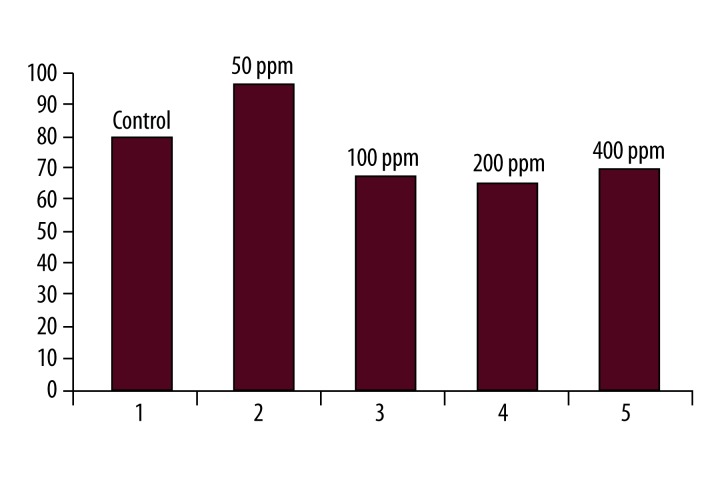
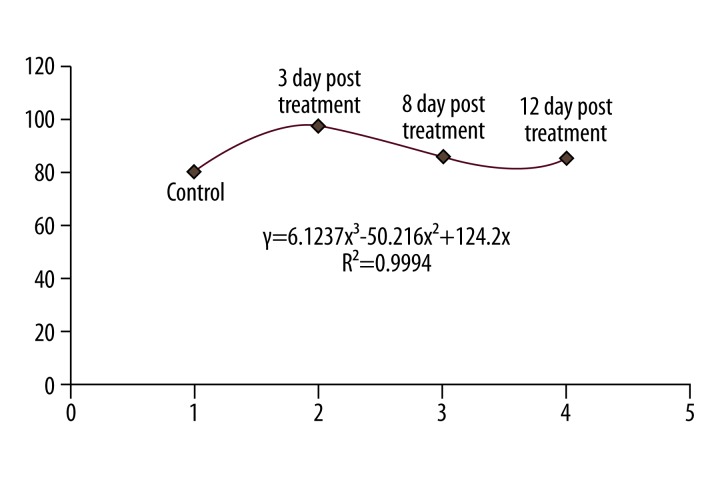
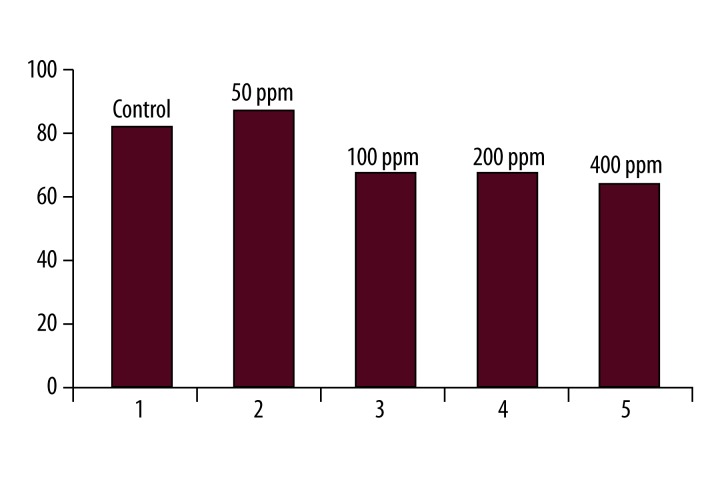
Of the 186 patients studied, 140 (75.3%) had gram-negative bacilli containing ESBL and 46 (24.7%) had gram-negative bacilli without ESBL and the most prevalent bacteria was identified as Klebsiella pneumonia, with especially strong resistance to cefotaxime. All of these bacteria were sensitive to the silver nanoparticle solution with density of 100 ppm, but the 4 nm size did not show any significant difference from control group Wistar rats at 6 months.
The results seem to indicate a direct correlation between silver nanoparticle solution concentration and the diameter of growth zone for ESBL-producing bacteria. Assays in our study were in vitro; if use of silver nanoparticle particles in vivo proves to be with adverse effects, it could be a valuable alternative to antibiotics.
医院病原体中的抗菌药物耐药性是一个重要问题。它可导致住院时间延长、成本增加,并致使住院患者的死亡率和发病率上升。本研究的目的是对能够产生超广谱β-内酰胺酶(ESBLs)的革兰氏阴性杆菌进行分类和鉴定,研究MIC银纳米颗粒对细菌菌株的影响,然后在Wistar大鼠中进行研究。
在8个月期间对伊斯法罕市3家医院的186份临床样本进行了研究。通过纸片扩散法进行ESBL检测。采用琼脂稀释法测定最低抑菌浓度(MIC)值。此外,使用标准ESBL纸片和双纸片协同试验(DDT)程序检测ESBLs的产生情况。采用学生t检验和方差分析对数据进行统计分析。然后将产生ESBLs的细菌暴露于最低浓度的银纳米颗粒中,随后在Wistar大鼠中进行检测。
在研究的186例患者中,140例(75.3%)有含ESBLs的革兰氏阴性杆菌,46例(24.7%)有不含ESBLs的革兰氏阴性杆菌,最常见的细菌被鉴定为肺炎克雷伯菌,对头孢噻肟耐药性尤其强。所有这些细菌对密度为100 ppm的银纳米颗粒溶液敏感,但4纳米尺寸的银纳米颗粒在6个月时与Wistar大鼠对照组相比未显示出任何显著差异。
结果似乎表明银纳米颗粒溶液浓度与产生ESBLs细菌的生长区直径之间存在直接相关性。我们研究中的检测是在体外进行的;如果银纳米颗粒在体内的使用被证明有不良影响,它可能是抗生素的一种有价值的替代品。