Tillmann Taavi, Krishnadas Rajeev, Cavanagh Jonathan, Petrides K V
Arthritis Res Ther. 2013 Mar 21;15(2):R45. doi: 10.1186/ar4204.
Dysregulation of the hypothalamic-pituitary-adrenal (HPA) axis has been implicated in the pathology of rheumatoid arthritis (RA), particularly as vulnerable personality types are exposed to chronic stress. Emotions are powerful modulators of stress responses. However, little is known about whether patients with RA process emotions differently to matched controls. In this study we: 1) assessed whether the trait emotional intelligence (trait EI) scores of patients with RA differ from healthy controls at the facet level; 2) explored any subgroups in RA, in terms of trait EI and common risk factors.
A total of 637 patients with RA were compared to 496 controls on the trait EI Questionnaire (TEIQue). RA subgroups were explored in terms of trait EI, rheumatoid factor status (RF+/-), depression and time from onset of symptoms until diagnosis (diagnostic delay).
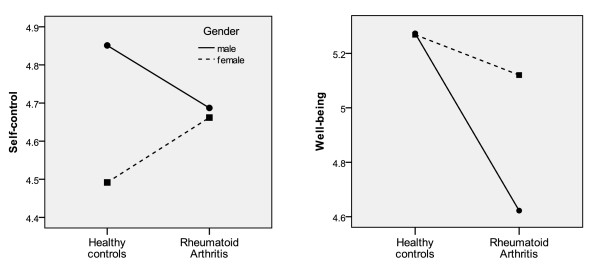
The RA group rated themselves lower on Adaptability, Stress-management, Emotion management, Self-esteem, Sociability, Assertiveness, Impulsiveness and Well-being, and higher on Empathy and Relationships than healthy controls. The RF- subtype reported more time with depression (25.2 vs. 11.3 months), a longer diagnostic delay (3.0 vs. 1.7 years), and greater emotional expression (5.15 vs. 4.72), than the RF+ subtype. These differences were significant at the P <0.05 level, but not following strict Bonferroni corrections and should therefore be treated as indicative only. RF- patients with a longer diagnostic delay reported depression lasting three times longer (42.7 months), when compared to three other subtypes (11.0 to 12.7 months).
RA patients and controls differ in their emotion-related personality traits, as operationalized by trait EI. These differences may make people with RA more susceptible to chronic stress and HPA-axis dysregulation. RA may be a highly heterogeneous illness where at least two subtypes may be characterized by personality, psychiatric and immunological differences. RF- status, as well as diagnostic delay and emotional expression, may predict future risk of depression. Research on the causes of RA could benefit from a systems science approach.
下丘脑 - 垂体 - 肾上腺(HPA)轴功能失调与类风湿关节炎(RA)的发病机制有关,尤其是当易感人格类型暴露于慢性应激时。情绪是应激反应的有力调节因素。然而,对于RA患者与匹配的对照组在情绪处理方式上是否存在差异,我们知之甚少。在本研究中,我们:1)评估RA患者的特质情绪智力(特质EI)得分在各个方面是否与健康对照组不同;2)根据特质EI和常见风险因素探索RA中的任何亚组。
在特质情绪智力量表(TEIQue)上,将总共637例RA患者与496例对照组进行比较。根据特质EI、类风湿因子状态(RF + / - )、抑郁以及从症状出现到诊断的时间(诊断延迟)对RA亚组进行探索。
与健康对照组相比,RA组在适应性、压力管理、情绪管理、自尊、社交能力、果断性、冲动性和幸福感方面给自己的评分较低,而在同理心和人际关系方面评分较高。RF - 亚组报告的抑郁时间更长(25.2个月对11.3个月),诊断延迟更长(3.0年对1.7年),并且情绪表达更强烈(5.15对4.72),比RF + 亚组。这些差异在P <0.05水平上具有统计学意义,但经过严格的Bonferroni校正后则不然,因此应仅视为指示性差异。与其他三种亚组(11.0至12.7个月)相比,诊断延迟较长的RF - 患者报告的抑郁持续时间长三倍(42.7个月)。
通过特质EI衡量,RA患者和对照组在与情绪相关的人格特质上存在差异。这些差异可能使RA患者更容易受到慢性应激和HPA轴功能失调的影响。RA可能是一种高度异质性疾病,其中至少两种亚组可能具有人格、精神和免疫方面的差异。RF - 状态以及诊断延迟和情绪表达可能预测未来抑郁的风险。对RA病因的研究可能会从系统科学方法中受益。