Thomas Diana M, Bredlau Carl, Bosy-Westphal Anja, Mueller Manfred, Shen Wei, Gallagher Dympna, Maeda Yuna, McDougall Andrew, Peterson Courtney M, Ravussin Eric, Heymsfield Steven B
Center for Quantitative Obesity Research, Montclair State University, Montclair, NJ, USA.
Obesity (Silver Spring). 2013 Nov;21(11):2264-71. doi: 10.1002/oby.20408. Epub 2013 Jun 11.
To develop a new geometrical index that combines height, waist circumference (WC), and hip circumference (HC) and relate this index to total and visceral body fat.
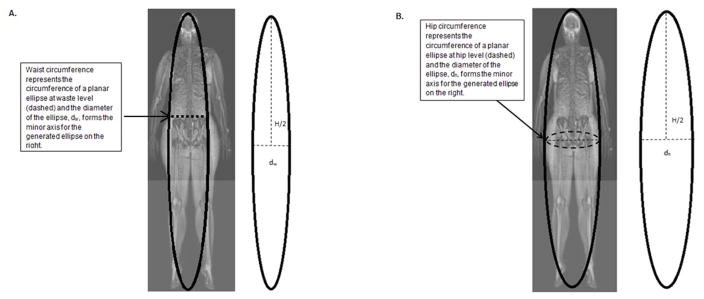
Subject data were pooled from three databases that contained demographic, anthropometric, dual energy X-ray absorptiometry (DXA) measured fat mass, and magnetic resonance imaging measured visceral adipose tissue (VAT) volume. Two elliptical models of the human body were developed. Body roundness was calculated from the model using a well-established constant arising from the theory. Regression models based on eccentricity and other variables were used to predict %body fat and %VAT.
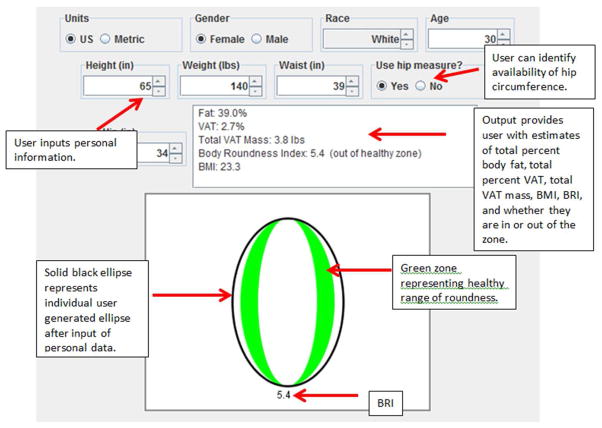
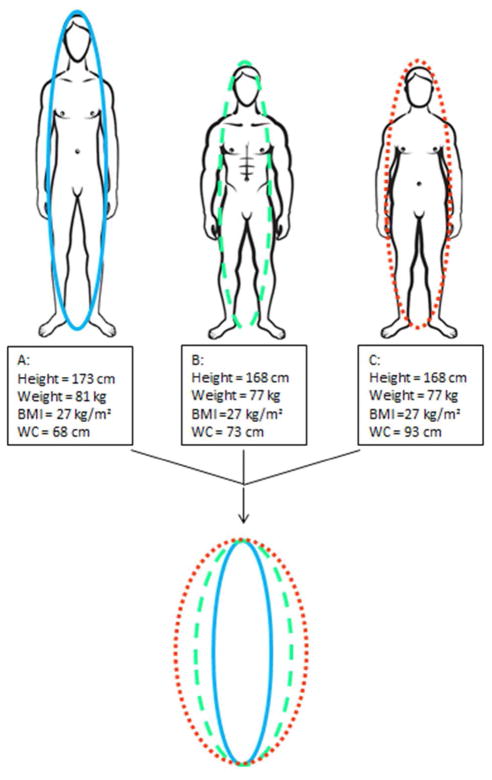
A body roundness index (BRI) was derived to quantify the individual body shape in a height-independent manner. Body roundness slightly improved predictions of %body fat and %VAT compared to the traditional metrics of body mass index (BMI), WC, or HC. On this basis, healthy body roundness ranges were established. An automated graphical program simulating study results was placed at http://www.pbrc.edu/bodyroundness.
BRI, a new shape measure, is a predictor of %body fat and %VAT and can be applied as a visual tool for health status evaluations.
开发一种结合身高、腰围(WC)和臀围(HC)的新几何指数,并将该指数与全身及内脏脂肪相关联。
从三个数据库汇总受试者数据,这些数据库包含人口统计学、人体测量学、双能X线吸收法(DXA)测量的脂肪量以及磁共振成像测量的内脏脂肪组织(VAT)体积。建立了两种人体椭圆模型。根据该理论中一个既定常数,利用模型计算身体圆度。基于偏心率和其他变量的回归模型用于预测体脂百分比和内脏脂肪百分比。
得出身体圆度指数(BRI),以独立于身高的方式量化个体身体形状。与体重指数(BMI)、腰围或臀围等传统指标相比,身体圆度对体脂百分比和内脏脂肪百分比的预测略有改善。在此基础上,确定了健康身体圆度范围。一个模拟研究结果的自动化图形程序可在http://www.pbrc.edu/bodyroundness获取。
BRI作为一种新的体型测量指标,是体脂百分比和内脏脂肪百分比的预测指标,可作为健康状况评估的可视化工具。