Department of Entomology, University of California Davis, Davis, California, United States of America.
PLoS One. 2013;8(3):e58824. doi: 10.1371/journal.pone.0058824. Epub 2013 Mar 8.
The effect of temperature on insect biology is well understood under constant temperature conditions, but less so under more natural, fluctuating conditions. A fluctuating temperature profile around a mean of 26°C can alter Aedes aegypti vector competence for dengue viruses as well as numerous life-history traits, however, the effect of fluctuations on mosquitoes at critical thermal limits is unknown.
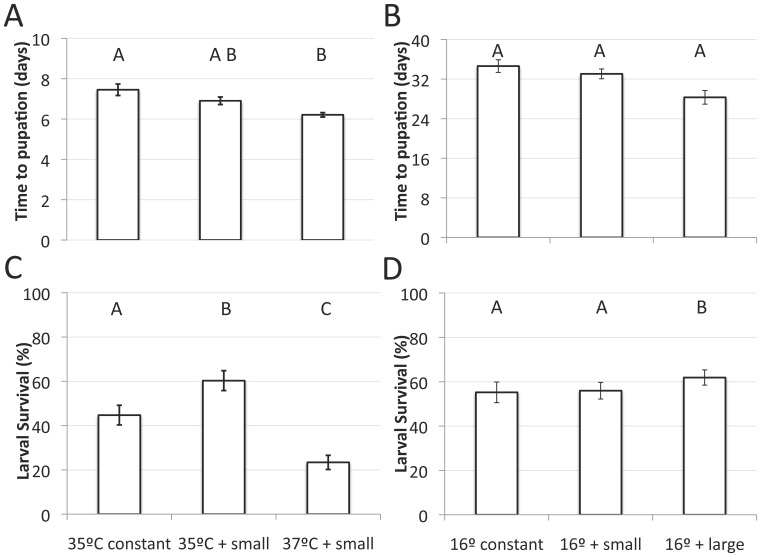
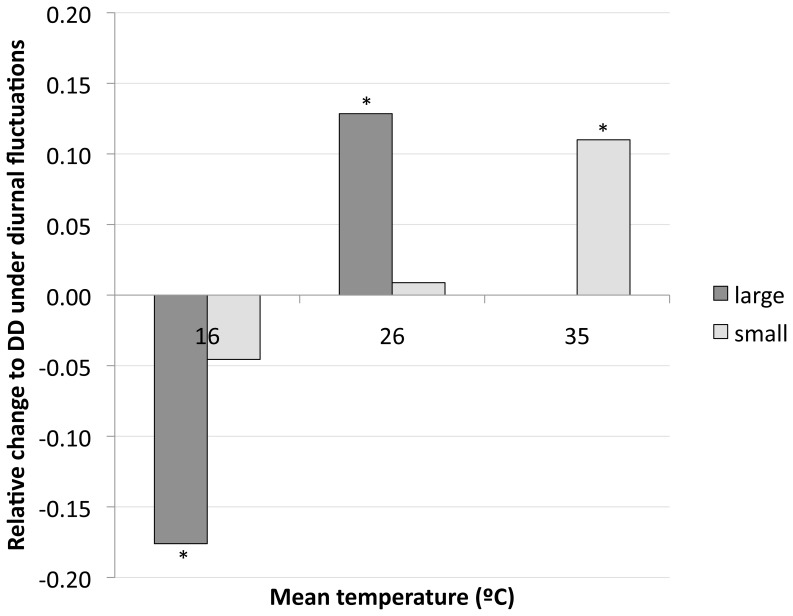
METHODOLOGY/PRINCIPAL FINDINGS: We investigated the effects of large and small daily temperature fluctuations at low (16°C) and high (35-37°C) mean temperatures, after we identified these temperatures as being thresholds for immature development and/or adult reproduction under constant temperature conditions. We found that temperature effects on larval development time, larval survival and adult reproduction depend on the combination of mean temperature and magnitude of fluctuations. Importantly, observed degree-day estimates for mosquito development under fluctuating temperature profiles depart significantly (around 10-20%) from that predicted by constant temperatures of the same mean. At low mean temperatures, fluctuations reduce the thermal energy required to reach pupation relative to constant temperature, whereas at high mean temperatures additional thermal energy is required to complete development. A stage-structured model based on these empirical data predicts that fluctuations can significantly affect the intrinsic growth rate of mosquito populations.
CONCLUSIONS/SIGNIFICANCE: Our results indicate that by using constant temperatures, one could under- or over-estimate values for numerous life-history traits compared to more natural field conditions dependent upon the mean temperature. This complexity may in turn reduce the accuracy of population dynamics modeling and downstream applications for mosquito surveillance and disease prevention.
在恒温条件下,人们对温度对昆虫生物学的影响已有深入了解,但在更为自然、波动的条件下则知之甚少。在接近 26°C 的平均温度下,波动的温度曲线会改变埃及伊蚊对登革热病毒的媒介能力以及许多生活史特征,但波动对关键热限下蚊子的影响尚不清楚。
方法/主要发现:在确定 16°C(低温)和 35-37°C(高温)这两个温度分别是蚊虫在恒温条件下的发育和繁殖的临界点后,我们研究了大、小日温差在低温和高温时对蚊子的影响。我们发现,温度对幼虫发育时间、幼虫存活率和成虫繁殖的影响取决于平均温度和波动幅度的组合。重要的是,根据波动温度曲线得出的蚊子发育的积温估计值与相同平均温度的恒温条件下的预测值有显著差异(约 10-20%)。在平均温度较低时,波动会减少与恒温相比完成蛹化所需的热能,而在平均温度较高时,还需要额外的热能才能完成发育。基于这些实验数据的阶段结构模型预测,波动会显著影响蚊子种群的内禀增长率。
结论/意义:我们的研究结果表明,与更自然的野外条件相比,在恒温条件下,许多生活史特征的值可能被低估或高估,具体取决于平均温度。这种复杂性可能会降低种群动态模型的准确性,并对蚊子监测和疾病预防等下游应用产生影响。