Laboratory of Entomology, Wageningen University, PO Box 8031, 6700EH Wageningen, The Netherlands.
Malar J. 2010 Jul 9;9:196. doi: 10.1186/1475-2875-9-196.
The relationship between mosquito development and temperature is one of the keys to understanding the current and future dynamics and distribution of vector-borne diseases such as malaria. Many process-based models use mean air temperature to estimate larval development times, and hence adult vector densities and/or malaria risk.
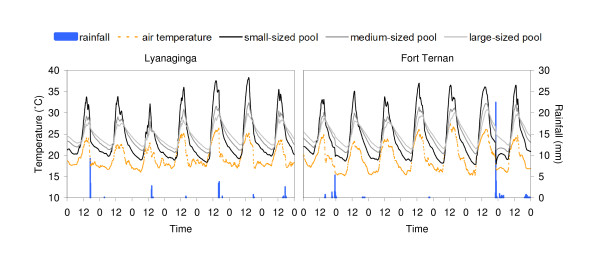
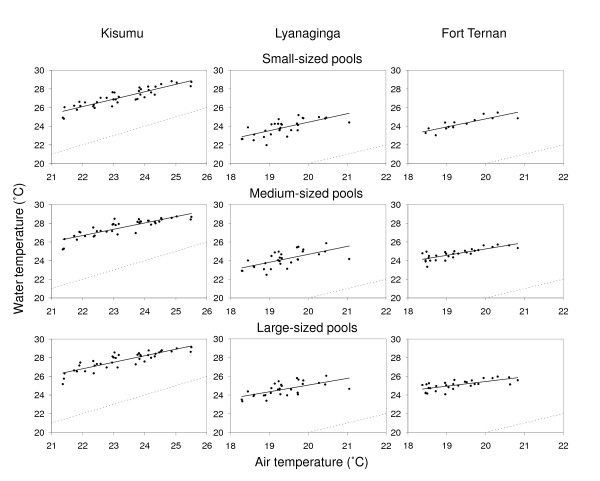
Water temperatures in three different-sized water pools, as well as the adjacent air temperature in lowland and highland sites in western Kenya were monitored. Both air and water temperatures were fed into a widely-applied temperature-dependent development model for Anopheles gambiae immatures, and subsequently their impact on predicted vector abundance was assessed.
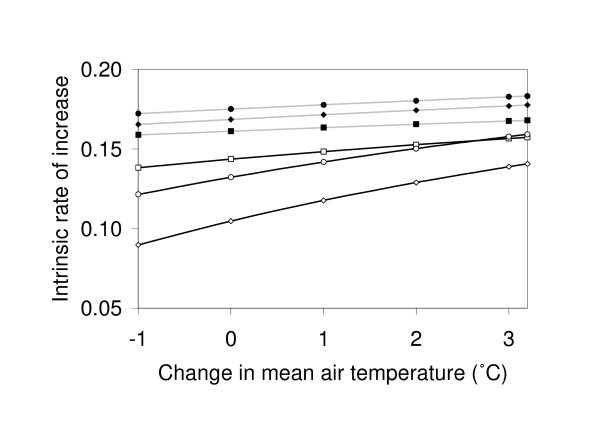
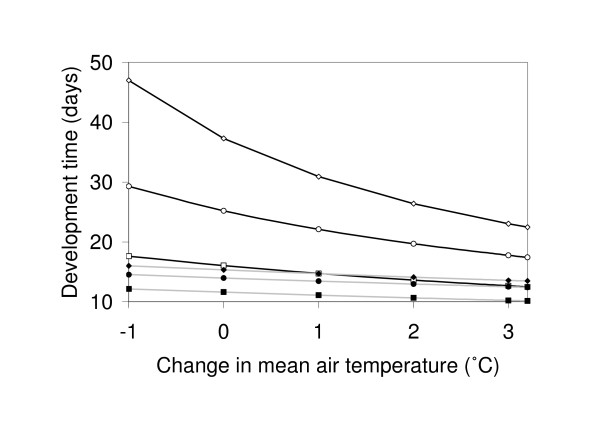
Mean water temperature in typical mosquito breeding sites was 4-6 degrees C higher than the mean temperature of the adjacent air, resulting in larval development rates, and hence population growth rates, that are much higher than predicted based on air temperature. On the other hand, due to the non-linearities in the relationship between temperature and larval development rate, together with a marginal buffering in the increase in water temperature compared with air temperature, the relative increases in larval development rates predicted due to climate change are substantially less.
Existing models will tend to underestimate mosquito population growth under current conditions, and may overestimate relative increases in population growth under future climate change. These results highlight the need for better integration of biological and environmental information at the scale relevant to mosquito biology.
蚊子的发育与温度之间的关系是了解疟疾等虫媒传染病当前和未来动态及分布的关键之一。许多基于过程的模型使用平均空气温度来估算幼虫的发育时间,从而估算成蚊密度和/或疟疾风险。
在肯尼亚西部的低地和高地地点,监测了三个不同大小的水池中的水温以及相邻的空气温度。将空气和水的温度输入到一种广泛应用的温度相关的冈比亚按蚊幼虫发育模型中,随后评估其对预测的媒介丰度的影响。
典型蚊子滋生地的平均水温比相邻空气的平均温度高 4-6 摄氏度,导致幼虫的发育速度,从而导致种群增长率远高于基于空气温度的预测。另一方面,由于温度与幼虫发育率之间的关系是非线性的,并且与空气温度相比,水温的增加幅度较小,因此由于气候变化而预测的幼虫发育速度的相对增加幅度要小得多。
现有模型往往会低估当前条件下蚊子种群的增长,并且可能高估未来气候变化下种群增长的相对增加。这些结果强调需要更好地整合与蚊子生物学相关的生物和环境信息。