National Hospital, Colombo, Sri Lanka.
BMC Med Educ. 2013 Mar 25;13:42. doi: 10.1186/1472-6920-13-42.
The challenge of imparting a large amount of knowledge within a limited time period in a way it is retained, remembered and effectively interpreted by a student is considerable. This has resulted in crucial changes in the field of medical education, with a shift from didactic teacher centered and subject based teaching to the use of interactive, problem based, student centered learning. This study tested the hypothesis that learning styles (visual, auditory, read/write and kinesthetic) and approaches to learning (deep, strategic and superficial) differ among first and final year undergraduate medical students, and postgraduates medical trainees.
We used self administered VARK and ASSIST questionnaires to assess the differences in learning styles and approaches to learning among medical undergraduates of the University of Colombo and postgraduate trainees of the Postgraduate Institute of Medicine, Colombo.
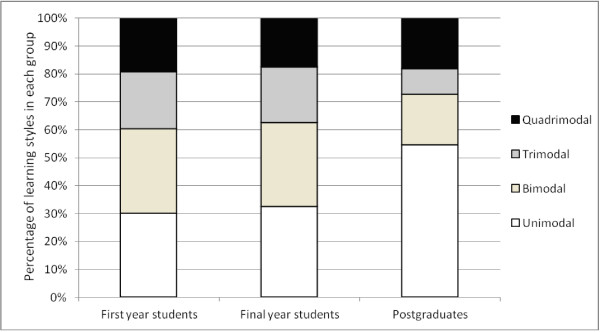
A total of 147 participated: 73 (49.7%) first year students, 40 (27.2%) final year students and 34(23.1%) postgraduate students. The majority (69.9%) of first year students had multimodal learning styles. Among final year students, the majority (67.5%) had multimodal learning styles, and among postgraduates, the majority were unimodal (52.9%) learners.Among all three groups, the predominant approach to learning was strategic. Postgraduates had significant higher mean scores for deep and strategic approaches than first years or final years (p < 0.05). Mean scores for the superficial approach did not differ significantly between groups.
The learning approaches suggest a positive shift towards deep and strategic learning in postgraduate students. However a similar difference was not observed in undergraduate students from first year to final year, suggesting that their curriculum may not have influenced learning methodology over a five year period.
在有限的时间内传授大量知识,使其被学生保留、记忆并有效理解,这是一项极具挑战性的任务。这导致医学教育领域发生了重大变化,教学方法从以教师为中心、以学科为基础的教学转变为以互动、以问题为基础、以学生为中心的学习。本研究检验了以下假设,即学习风格(视觉型、听觉型、读写型和动觉型)和学习方法(深度学习、策略性学习和浅层学习)在医学本科一年级和五年级学生以及研究生医学实习生中存在差异。
我们使用自我管理的 VARK 和 ASSIST 问卷来评估科伦坡大学医学本科生和科伦坡研究生医学研究所研究生的学习风格和学习方法差异。
共有 147 人参与:73 人(49.7%)为一年级学生,40 人(27.2%)为五年级学生,34 人(23.1%)为研究生学生。大多数(69.9%)一年级学生具有多模态学习风格。在五年级学生中,大多数(67.5%)具有多模态学习风格,而在研究生中,大多数(52.9%)是单模态学习者。在所有三个组中,主要的学习方法是策略性学习。与一年级或五年级学生相比,研究生的深度学习和策略性学习方法的平均得分显著更高(p<0.05)。各组之间的浅层学习方法的平均得分没有显著差异。
学习方法表明研究生学习方法向深度学习和策略性学习的积极转变。然而,从一年级到五年级,本科学生并没有观察到类似的差异,这表明他们的课程在五年内可能没有影响学习方法。