EA DevAH - Development, Adaption and Disadvantage, Cardio-Respiratory Regulations and Motor Control, Faculty of Medicine and UFR STAPS, Université de Lorraine Nancy, France ; Department of Neurology, Centre Hospitalier Emile Mayrisch Esch-sur-Alzette, Luxembourg.
Front Neurol. 2013 Mar 22;4:29. doi: 10.3389/fneur.2013.00029. eCollection 2013.
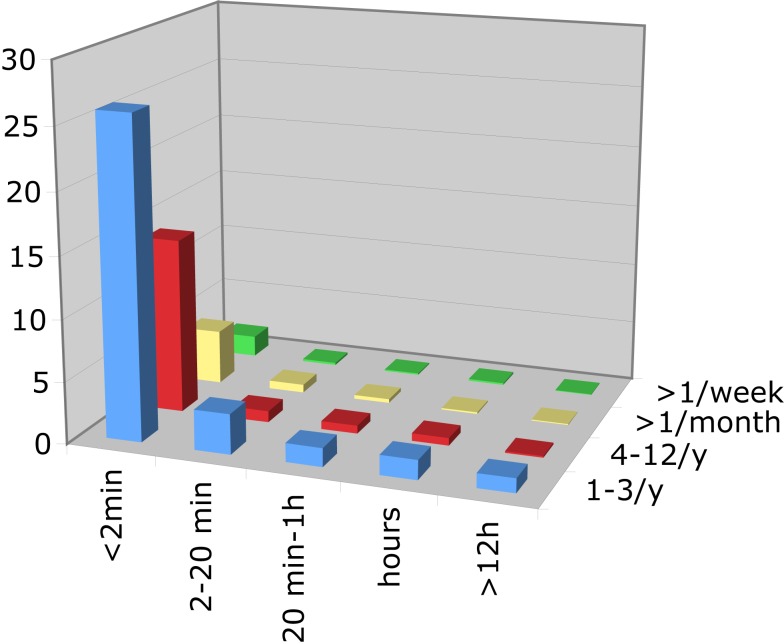
Vertigo, dizziness, and unsteadiness (VDU) are common symptoms traditionally considered to result from different kinds of vestibular and non-vestibular dysfunctions. The epidemiology of each symptom and how they relate to each other and to migraine, agoraphobia, motion sickness susceptibility (MSS), vaso-vagal episodes (VVE), and anxiety-depression was the object of this population-based study in north-eastern France. A self-administered questionnaire was returned by 2987 adults (age span 18-86 years, 1471 women). The 1-year prevalence for vertigo was 48.3%, for unsteadiness 39.1%, and for dizziness 35.6%. The three symptoms were correlated with each other, occurred mostly (69.4%) in various combinations rather than in isolation, less than once per month, and 90% of episodes lasted ≤2 min. The three symptoms were similar in terms of female predominance, temporary profile of the episodes, and their link to falls and nausea. Symptom episodes of >1 h increase the risk of falls. VDU are much more common than the known prevalence of vestibular disorders. The number of drugs taken increase VDU even when controlling for age. Each VDU symptom was correlated with each co-morbidity in Chi-squared tests. The data suggest that the three symptoms are more likely to represent a spectrum resulting from a range of similar - rather than from different, unrelated - mechanisms or disorders. Logistic regressions controlling for each vestibular symptom showed that vertigo correlated with each co-morbidity but dizziness and unsteadiness did not, suggesting that vertigo is certainly not a more specific symptom than the other two. A logistic regression using a composite score of VDU, controlling for each co-morbidity showed a correlation of VDU to migraine and VVE but not to MSS and not to agoraphobia in men, only in women.
眩晕、头晕和不稳(VDU)是常见的症状,传统上被认为是由不同类型的前庭和非前庭功能障碍引起的。本基于人群的研究在法国东北部对每种症状的流行病学及其与偏头痛、广场恐惧症、运动病易感性(MSS)、血管迷走性发作(VVE)和焦虑抑郁的关系进行了研究。研究人员对 2987 名年龄在 18-86 岁之间的成年人(1471 名女性)进行了一项自我管理的问卷调查。眩晕的 1 年患病率为 48.3%,不稳为 39.1%,头晕为 35.6%。这三种症状相互关联,大多以各种组合而不是单独出现(69.4%),每月少于一次,90%的发作持续时间≤2 分钟。这三种症状在女性患病率较高、发作的暂时性特征以及与跌倒和恶心的关系方面相似。发作持续时间>1 小时会增加跌倒的风险。VDU 比已知的前庭障碍患病率更为常见。即使在控制年龄的情况下,服用的药物数量也会增加 VDU。在卡方检验中,每种 VDU 症状都与其他合并症相关。这些数据表明,这三种症状更可能代表一系列相似机制或疾病引起的频谱,而不是不同的、不相关的机制或疾病。在控制每个前庭症状的情况下进行逻辑回归显示,眩晕与每种合并症相关,但头晕和不稳没有,这表明眩晕肯定不是比其他两种更具特异性的症状。在使用控制每个合并症的 VDU 综合评分的逻辑回归中,在男性中仅在女性中,VDU 与偏头痛和 VVE 相关,但与 MSS 和广场恐惧症不相关。