Theoretical Neuroscience Group, Faculté de Médecine, Institut de Neurosciences des Systèmes, Inserm UMR1106, Aix-Marseille Université Marseille, France ; Bernstein Center for Computational Neuroscience Berlin, Germany ; Department of Software Engineering and Theoretical Computer Science, Technische Universität Berlin Berlin, Germany.
Front Comput Neurosci. 2013 Mar 26;7:20. doi: 10.3389/fncom.2013.00020. eCollection 2013.
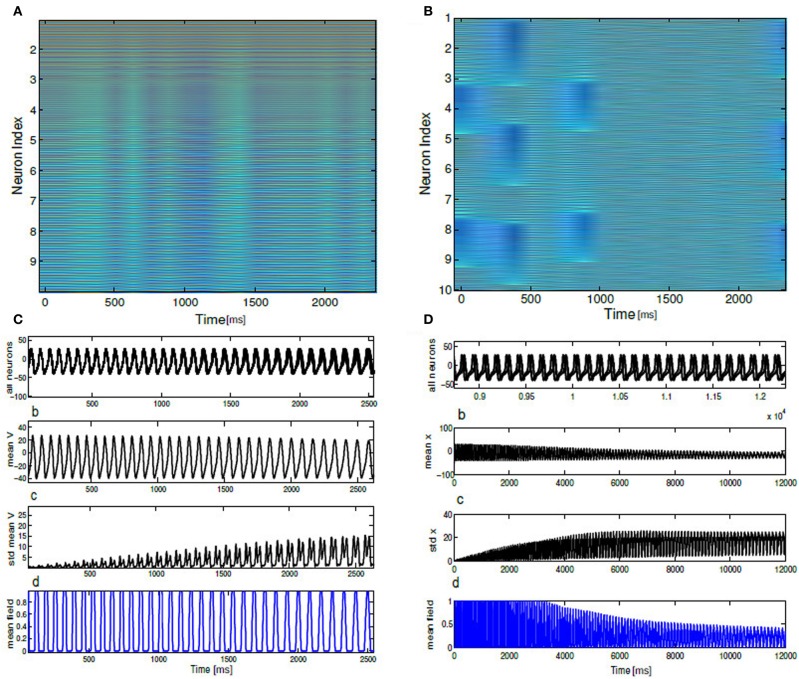
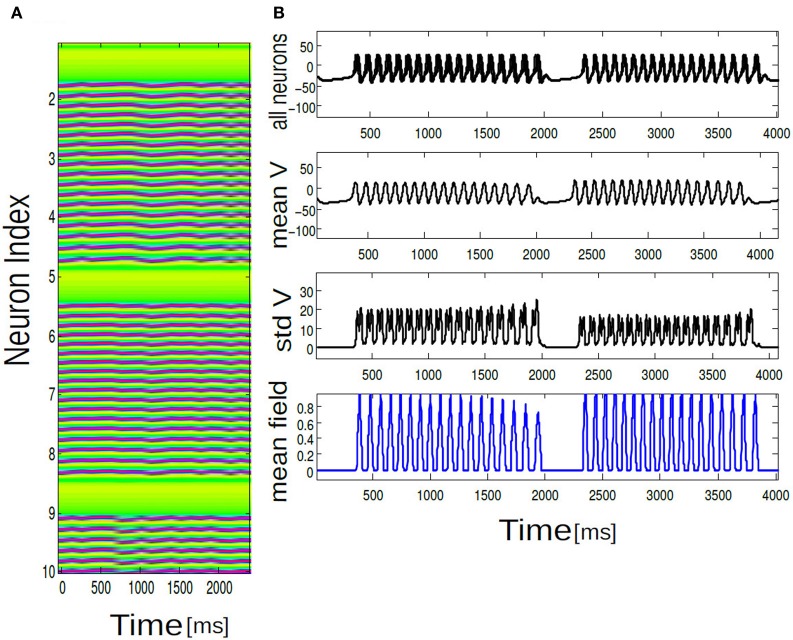
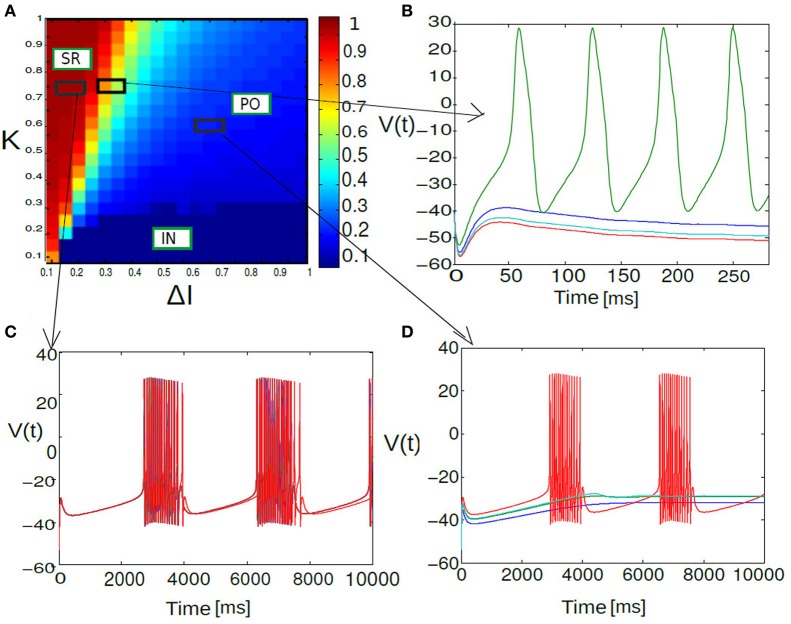
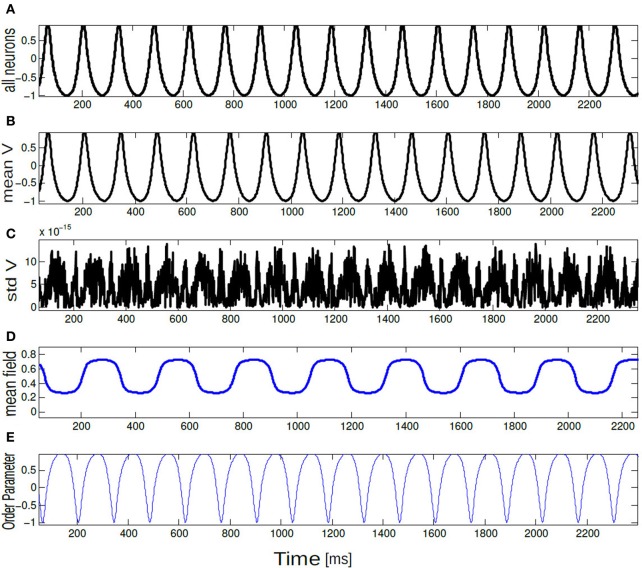
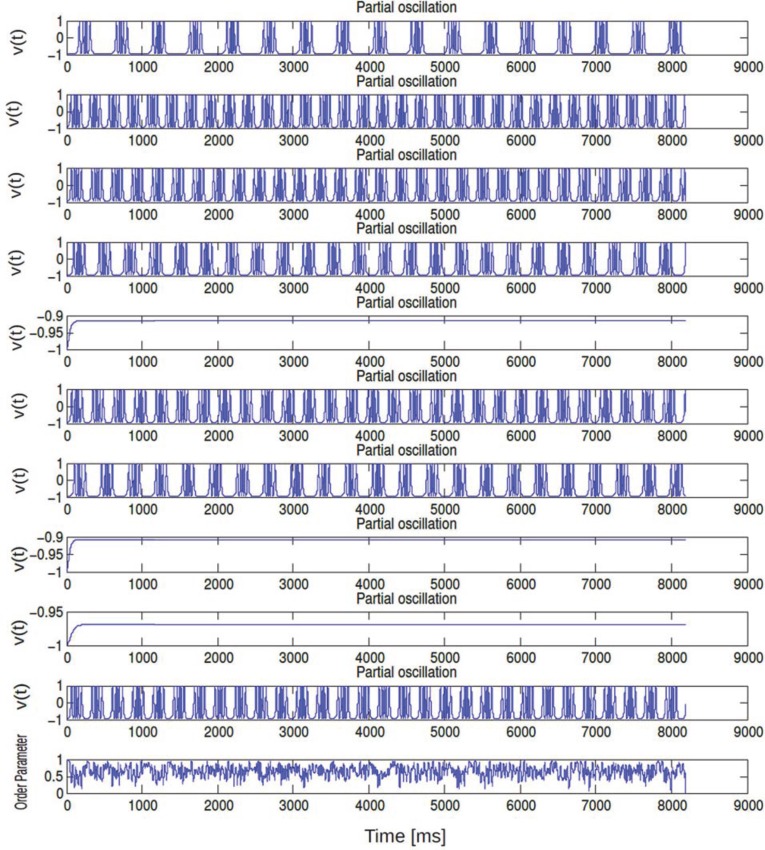
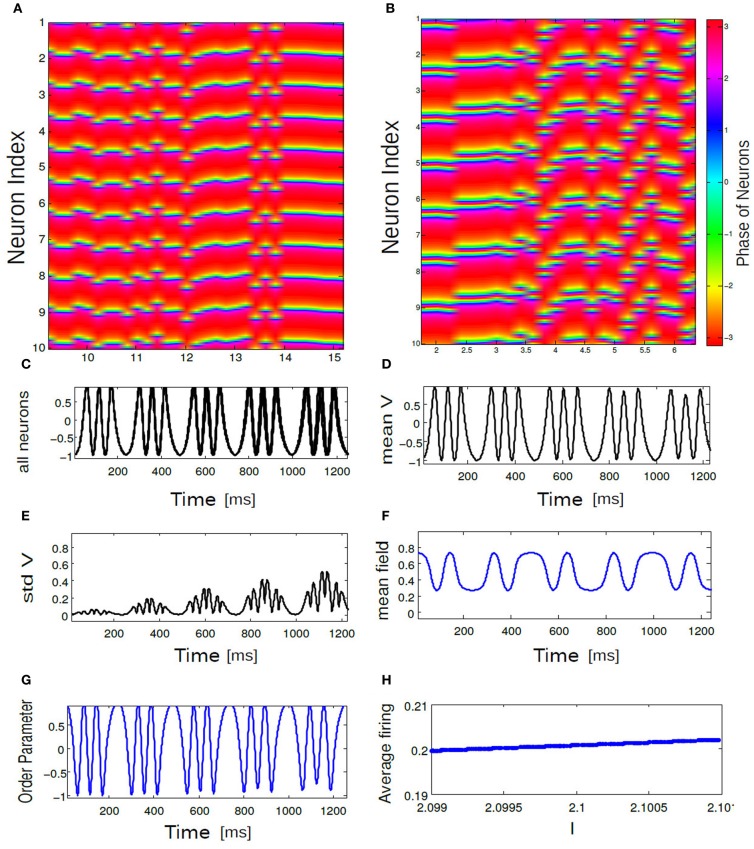
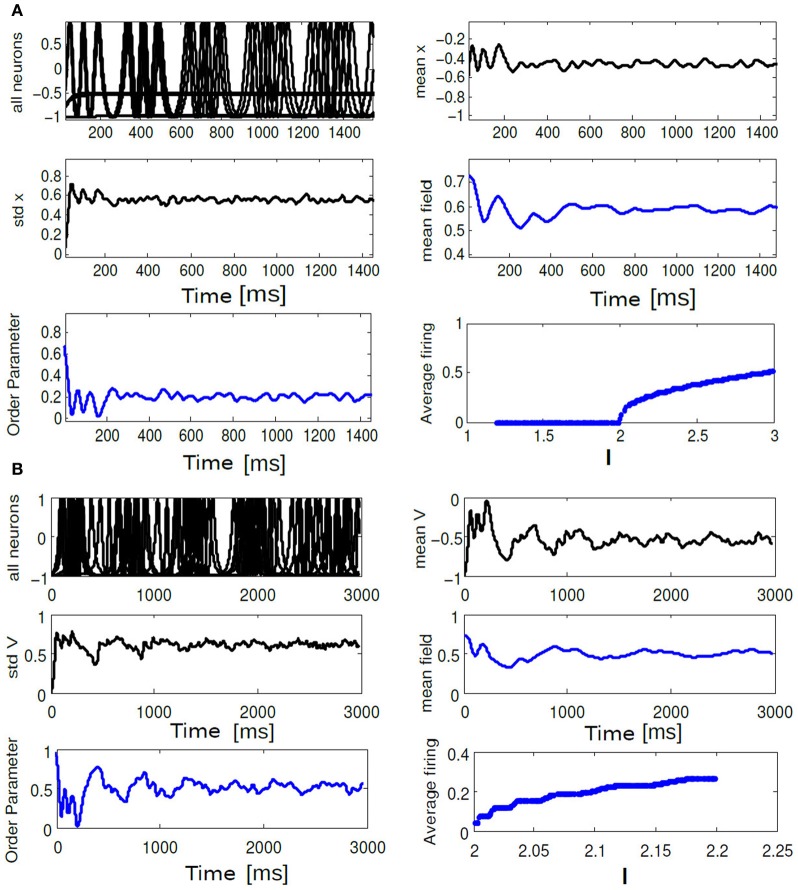
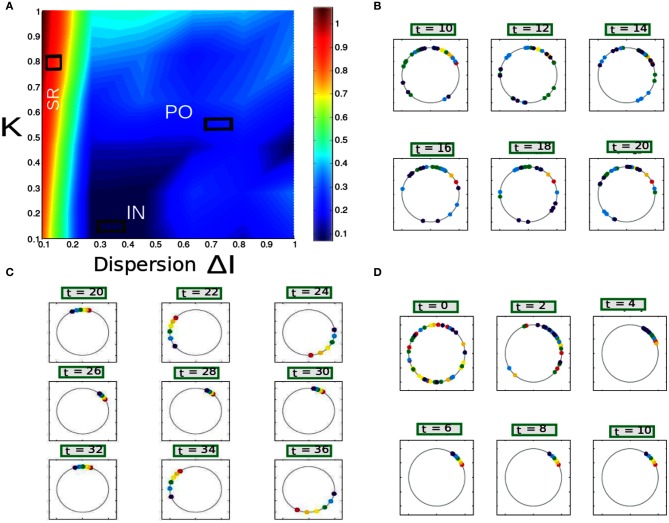
Computational models at different space-time scales allow us to understand the fundamental mechanisms that govern neural processes and relate uniquely these processes to neuroscience data. In this work, we propose a novel neurocomputational unit (a mesoscopic model which tell us about the interaction between local cortical nodes in a large scale neural mass model) of bursters that qualitatively captures the complex dynamics exhibited by a full network of parabolic bursting neurons. We observe that the temporal dynamics and fluctuation of mean synaptic action term exhibits a high degree of correlation with the spike/burst activity of our population. With heterogeneity in the applied drive and mean synaptic coupling derived from fast excitatory synapse approximations we observe long term behavior in our population dynamics such as partial oscillations, incoherence, and synchrony. In order to understand the origin of multistability at the population level as a function of mean synaptic coupling and heterogeneity in the firing rate threshold we employ a simple generative model for parabolic bursting recently proposed by Ghosh et al. (2009). Further, we use here a mean coupling formulated for fast spiking neurons for our analysis of generic model. Stability analysis of this mean field network allow us to identify all the relevant network states found in the detailed biophysical model. We derive here analytically several boundary solutions, a result which holds for any number of spikes per burst. These findings illustrate the role of oscillations occurring at slow time scales (bursts) on the global behavior of the network.
在不同时空尺度上的计算模型使我们能够理解控制神经过程的基本机制,并将这些过程与神经科学数据独特地联系起来。在这项工作中,我们提出了一种新的神经计算单元(一种介观模型,它告诉我们在大规模神经质量模型中局部皮质节点之间的相互作用),该模型定性地捕捉了由完整的抛物爆发神经元网络表现出的复杂动力学。我们观察到,时间动态和平均突触作用项的波动与我们的群体的尖峰/爆发活动高度相关。通过应用驱动和源自快速兴奋性突触近似的平均突触耦合的异质性,我们观察到我们的群体动力学中的长期行为,例如部分振荡、非相干性和同步性。为了理解群体水平的多稳定性的起源作为平均突触耦合和发射率阈值的异质性的函数,我们使用 Ghosh 等人最近提出的(2009 年)的一个简单的抛物爆发生成模型。此外,我们在这里使用快速放电神经元的平均耦合来分析通用模型。这个平均场网络的稳定性分析允许我们识别出在详细的生物物理模型中发现的所有相关的网络状态。我们在这里推导出几个边界解,这一结果适用于每爆发的任意数量的尖峰。这些发现说明了在慢时间尺度(爆发)上发生的振荡对网络的全局行为的作用。