Department of Epidemiology and Public Health, University College London, London WC1E 6BT, UK.
Psychosom Med. 2013 Apr;75(3):311-6. doi: 10.1097/PSY.0b013e3182898e6d. Epub 2013 Mar 26.
The purpose of this study was to test whether lower socioeconomic status (SES) augments the effect of psychological distress on mortality from stroke or coronary heart disease (CHD).
We prospectively linked data from 66,500 participants 35 years or older in the Health Survey for England, selected using stratified random sampling from 1994 to 2004, and free of cardiovascular disease and cancer at baseline, with mortality records. The median follow-up time was 7.9 years. SES was indexed by occupational class, and psychological distress was assessed using the 12-item General Health Questionnaire (GHQ-12).
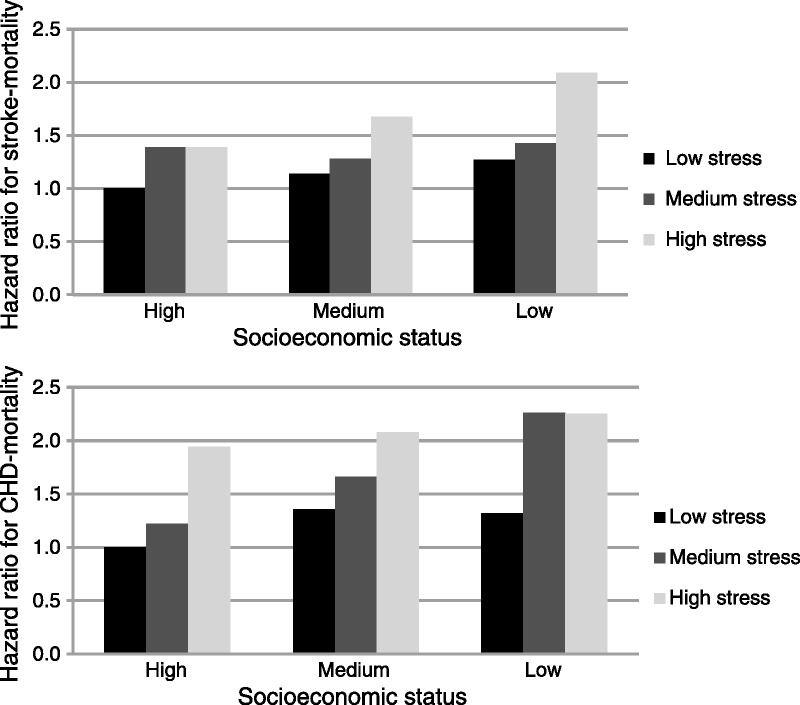
After adjustment for demographic and clinical variables, both psychological distress and low SES were associated with increased mortality: the hazard ratios (HR) for one-category increase in low SES (three categories in total) were 1.15 for stroke-death (95% confidence interval [CI] = 1.00-1.31, p = .043) and 1.24 for CHD-death (95% CI = 1.09-1.41, p = .001); the HR for one-category increase in GHQ-12 (three categories in total) was 1.18 for stroke-death (95% CI = 1.07-1.30, p = .001) and 1.24 for CHD-death (95% CI = 1.13-1.36, p < .001). In stratified analyses, the strongest associations were found in the lowest SES categories: the HR for GHQ-12 toward stroke-death was 1.15 in high-SES participants (95% CI = 0.97-1.37, p = .107) and 1.31 in low-SES ones (95% CI = 1.13-1.51, p < .001); the HR for GHQ-12 toward CHD-death was 1.10 in high-SES participants (95% CI = 0.97-1.25, p = .129) and 1.33 in low-SES ones (95% CI = 1.19-1.48, p < .001).
People in low socioeconomic circumstances are more vulnerable to the adverse effect of psychological distress. This pattern should be taken into account when evaluating the association between psychosocial variables and health outcomes.
本研究旨在检验社会经济地位(SES)较低是否会增强心理困扰对中风或冠心病(CHD)死亡的影响。
我们前瞻性地将 1994 年至 2004 年期间从英格兰健康调查中选择的 66500 名 35 岁及以上的参与者的数据与死亡率记录相关联,这些参与者无心血管疾病和癌症,采用分层随机抽样。中位随访时间为 7.9 年。SES 由职业类别指数表示,心理困扰采用 12 项一般健康问卷(GHQ-12)评估。
在调整人口统计学和临床变量后,心理困扰和低 SES 均与死亡率增加相关:低 SES(共三个类别)增加一个类别的风险比(HR)分别为中风死亡(1.15;95%置信区间[CI]:1.00-1.31,p=0.043)和 CHD 死亡(1.24;95% CI:1.09-1.41,p=0.001);GHQ-12 增加一个类别的 HR 分别为中风死亡(1.18;95% CI:1.07-1.30,p=0.001)和 CHD 死亡(1.24;95% CI:1.13-1.36,p<0.001)。在分层分析中,在最低 SES 类别中发现了最强的关联:GHQ-12 与中风死亡的 HR 分别为高 SES 组的 1.15(95% CI:0.97-1.37,p=0.107)和低 SES 组的 1.31(95% CI:1.13-1.51,p<0.001);GHQ-12 与 CHD 死亡的 HR 分别为高 SES 组的 1.10(95% CI:0.97-1.25,p=0.129)和低 SES 组的 1.33(95% CI:1.19-1.48,p<0.001)。
社会经济地位较低的人更容易受到心理困扰的不利影响。在评估心理社会变量与健康结果之间的关联时,应考虑到这种模式。