Faculty of Life Sciences, University of Manchester, Manchester, United Kingdom.
PLoS One. 2013;8(3):e59590. doi: 10.1371/journal.pone.0059590. Epub 2013 Mar 22.
The BAG6 protein is a subunit of a heterotrimeric complex that binds a range of membrane and secretory protein precursors localized to the cytosol, enforcing quality control and influencing their subsequent fate.
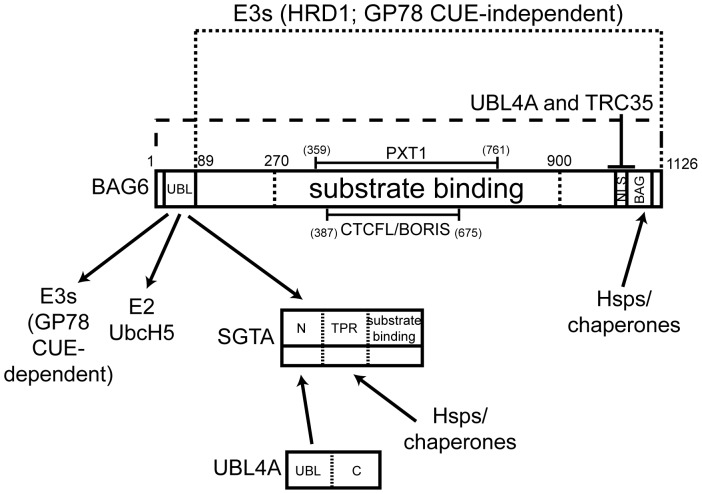
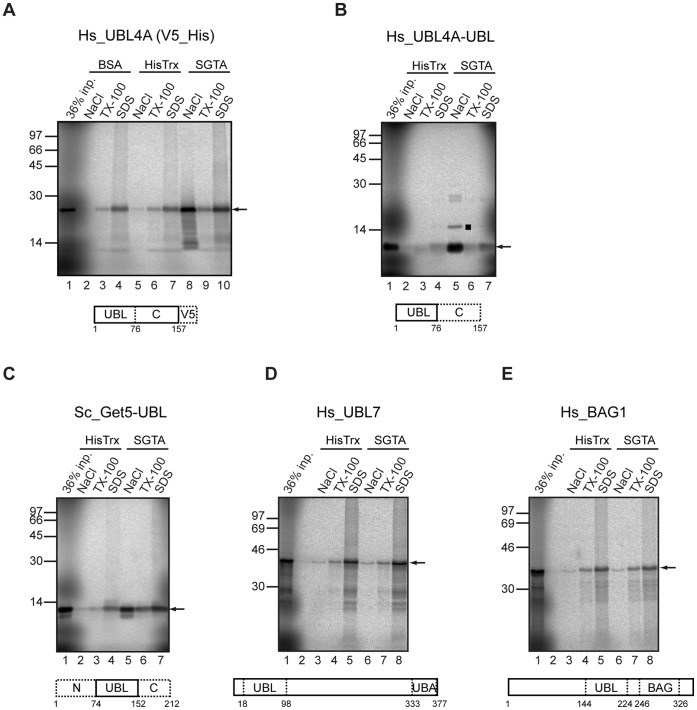
BAG6 has an N-terminal ubiquitin-like domain, and a C-terminal Bcl-2-associated athanogene domain, separated by a large central proline-rich region. We have used in vitro binding approaches to identify regions of BAG6 important for its interactions with: i) the small-glutamine rich tetratricopeptide repeat-containing protein alpha (SGTA) and ii) two model tail-anchored membrane proteins as a paradigm for its hydrophobic substrates. We show that the BAG6-UBL is essential for binding to SGTA, and find that the UBL of a second subunit of the BAG6-complex, ubiquitin-like protein 4A (UBL4A), competes for SGTA binding. Our data show that this binding is selective, and suggest that SGTA can bind either BAG6, or UBL4A, but not both at the same time. We adapted our in vitro binding assay to study the association of BAG6 with an immobilized tail-anchored protein, Sec61β, and find both the UBL and BAG domains are dispensable for binding this substrate. This conclusion was further supported using a heterologous subcellular localization assay in yeast, where the BAG6-dependent nuclear relocalization of a second tail-anchored protein, GFP-Sed5, also required neither the UBL, nor the BAG domain of BAG6.
On the basis of these findings, we propose a working model where the large central region of the BAG6 protein provides a binding site for a diverse group of substrates, many of which expose a hydrophobic stretch of polypeptide. This arrangement would enable the BAG6 complex to bring together its substrates with potential effectors including those recruited via its N-terminal UBL. Such effectors may include SGTA, and the resulting assemblies influence the subsequent fate of the hydrophobic BAG6 substrates.
BAG6 蛋白是一种异三聚体复合物的亚基,该复合物结合了一系列定位于细胞质的膜和分泌蛋白前体,执行质量控制并影响其后续命运。
BAG6 具有 N 端泛素样结构域和 C 端 Bcl-2 相关的athanogene 结构域,中间由富含脯氨酸的大区域隔开。我们使用体外结合方法来鉴定 BAG6 与其相互作用的重要区域:i)富含小谷氨酰胺的四肽重复蛋白 α(SGTA)和 ii)两种模型尾部锚定的膜蛋白,作为其疏水底物的范例。我们表明 BAG6-UBL 对于与 SGTA 结合是必不可少的,并且发现 BAG6 复合物的第二个亚基泛素样蛋白 4A(UBL4A)的 UBL 竞争与 SGTA 结合。我们的数据表明这种结合是选择性的,并且表明 SGTA 可以与 BAG6 或 UBL4A 结合,但不能同时与两者结合。我们改编了我们的体外结合测定法来研究 BAG6 与固定化尾部锚定蛋白 Sec61β 的结合,并且发现 UBL 和 BAG 结构域对于结合该底物都是可有可无的。这一结论进一步得到了在酵母中使用异源亚细胞定位测定法的支持,其中第二个尾部锚定蛋白 GFP-Sed5 的 BAG6 依赖性核再定位也不需要 BAG6 的 UBL 或 BAG 结构域。
基于这些发现,我们提出了一个工作模型,其中 BAG6 蛋白的大中央区域为一组不同的底物提供了一个结合位点,其中许多底物暴露了一个疏水多肽延伸。这种排列方式将使 BAG6 复合物能够将其底物与潜在的效应物聚集在一起,包括通过其 N 端 UBL 招募的那些。这种效应物可能包括 SGTA,而由此产生的组装影响疏水 BAG6 底物的后续命运。