Department of Sleep Medicine, University of Giessen Lung Center, Klinikstrasse 33, 35392 Giessen, Germany.
Oxid Med Cell Longev. 2013;2013:234631. doi: 10.1155/2013/234631. Epub 2013 Mar 3.
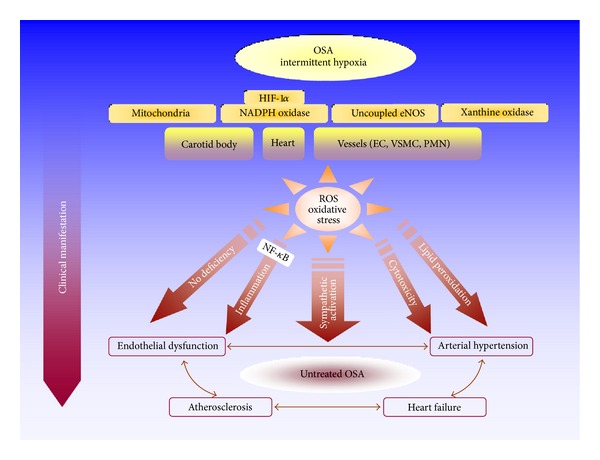
Obstructive sleep apnea (OSA) is an independent risk factor for cardiovascular (CV) diseases such as arterial hypertension, heart failure, and stroke. Based on human research, sympathetic activation, inflammation, and oxidative stress are thought to play major roles in the pathophysiology of OSA-related CV diseases. Animal models of OSA have shown that endothelial dysfunction, vascular remodelling, and systemic and pulmonary arterial hypertension as well as heart failure can develop in response to chronic intermittent hypoxia (CIH). The available animal data are clearly in favour of oxidative stress playing a key role in the development of all of these CV manifestations of OSA. Presumably, the oxidative stress is due to an activation of NADPH oxidase and other free oxygen radicals producing enzymes within the CV system as evidenced by data from knockout mice and pharmacological interventions. It is hoped that animal models of OSA-related CV disease will continue to contribute to a deeper understanding of their underlying pathophysiology and will foster the way for the development of cardioprotective treatment options other than conventional CPAP therapy.
阻塞性睡眠呼吸暂停(OSA)是心血管(CV)疾病的独立危险因素,如动脉高血压、心力衰竭和中风。基于人类研究,交感神经激活、炎症和氧化应激被认为在 OSA 相关 CV 疾病的病理生理学中起主要作用。OSA 的动物模型表明,内皮功能障碍、血管重塑以及全身和肺动脉高血压以及心力衰竭可能会因慢性间歇性低氧(CIH)而发展。现有的动物数据清楚地表明,氧化应激在所有这些 OSA 的 CV 表现的发展中起关键作用。据推测,氧化应激是由于 CV 系统内 NADPH 氧化酶和其他产生自由基的酶的激活所致,这一点有来自基因敲除小鼠和药物干预的数据为证。人们希望 OSA 相关 CV 疾病的动物模型将继续有助于更深入地了解其潜在的病理生理学,并为开发除传统 CPAP 治疗以外的心脏保护治疗选择铺平道路。