Lam Y W Francis
Department of Pharmacology, School of Medicine, University of Texas Health Science Center San Antonio, 7703 Floyd Curl Drive, San Antonio, TX 78229-3900, USA.
ISRN Pharmacol. 2013;2013:641089. doi: 10.1155/2013/641089. Epub 2013 Feb 28.
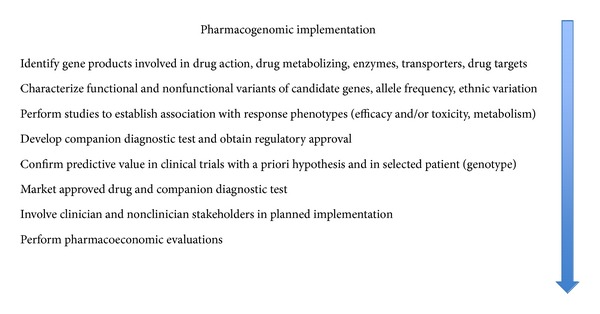
The mapping of the human genome and subsequent advancements in genetic technology had provided clinicians and scientists an understanding of the genetic basis of altered drug pharmacokinetics and pharmacodynamics, as well as some examples of applying genomic data in clinical practice. This has raised the public expectation that predicting patients' responses to drug therapy is now possible in every therapeutic area, and personalized drug therapy would come sooner than later. However, debate continues among most stakeholders involved in drug development and clinical decision-making on whether pharmacogenomic biomarkers should be used in patient assessment, as well as when and in whom to use the biomarker-based diagnostic tests. Currently, most would agree that achieving the goal of personalized therapy remains years, if not decades, away. Realistic application of genomic findings and technologies in clinical practice and drug development require addressing multiple logistics and challenges that go beyond discovery of gene variants and/or completion of prospective controlled clinical trials. The goal of personalized medicine can only be achieved when all stakeholders in the field work together, with willingness to accept occasional paradigm change in their current approach.
人类基因组图谱绘制以及随后基因技术的进步,使临床医生和科学家了解到药物药代动力学和药效学改变的遗传基础,以及在临床实践中应用基因组数据的一些实例。这提高了公众的期望,即现在在每个治疗领域预测患者对药物治疗的反应都是可能的,个性化药物治疗将指日可待。然而,参与药物开发和临床决策的大多数利益相关者仍在争论是否应在患者评估中使用药物基因组生物标志物,以及何时以及对谁使用基于生物标志物的诊断测试。目前,大多数人都认为,实现个性化治疗的目标即使不是几十年,也仍需数年时间。基因组研究结果和技术在临床实践和药物开发中的实际应用需要解决多个后勤问题和挑战,这些问题和挑战不仅仅局限于基因变异的发现和/或前瞻性对照临床试验的完成。只有当该领域的所有利益相关者共同努力,并愿意偶尔接受其当前方法中的范式转变时,个性化医疗的目标才能实现。