Department of Biotechnological and Applied Clinical Sciences, University of L'Aquila, 67100 L'Aquila, Italy.
Biomed Res Int. 2013;2013:187204. doi: 10.1155/2013/187204. Epub 2012 Dec 30.
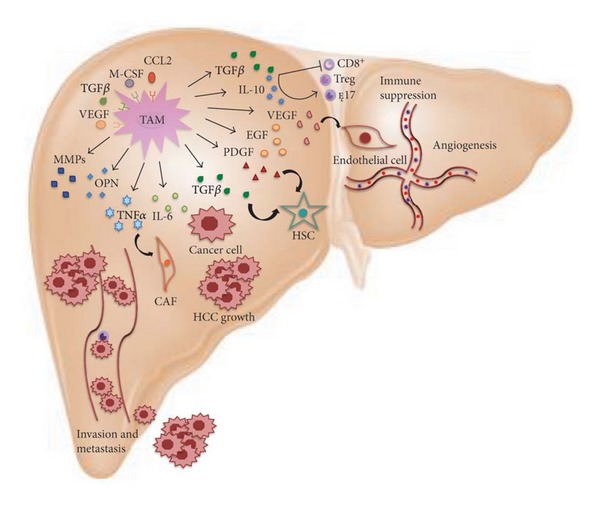
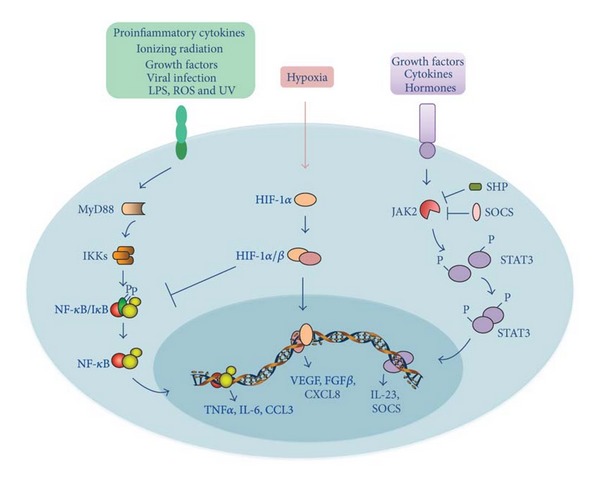
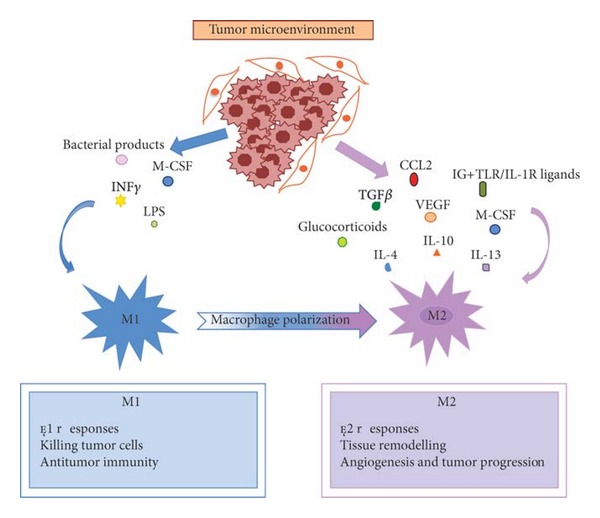
Hepatocellular carcinoma (HCC) is one of the most common and aggressive human cancers worldwide. HCC is an example of inflammation-related cancer and represents a paradigm of the relation occurring between tumor microenvironment and tumor development. Tumor-associated macrophages (TAMs) are a major component of leukocyte infiltrate of tumors and play a pivotal role in tumor progression of inflammation-related cancer, including HCC. Several studies indicate that, in the tumor microenvironment, TAMs acquire an M2-polarized phenotype and promote angiogenesis, metastasis, and suppression of adaptive immunity through the expression of cytokines, chemokines, growth factors, and matrix metalloproteases. Indeed, an established M2 macrophage population has been associated with poor prognosis in HCC. The molecular links that connect cancer cells and TAMs are not completely known, but recent studies have demonstrated that NF-κB, STAT-3, and HIF-1 signaling pathways play key roles in this crosstalk. In this paper, we discuss the current knowledge about the role of TAMs in HCC development, highlighting the role of TAM-derived cytokines, chemokines, and growth factors in the initiation and progression of liver cancer and outlining the signaling pathways involved in the interplay between cancer cells and TAMs.
肝细胞癌(HCC)是全球最常见和侵袭性最强的人类癌症之一。HCC 是炎症相关癌症的一个例子,代表了肿瘤微环境与肿瘤发展之间发生的关系的范例。肿瘤相关巨噬细胞(TAMs)是肿瘤白细胞浸润的主要组成部分,在炎症相关癌症(包括 HCC)的肿瘤进展中发挥着关键作用。几项研究表明,在肿瘤微环境中,TAMs 获得 M2 极化表型,并通过表达细胞因子、趋化因子、生长因子和基质金属蛋白酶促进血管生成、转移和适应性免疫抑制。事实上,已确定的 M2 巨噬细胞群体与 HCC 的预后不良有关。连接癌细胞和 TAMs 的分子联系尚不完全清楚,但最近的研究表明,NF-κB、STAT-3 和 HIF-1 信号通路在这种串扰中发挥关键作用。在本文中,我们讨论了 TAMs 在 HCC 发展中的作用的现有知识,强调了 TAM 衍生的细胞因子、趋化因子和生长因子在肝癌的发生和进展中的作用,并概述了涉及癌细胞和 TAMs 相互作用的信号通路。