Radboud Expertise Centre for Q fever, Department of Internal Medicine, Division of Infectious Diseases, Radboud University Nijmegen Medical Centre, P.O. Box 9101, 6500 HB, Nijmegen, The Netherlands.
BMC Infect Dis. 2013 Mar 27;13:157. doi: 10.1186/1471-2334-13-157.
Q fever is a zoonosis that is present in many countries. Q fever fatigue syndrome (QFS) is one of the most frequent sequelae after an acute Q fever infection. QFS is characterized by persistent fatigue following an acute Q fever infection, leading to substantial morbidity and a high socio-economic burden. The occurrence of QFS is well-documented, and has been described in many countries over the past decades. However, a treatment with proven efficacy is not available. Only a few uncontrolled studies have tested the efficacy of treatment with antibiotics on QFS. These studies suggest a positive effect of long-term treatment with a tetracycline on performance state; however, no randomized controlled trials have been performed. Cognitive behavioral therapy (CBT) has been proven to be an effective treatment modality for chronic fatigue in other diseases, but has not yet been tested in QFS. Therefore, we designed a trial to assess the efficacy of long-term treatment with the tetracycline doxycycline and CBT in patients with QFS.
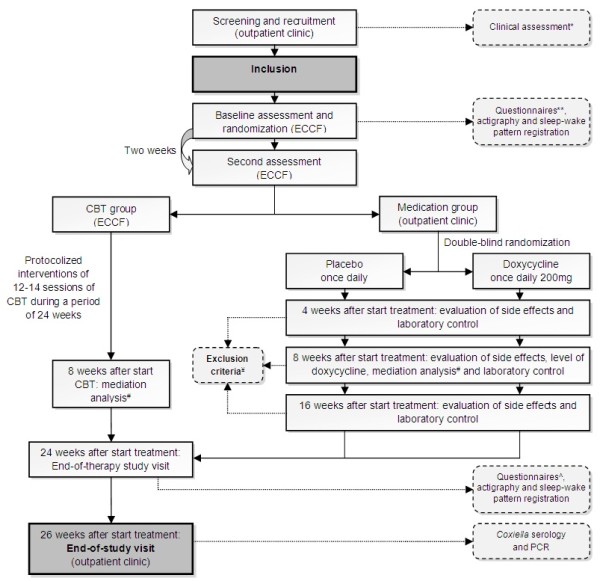
METHODS/DESIGN: A randomized placebo-controlled trial will be conducted. One-hundred-eighty adult patients diagnosed with QFS will be recruited and randomized between one of three groups: CBT, long-term doxycycline or placebo. First, participants will be randomized between CBT and medication (ratio 1:2). A second double-blinded randomization between doxycycline and placebo (ratio 1:1) will be performed in the medication condition. Each group will be treated for six months. Outcome measures will be assessed at baseline and post intervention. The primary outcome measure is fatigue severity. Secondary outcome measures are functional impairment, level of psychological distress, and Coxiella burnetii PCR and serology.
The Qure study is the first randomized placebo-controlled trial, which evaluates the efficacy of long-term doxycycline and of cognitive behavioral therapy in patients with QFS. The results of this study will provide knowledge about evidence-based treatment options for adult patients with QFS.
ClinicalTrials.gov: NCT01318356, and Netherlands Trial Register: NTR2797.
Q 热是一种存在于许多国家的动物传染病。Q 热疲劳综合征(QFS)是急性 Q 热感染后的最常见后遗症之一。QFS 的特征是在急性 Q 热感染后持续疲劳,导致发病率高和高社会经济负担。QFS 的发生已有充分的记录,并在过去几十年中在许多国家都有描述。然而,目前尚无有效的治疗方法。只有少数非对照研究测试了抗生素治疗 QFS 的疗效。这些研究表明,长期使用四环素治疗对表现状态有积极影响;然而,尚未进行随机对照试验。认知行为疗法(CBT)已被证明是治疗其他疾病慢性疲劳的有效治疗方法,但尚未在 QFS 中进行测试。因此,我们设计了一项试验,以评估长期使用四环素多西环素和认知行为疗法治疗 QFS 患者的疗效。
方法/设计:将进行一项随机安慰剂对照试验。将招募 180 名被诊断患有 QFS 的成年患者,并将其随机分为三组:CBT、长期多西环素或安慰剂。首先,参与者将在 CBT 和药物治疗之间进行随机分组(比例 1:2)。在药物治疗条件下,将进行第二次双盲多西环素和安慰剂之间的随机分组(比例 1:1)。每组将接受六个月的治疗。在基线和干预后评估结果测量。主要结果测量是疲劳严重程度。次要结果测量是功能障碍、心理困扰程度以及柯克斯体伯氏菌 PCR 和血清学。
Qure 研究是第一项评估长期多西环素和认知行为疗法治疗 QFS 患者疗效的随机安慰剂对照试验。该研究的结果将为成人 QFS 患者提供循证治疗选择的知识。
ClinicalTrials.gov:NCT01318356,和荷兰试验注册处:NTR2797。