Afonseca Samuel Oliveira de, Cruz Felipe Melo, Cubero Daniel de Iracema Gomes, Lera Andrea Thaumaturgo, Schindler Fernanda, Okawara Marcia, Souza Luiz Fernando de, Rodrigues Nataly Pimentel, Giglio Auro del
Department of Hematology and Oncology, Faculdade de Medicina do ABC, Fundação ABC, Santo André, São Paulo, Brazil.
Sao Paulo Med J. 2013;131(1):35-8. doi: 10.1590/s1516-31802013000100006.
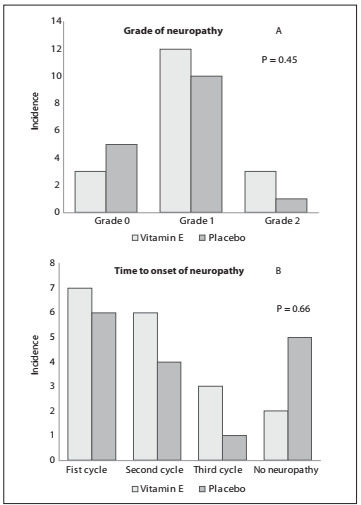
CONTEXT AND OBJECTIVE Oxaliplatin is one of the chemotherapy regimens most used for treating colorectal cancer. One of the main limitations to its use is induction of peripheral neuropathy. Previous studies have shown that vitamin E can reduce the incidence of peripheral neuropathy by 50%. This study aimed to assess the effectiveness of vitamin E for prevention of oxaliplatin-induced peripheral neuropathy. DESIGN AND SETTING Prospective, phase II, randomized pilot study developed at a university hospital in the Greater ABC region. METHODS Patients were randomized five days before starting oxaliplatin treatment, to receive either vitamin E or placebo until the end of the chemotherapy regimen. The outcome was evaluated using the Common Terminology Criteria for Adverse Events (CTCAE), version 3, and specific gradation scales for oxaliplatin-induced peripheral neuropathy. Patients with colorectal and gastric cancer who had been scheduled to receive oxaliplatin-based chemotherapy were included. Both groups received calcium and magnesium supplementation before and after oxaliplatin infusions. RESULTS Eighteen patients were randomized to the vitamin E group and 16 to the placebo group. Cumulative incidence of 83% with peripheral neuropathy grades 1/2 was observed in the vitamin E group, versus 68% in the placebo group (P = 0.45). A trend towards more diarrhea was observed among patients who received vitamin E (55.6% vs. 18.8%; P = 0.06). There were no other significant differences in toxicity between the groups. CONCLUSIONS No significant decrease in the incidence of acute oxaliplatin-induced peripheral neuropathy was demonstrated through vitamin E use.
奥沙利铂是治疗结直肠癌最常用的化疗方案之一。其使用的主要局限性之一是会诱发周围神经病变。既往研究表明,维生素E可使周围神经病变的发生率降低50%。本研究旨在评估维生素E预防奥沙利铂诱发周围神经病变的有效性。
在大ABC地区的一家大学医院开展的前瞻性、II期、随机对照试验性研究。
在开始奥沙利铂治疗前5天,将患者随机分组,分别给予维生素E或安慰剂,直至化疗方案结束。采用不良事件通用术语标准(CTCAE)第3版及奥沙利铂诱发周围神经病变的特定分级量表评估结果。纳入计划接受以奥沙利铂为基础的化疗的结直肠癌和胃癌患者。两组在奥沙利铂输注前后均补充钙和镁。
18例患者被随机分入维生素E组,16例分入安慰剂组。维生素E组1/2级周围神经病变的累积发生率为83%,安慰剂组为68%(P = 0.45)。接受维生素E治疗的患者中腹泻较多的趋势较为明显(55.6%对18.8%;P = 0.06)。两组间在毒性方面无其他显著差异。
使用维生素E并未显著降低奥沙利铂诱发的急性周围神经病变的发生率。