London School of Hygiene & Tropical Medicine, London, United Kingdom.
PLoS Pathog. 2013 Mar;9(3):e1003260. doi: 10.1371/journal.ppat.1003260. Epub 2013 Mar 28.
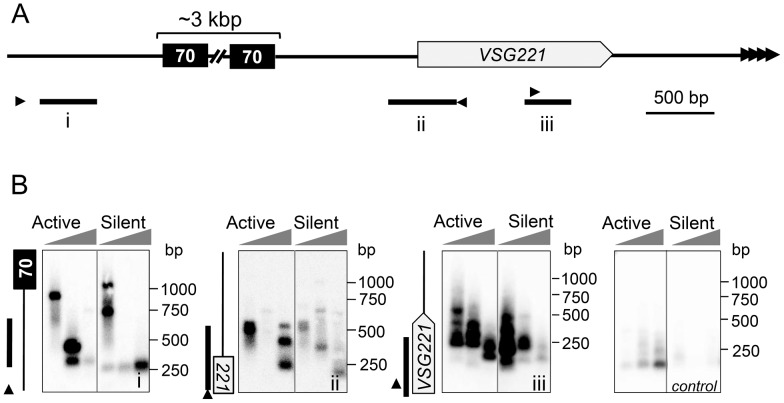
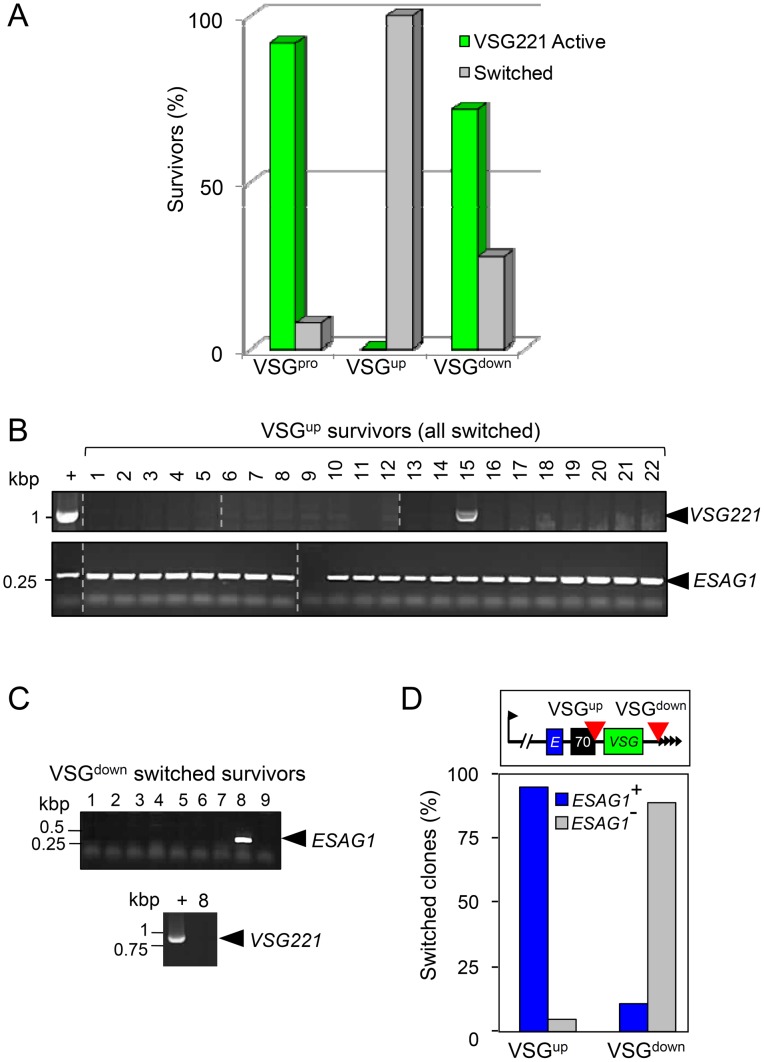
Antigenic variation in African trypanosomes requires monoallelic transcription and switching of variant surface glycoprotein (VSG) genes. The transcribed VSG, always flanked by '70 bp'-repeats and telomeric-repeats, is either replaced through DNA double-strand break (DSB) repair or transcriptionally inactivated. However, little is known about the subtelomeric DSBs that naturally trigger antigenic variation in Trypanosoma brucei, the subsequent DNA damage responses, or how these responses determine the mechanism of VSG switching. We found that DSBs naturally accumulate close to both transcribed and non-transcribed telomeres. We then induced high-efficiency meganuclease-mediated DSBs and monitored DSB-responses and DSB-survivors. By inducing breaks at distinct sites within both transcribed and silent VSG transcription units and assessing local DNA resection, histone modification, G2/M-checkpoint activation, and both RAD51-dependent and independent repair, we reveal how breaks at different sites trigger distinct responses and, in 'active-site' survivors, different switching mechanisms. At the active site, we find that promoter-adjacent breaks typically failed to trigger switching, 70 bp-repeat-adjacent breaks almost always triggered switching through 70 bp-repeat recombination (∼60% RAD51-dependent), and telomere-repeat-adjacent breaks triggered switching through loss of the VSG expression site (25% of survivors). Expression site loss was associated with G2/M-checkpoint bypass, while 70 bp-repeat-recombination was associated with DNA-resection, γH2A-focus assembly and a G2/M-checkpoint. Thus, the probability and mechanism of antigenic switching are highly dependent upon the location of the break. We conclude that 70 bp-repeat-adjacent and telomere-repeat-adjacent breaks trigger distinct checkpoint responses and VSG switching pathways. Our results show how subtelomere fragility can generate the triggers for the major antigenic variation mechanisms in the African trypanosome.
在非洲锥虫中,抗原变异需要单等位基因转录和变异表面糖蛋白(VSG)基因的转换。转录的 VSG 总是被“70bp”重复和端粒重复侧翼,要么通过 DNA 双链断裂(DSB)修复,要么通过转录失活来替代。然而,对于自然触发布氏锥虫抗原变异的亚端粒 DSB、随后的 DNA 损伤反应,或者这些反应如何决定 VSG 转换机制,人们知之甚少。我们发现 DSB 自然地聚集在转录和非转录的端粒附近。然后,我们诱导高效的 meganuclease 介导的 DSB,并监测 DSB 反应和 DSB 幸存者。通过在转录和沉默的 VSG 转录单元内的不同位点诱导断裂,并评估局部 DNA 切除、组蛋白修饰、G2/M 检查点激活以及 RAD51 依赖性和非依赖性修复,我们揭示了不同位点的断裂如何触发不同的反应,以及在“活性位点”幸存者中,不同的转换机制。在活性位点,我们发现靠近启动子的断裂通常不能触发转换,70bp 重复附近的断裂几乎总是通过 70bp 重复重组(约 60%RAD51 依赖性)触发转换,而端粒重复附近的断裂通过表达位点的 VSG 丢失触发转换(25%的幸存者)。表达位点的丢失与 G2/M 检查点旁路有关,而 70bp 重复重组与 DNA 切除、γH2A 焦点组装和 G2/M 检查点有关。因此,抗原转换的概率和机制高度依赖于断裂的位置。我们得出结论,70bp 重复相邻和端粒重复相邻的断裂触发不同的检查点反应和 VSG 转换途径。我们的结果表明,亚端粒的脆弱性如何产生非洲锥虫主要抗原变异机制的触发因素。