Department of Pathology, Johns Hopkins University School of Medicine, Baltimore, Maryland, United States of America.
PLoS Genet. 2013 Mar;9(3):e1003402. doi: 10.1371/journal.pgen.1003402. Epub 2013 Mar 28.
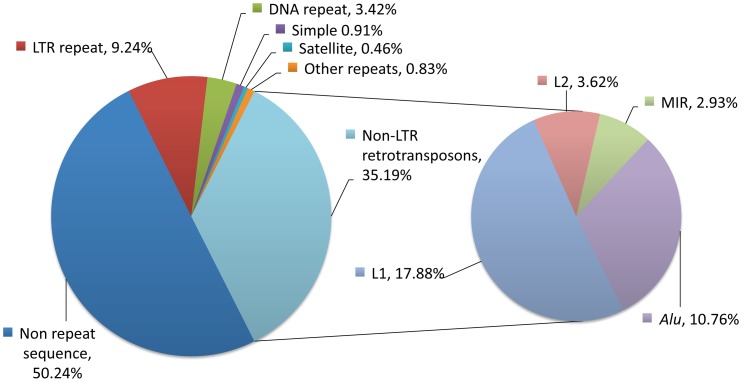
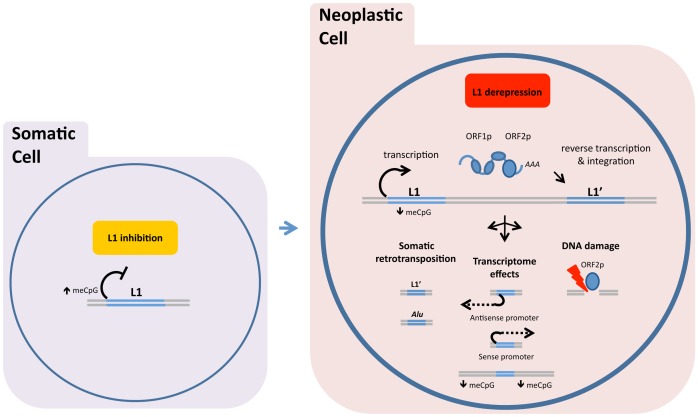
LINE-1 (L1) retrotransposons make up a significant portion of human genomes, with an estimated 500,000 copies per genome. Like other retrotransposons, L1 retrotransposons propagate through RNA sequences that are reverse transcribed into DNA sequences, which are integrated into new genomic loci. L1 somatic insertions have the potential to disrupt the transcriptome by inserting into or nearby genes. By mutating genes and playing a role in epigenetic dysregulation, L1 transposons may contribute to tumorigenesis. Studies of the "mobilome" have lagged behind other tumor characterizations at the sequence, transcript, and epigenetic levels. Here, we consider evidence that L1 retrotransposons may sometimes drive human tumorigenesis.
LINE-1 (L1) 反转录转座子构成了人类基因组的重要部分,每个基因组中估计有 500,000 个拷贝。与其他反转录转座子一样,L1 反转录转座子通过逆转录成 DNA 序列的 RNA 序列进行传播,这些 DNA 序列整合到新的基因组位点中。L1 体细胞插入有可能通过插入或邻近基因来破坏转录组。通过突变基因和在表观遗传失调中发挥作用,L1 转座子可能有助于肿瘤发生。对“移动组”的研究在序列、转录和表观遗传水平上落后于其他肿瘤特征。在这里,我们考虑了 L1 反转录转座子有时可能驱动人类肿瘤发生的证据。