Department of Pediatrics, University of Pittsburgh School of Medicine, Pittsburgh, Pennsylvania, USA.
PLoS One. 2013;8(3):e58565. doi: 10.1371/journal.pone.0058565. Epub 2013 Mar 13.
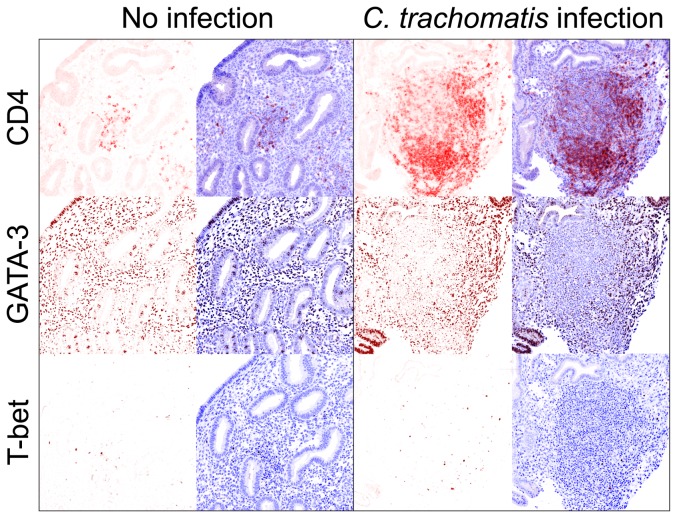
While Chlamydia trachomatis infections are frequently asymptomatic, mechanisms that regulate host response to this intracellular Gram-negative bacterium remain undefined. This investigation thus used peripheral blood mononuclear cells and endometrial tissue from women with or without Chlamydia genital tract infection to better define this response. Initial genome-wide microarray analysis revealed highly elevated expression of matrix metalloproteinase 10 and other molecules characteristic of Type 2 immunity (e.g., fibrosis and wound repair) in Chlamydia-infected tissue. This result was corroborated in flow cytometry and immunohistochemistry studies that showed extant upper genital tract Chlamydia infection was associated with increased co-expression of CD200 receptor and CD206 (markers of alternative macrophage activation) by endometrial macrophages as well as increased expression of GATA-3 (the transcription factor regulating TH2 differentiation) by endometrial CD4(+) T cells. Also among women with genital tract Chlamydia infection, peripheral CD3(+) CD4(+) and CD3(+) CD4(-) cells that proliferated in response to ex vivo stimulation with inactivated chlamydial antigen secreted significantly more interleukin (IL)-4 than tumor necrosis factor, interferon-γ, or IL-17; findings that repeated in T cells isolated from these same women 1 and 4 months after infection had been eradicated. Our results thus newly reveal that genital infection by an obligate intracellular bacterium induces polarization towards Type 2 immunity, including Chlamydia-specific TH2 development. Based on these findings, we now speculate that Type 2 immunity was selected by evolution as the host response to C. trachomatis in the human female genital tract to control infection and minimize immunopathological damage to vital reproductive structures.
虽然沙眼衣原体感染通常无症状,但调节宿主对这种细胞内革兰氏阴性菌反应的机制仍未确定。因此,本研究使用来自患有或不患有生殖道沙眼衣原体感染的女性的外周血单核细胞和子宫内膜组织,以更好地定义这种反应。最初的全基因组微阵列分析显示,在沙眼衣原体感染组织中,基质金属蛋白酶 10 和其他 2 型免疫特征分子(如纤维化和伤口修复)的表达高度上调。这一结果在流式细胞术和免疫组织化学研究中得到了证实,这些研究表明,现有的上生殖道沙眼衣原体感染与子宫内膜巨噬细胞中 CD200 受体和 CD206(替代巨噬细胞激活的标志物)的共表达增加以及子宫内膜 CD4+T 细胞中 GATA-3(调节 TH2 分化的转录因子)的表达增加有关。同样,在患有生殖道沙眼衣原体感染的女性中,对外源性刺激物(灭活的沙眼衣原体抗原)有反应性增殖的外周血 CD3+CD4+和 CD3+CD4-细胞分泌的白细胞介素(IL)-4 明显多于肿瘤坏死因子、干扰素-γ或 IL-17;在感染后 1 个月和 4 个月从这些女性中分离出的 T 细胞中也发现了同样的结果。我们的研究结果因此首次揭示,一种专性细胞内细菌的生殖道感染会诱导 2 型免疫的极化,包括针对沙眼衣原体的特异性 TH2 发育。基于这些发现,我们现在推测,2 型免疫是宿主对人类女性生殖道中沙眼衣原体的反应,是通过进化选择的,以控制感染并最大限度地减少对重要生殖结构的免疫病理损伤。