Department of Neurology, Innsbruck Medical University, Innsbruck, Austria. mail:
PLoS One. 2013;8(3):e59952. doi: 10.1371/journal.pone.0059952. Epub 2013 Mar 28.
Matrix metalloproteinases (MMPs) and their tissue inhibitors (TIMPs) are involved in vascular remodeling, (neuro)inflammation, blood-brain barrier breakdown and neuronal apoptosis. Proinflammatory mechanisms are suggested to play an important role during early brain injury and cerebral vasospasm after aneurysmal subarachnoid hemorrhage (SAH). This study aimed to analyze MMP-3, MMP-9, TIMP-1 and TIMP-3 in patients with SAH and their respective association with cerebral vasospasm (CVS).
Blood samples were collected in 20 SAH patients on days 1 to 7, 9, 11, 13 and 15 and 20 healthy age and gender matched volunteers. Serum MMPs and TIMPs were analyzed using enzyme-linked immunosorbent assay. Doppler sonographic CVS was defined as a mean blood flow velocity above 120 cm/sec in the middle cerebral artery. When discharged from hospital and at 6 month follow-up neurological outcome was evaluated using the Glasgow Outcome Score and the modified Rankin Scale.
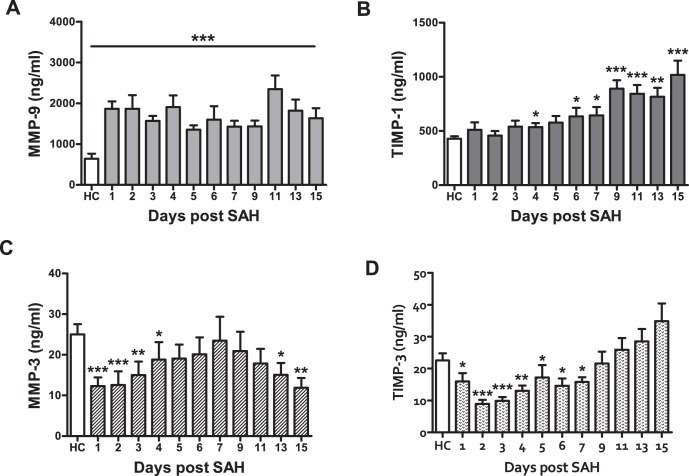
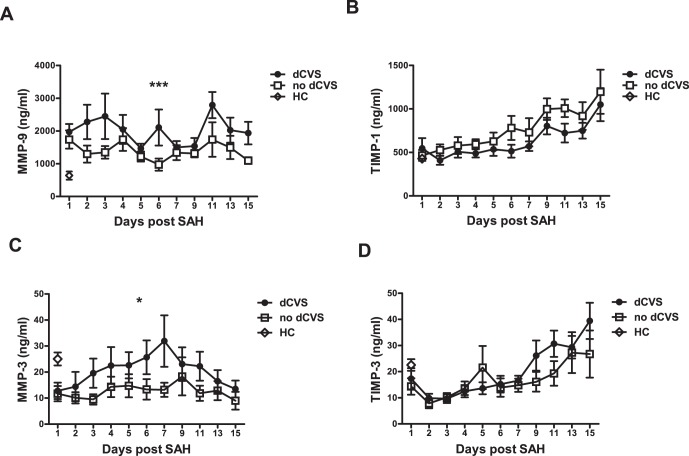
MMP-9 was higher in SAH patients compared to healthy controls (p<0.001). Patients with CVS (n = 11) had elevated MMP-9 serum levels compared to patients without CVS (n = 9, p<0.05). Higher MMP-9 was observed in the presence of cerebral ischemia associated with cerebral vasospasm (p<0.05). TIMP-1 was increased in patients with SAH on day 4 (p<0.05). There was an imbalance of the MMP-9/TIMP-1 ratio in favor of MMP-9 in SAH patients, in particular those with CVS (p<0.001). MMP-3 and TIMP-3 were significantly lower in SAH patients throughout day 4 and day 7, respectively (p<0.05). We did not find an association between MMP-, TIMP levels and neurological outcome after 6 months.
MMP-3 and -9 are differentially regulated in SAH patients with both enzymes showing peak levels correlating with the development of CVS. The inhibitors TIMP-1 and -3 were low during the acute phase after SAH and increased later on which might suggest a preponderance of pro-inflammatory mechanisms.
基质金属蛋白酶(MMPs)及其组织抑制剂(TIMPs)参与血管重塑、(神经)炎症、血脑屏障破坏和神经元凋亡。在蛛网膜下腔出血(SAH)后早期脑损伤和脑血管痉挛(CVS)中,促炎机制被认为起着重要作用。本研究旨在分析 SAH 患者的 MMP-3、MMP-9、TIMP-1 和 TIMP-3,并分析其与 CVS 的相关性。
在发病第 1 天至第 7、9、11、13 和 15 天以及 20 名年龄和性别匹配的健康志愿者中采集 20 例 SAH 患者的血样。采用酶联免疫吸附试验分析血清 MMP 和 TIMP。多普勒超声 CVS 定义为大脑中动脉平均血流速度超过 120cm/sec。出院时和 6 个月随访时,采用格拉斯哥结局评分和改良 Rankin 量表评估神经功能预后。
与健康对照组相比,SAH 患者 MMP-9 水平升高(p<0.001)。与无 CVS 的患者(n=9)相比,有 CVS 的患者(n=11)MMP-9 血清水平升高(p<0.05)。在与 CVS 相关的脑缺血患者中,MMP-9 升高(p<0.05)。SAH 患者在第 4 天 TIMP-1 升高(p<0.05)。SAH 患者 MMP-9/TIMP-1 比值失衡,有利于 MMP-9(p<0.001),特别是有 CVS 的患者(p<0.001)。MMP-3 和 TIMP-3 在第 4 天和第 7 天分别显著降低(p<0.05)。我们未发现 MMP、TIMP 水平与 6 个月后的神经功能预后相关。
MMP-3 和 MMP-9 在伴有 CVS 的 SAH 患者中存在差异调节,两种酶的峰值水平与 CVS 的发展相关。抑制剂 TIMP-1 和 TIMP-3 在 SAH 后急性期较低,随后增加,这可能提示促炎机制占主导地位。