Department of Epidemiology, School of Public Health, Fudan University, and The Key Laboratory of Public Health Safety of Ministry of Education (Fudan University), Shanghai, China.
PLoS One. 2013;8(4):e60106. doi: 10.1371/journal.pone.0060106. Epub 2013 Apr 1.
Voluntary counseling and testing (VCT) plays an important integral role in response to the HIV/AIDS epidemic. However, VCT service has not been effectively utilized among rural migrants, a high risk group in China. In this study, we developed a community based intervention to examine if community mobilization with comprehensive VCT is more effective than current HIV preventions with routine VCT service in promoting VCT acceptability among rural migrants in Shanghai, China.
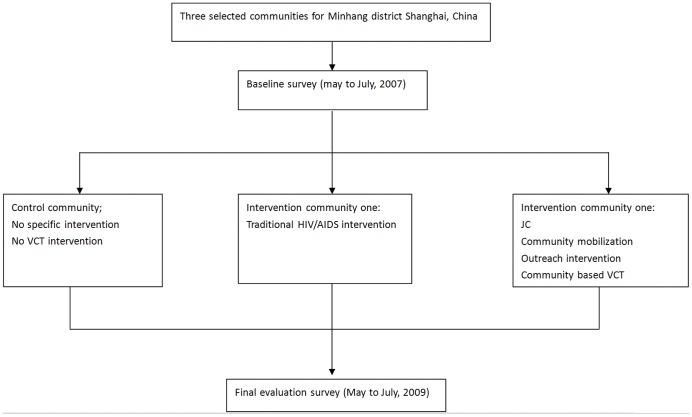
A comprehensive intervention with community mobilization and comprehensive VCT services including community-based VCT and mobile VCT was implemented during 2007-2009. Three communities in Minhang District of Shanghai were randomly selected and were designed to receive community mobilization and comprehensive VCT, traditional VCT and none intervention, respectively. After 24 months intervention, effects were evaluated by comparing outcome indicators between the baseline (2,690 participants) and follow-up surveys (1,850 participants).
A substantial increase in VCT acceptance was observed among community mobilization group (94.9% vs. 88.5%, P<0.001), whereas the reverse effect was seen in the traditional VCT group (86.1% vs. 94.6%, P<0.001) and control group (69.0% vs. 91.7%, P<0.001). Rural migrants from community mobilization group were more likely to accept VCT (OR = 2.91, 95% CI 1.69-4.97). Rural migrants from community mobilization group also showed significant increase in HIV/AIDS knowledge, positive attitude towards HIV positive individuals and condom use.
Community mobilization with comprehensive VCT has significant impact on promotion of VCT acceptance and utilization among rural migrants in Shanghai. These findings provide evidence to support community mobilization as a suitable strategy for VCT promotion among rural migrants in Shanghai, China.
自愿咨询检测(VCT)在应对艾滋病疫情方面发挥着重要的综合作用。然而,农村移民这一中国的高风险群体并未有效地利用 VCT 服务。在这项研究中,我们开展了一项基于社区的干预研究,旨在检验社区动员联合全面 VCT 是否比目前的常规 VCT 服务更能有效提高中国上海农村移民接受 VCT 的意愿。
在 2007-2009 年期间实施了一项包括社区动员和全面 VCT 服务(包括社区 VCT 和流动 VCT)的综合干预措施。上海闵行区的 3 个社区被随机选择,分别接受社区动员和全面 VCT、传统 VCT 和无干预措施。干预 24 个月后,通过比较基线(2690 名参与者)和随访调查(1850 名参与者)的结果指标来评估效果。
社区动员组的 VCT 接受率显著增加(94.9% vs. 88.5%,P<0.001),而传统 VCT 组(86.1% vs. 94.6%,P<0.001)和对照组(69.0% vs. 91.7%,P<0.001)的 VCT 接受率则呈下降趋势。来自社区动员组的农村移民更有可能接受 VCT(OR=2.91,95%CI 1.69-4.97)。来自社区动员组的农村移民的艾滋病知识、对 HIV 阳性个体的积极态度和安全套使用也显著增加。
社区动员联合全面 VCT 对提高上海农村移民接受和利用 VCT 服务具有显著影响。这些发现为在中国上海农村移民中开展社区动员作为 VCT 推广策略提供了证据支持。