Department of Biological Oceanography, Royal Netherlands Institute for Sea Research, PO Box 59, 1790 AB Den Burg, The Netherlands.
Environ Microbiol Rep. 2013 Apr;5(2):272-81. doi: 10.1111/1758-2229.12013.
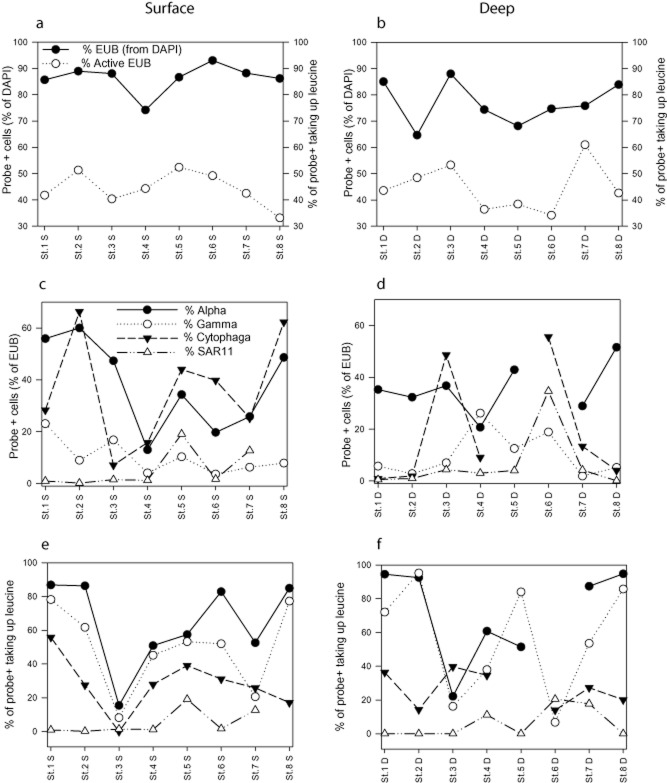
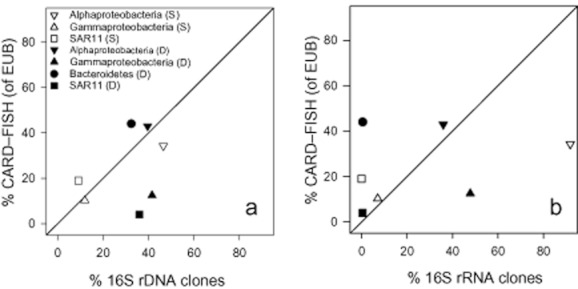
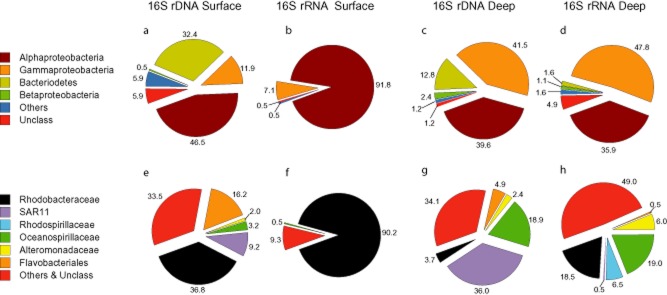
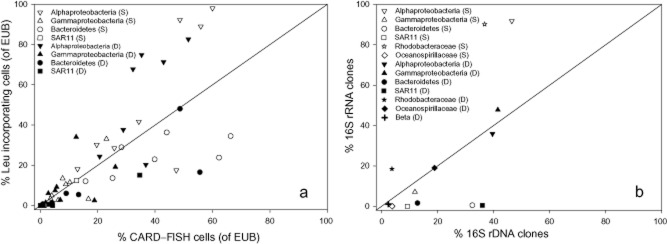
We collected surface- and deep-water samples (maximum depth 300 m) during the spring–summer transition in the coastal Arctic along a transect in the Kongsfjorden (Ny-Ålesund, Spitsbergen, Norway) to determine the structure of the active versus total marine bacterioplankton community using different approaches. Catalysed reporter deposition– fluorescence in situ hybridization combined with microautoradiography (MICRO–CARD–FISH) was used to determine the abundance and activity of different bacterial groups. The bacterial communities were dominated by members of Alphaproteobacteria followed by Bacteroidetes, whereas Gammaproteobacteria were present at low abundance but exhibited a high percentage of active cells taking up leucine. The clone libraries of 16S rRNA genes (16S rDNA) and 16S rRNA from two different depths were used to decipher the bacterial community structure. Independently of the type of clone libraries analysed (16S rDNA- or 16S rRNA-based), four major and four minor taxonomic groups were detected. The bacterioplankton community was mainly dominated at both the DNA and the RNA levels by Alphaproteobacteria followed by Gammaproteobacteria. The Rhodobacteriaceae were the most abundant members of the Alphaproteobacteria in both DNA and RNA clone libraries, followed by the SAR11 clade, which was only detectable at the 16S
我们在春季到夏季的过渡期间,沿着 Kongsfjorden(挪威斯匹次卑尔根的 Ny-Ålesund)的一条横断面,采集了表层和深层水样本(最大深度 300 米),以使用不同的方法确定活性与总海洋细菌浮游生物群落的结构。使用催化报告物沉积-荧光原位杂交结合微量放射性自显影(MICRO–CARD–FISH)来确定不同细菌群的丰度和活性。细菌群落主要由α变形菌门的成员组成,其次是拟杆菌门,而γ变形菌门的丰度较低,但表现出较高比例的摄取亮氨酸的活性细胞。16S rRNA 基因(16S rDNA)和两个不同深度的 16S rRNA 的克隆文库用于破译细菌群落结构。独立于分析的克隆文库类型(基于 16S rDNA 或 16S rRNA),检测到四个主要和四个次要分类群。在 DNA 和 RNA 水平上,细菌浮游生物群落主要由α变形菌门主导,其次是γ变形菌门。在 DNA 和 RNA 克隆文库中,红杆菌科都是α变形菌门中最丰富的成员,其次是 SAR11 分支,该分支仅在 16S 水平上检测到