Radboud University Nijmegen, Donders Institute for Brain, Cognition, and Behaviour, Nijmegen, The Netherlands.
PLoS One. 2013;8(4):e60377. doi: 10.1371/journal.pone.0060377. Epub 2013 Apr 2.
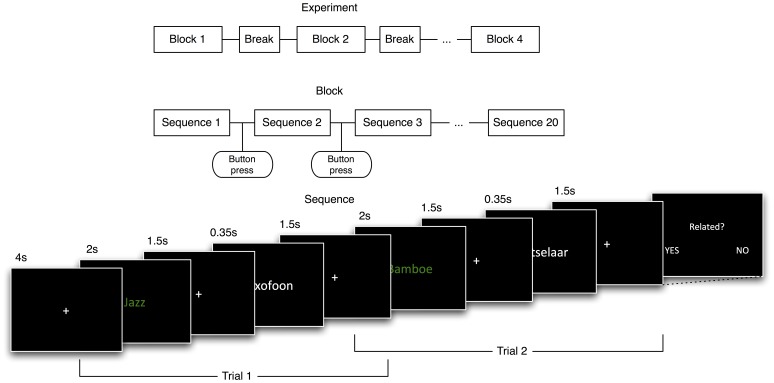
Semantic priming is usually studied by examining ERPs over many trials and subjects. This article aims at detecting semantic priming at the single-trial level. By using machine learning techniques it is possible to analyse and classify short traces of brain activity, which could, for example, be used to build a Brain Computer Interface (BCI). This article describes an experiment where subjects were presented with word pairs and asked to decide whether the words were related or not. A classifier was trained to determine whether the subjects judged words as related or unrelated based on one second of EEG data. The results show that the classifier accuracy when training per subject varies between 54% and 67%, and is significantly above chance level for all subjects (N = 12) and the accuracy when training over subjects varies between 51% and 63%, and is significantly above chance level for 11 subjects, pointing to a general effect.
语义启动通常通过在多个试验和被试中检查 ERP 来研究。本文旨在在单次试验水平上检测语义启动。通过使用机器学习技术,可以分析和分类短时间的脑活动,这可以例如用于构建脑机接口 (BCI)。本文描述了一项实验,其中向被试呈现单词对,并要求他们判断这些单词是否相关。然后,基于一秒的 EEG 数据,训练一个分类器来确定被试将单词判断为相关或不相关。结果表明,在每位被试的训练中,分类器的准确率在 54%到 67%之间,对于所有被试(N=12)来说,均显著高于随机水平,而在被试之间的训练中,准确率在 51%到 63%之间,对于 11 位被试来说,显著高于随机水平,表明存在普遍效应。