Park Margaret, Buchman Aron S, Lim Andrew S P, Leurgans Sue E, Bennett David A
Sleep Disorders Service and Research Center, Department of Behavioral Sciences, Rush University Medical Center, Chicago, IL.
Rush Alzheimer's Disease Center, Department of Neurological Sciences, Rush University Medical Center, Chicago, IL.
Am J Geriatr Psychiatry. 2014 Jul;22(7):718-26. doi: 10.1016/j.jagp.2012.12.023. Epub 2013 Mar 25.
Sleep complaints are associated with adverse health consequences. We hypothesized that non-disabled older persons with more sleep complaints have an increased risk of developing disability.
Subjects included 908 older clergy participating in the Religious Order Study without clinical dementia, history of stroke, or Parkinson disease. At baseline, participants rated their difficulty falling asleep, frequency of nocturnal awakenings, sleep efficacy, and napping frequency, from which a summary dyssomnia measure was derived. Self-report assessment of disability included instrumental activities of daily living (IADLs), basic activities of daily living (ADLs), and Rosow-Breslau mobility disability at baseline and at annual evaluations.
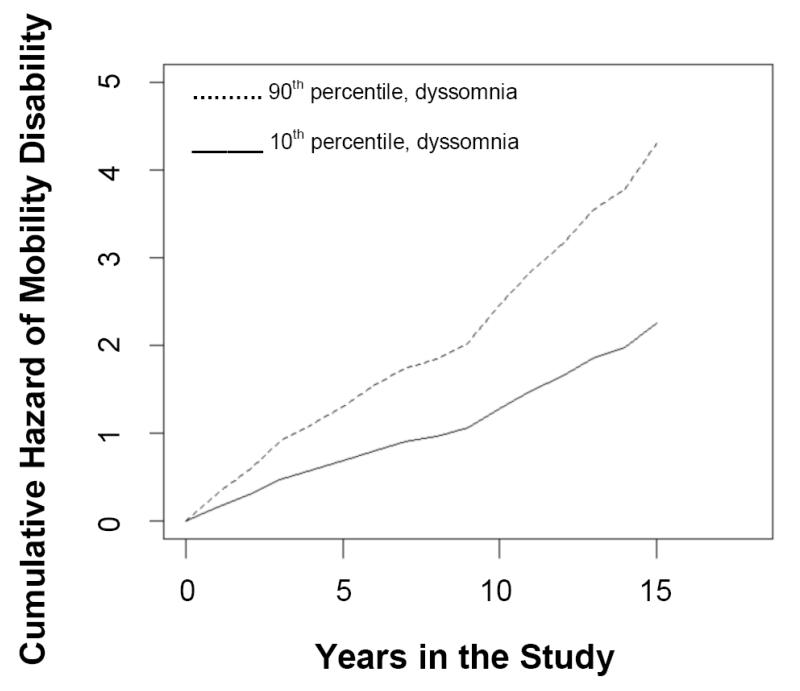
Mean follow-up was 9.6 (SD: 4.2) years. At baseline, more than 60% had one or more sleep complaints. In a series of Cox proportional hazards models controlling for age, sex, and education, a one-point higher dyssomnia score at baseline was associated with about 20% increased risk of IADL disability (hazard ratio: 1.20; 95% confidence interval [CI]: 1.04-1.39; χ(2)1 = 7.62; p <0.05), about 27% increased risk of ADL disability (hazard ratio: 1.27; 95% CI: 1.10-1.47; χ(2)1 = 12.15; p <0.01), and about 27% increased risk of mobility disability (hazard ratio: 1.27; 95% CI: 1.09-1.48; χ(2)1 = 11.04; p <0.01). These associations did not vary by age, sex, or education and remained significant after controlling for potential confounders including body mass index, chronic medical conditions, and several common medications. Controlling for depressive symptoms attenuated the association between sleep complaints and incident IADL and ADL disabilities but the association between sleep complaints and incident mobility disability remained significant.
Non-disabled older adults with more sleep complaints have an increased risk of developing disability.
睡眠问题与不良健康后果相关。我们假设睡眠问题较多的非残疾老年人发生残疾的风险增加。
研究对象包括908名参与宗教团体研究的老年神职人员,他们没有临床痴呆、中风病史或帕金森病。在基线时,参与者对入睡困难、夜间觉醒频率、睡眠效率和小睡频率进行评分,并由此得出睡眠障碍综合测量指标。残疾的自我报告评估包括基线时和年度评估时的日常生活工具性活动(IADL)、日常生活基本活动(ADL)以及罗索-布雷斯劳行动能力残疾情况。
平均随访时间为9.6(标准差:4.2)年。在基线时,超过60%的人有一项或多项睡眠问题。在一系列控制了年龄、性别和教育程度的Cox比例风险模型中,基线时睡眠障碍评分每高一分,IADL残疾风险增加约20%(风险比:1.20;95%置信区间[CI]:1.04 - 1.39;χ(2)1 = 7.62;p <0.05),ADL残疾风险增加约27%(风险比:1.27;95% CI:1.10 - 1.47;χ(2)1 = 12.15;p <0.01),行动能力残疾风险增加约27%(风险比:1.27;95% CI:1.09 - 1.48;χ(2)1 = 11.04;p <0.01)。这些关联不因年龄、性别或教育程度而有所不同,在控制了包括体重指数、慢性疾病和几种常用药物在内的潜在混杂因素后仍然显著。控制抑郁症状减弱了睡眠问题与IADL和ADL残疾事件之间的关联,但睡眠问题与行动能力残疾事件之间的关联仍然显著。
睡眠问题较多的非残疾老年人发生残疾的风险增加。