Department of Biomedical Engineering, Johns Hopkins University, Baltimore, Maryland, United States of America.
PLoS One. 2013;8(4):e60287. doi: 10.1371/journal.pone.0060287. Epub 2013 Apr 3.
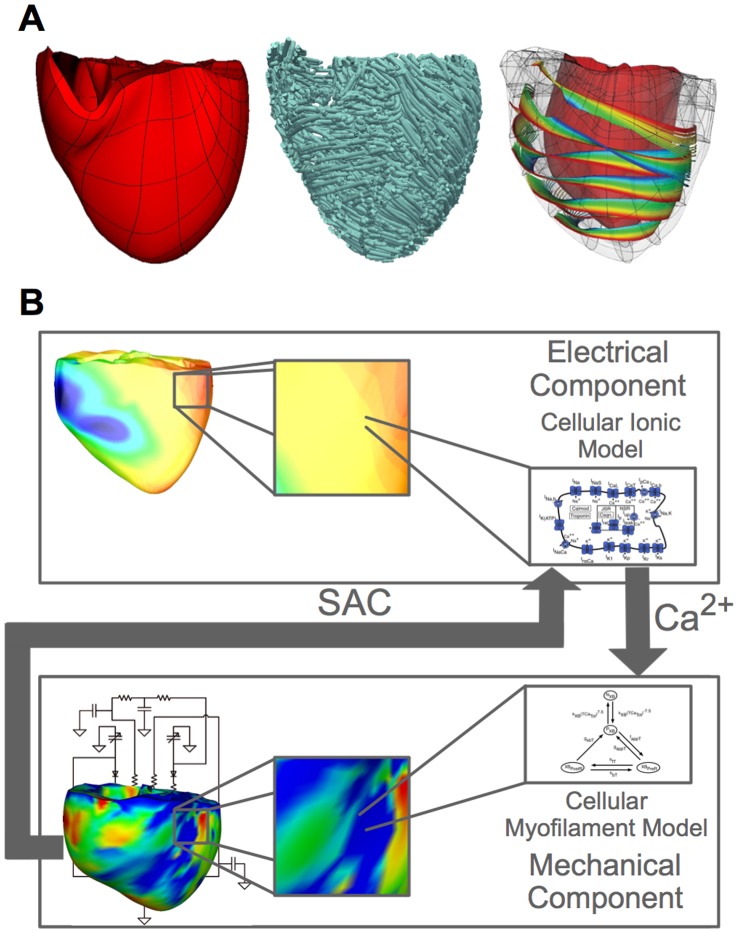
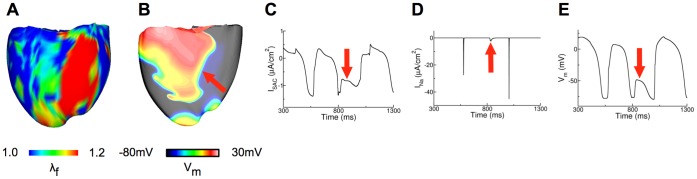
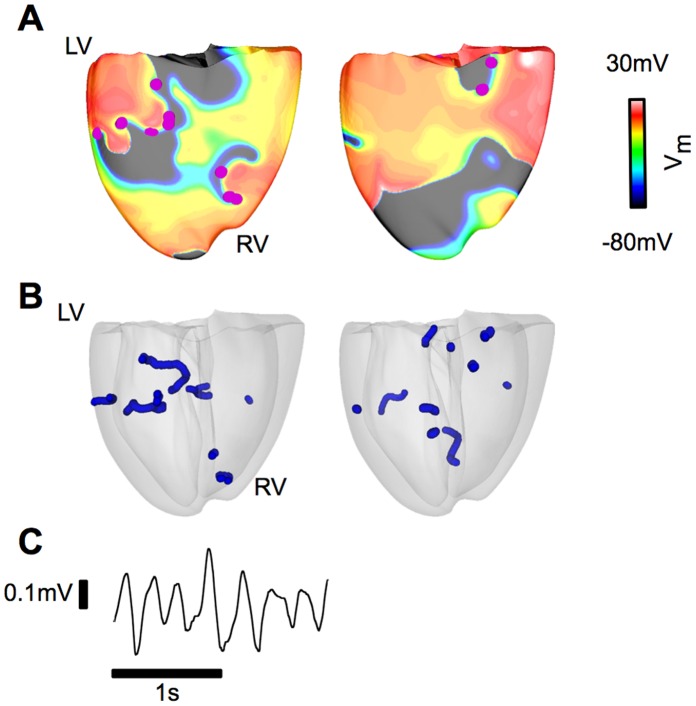
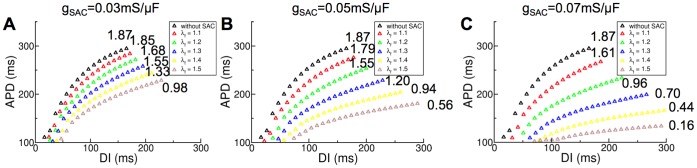
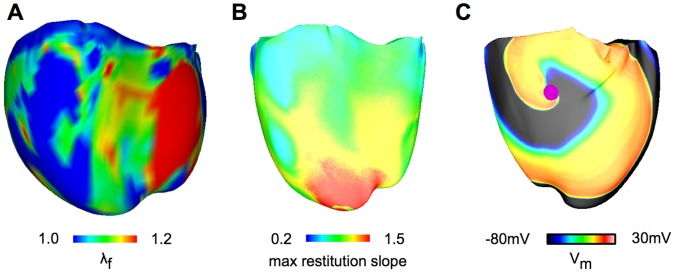
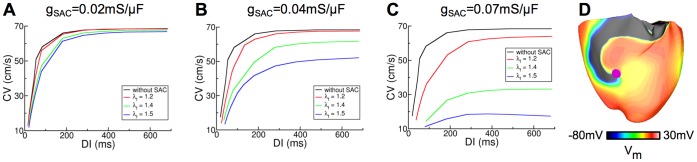
Recruitment of stretch-activated channels, one of the mechanisms of mechano-electric feedback, has been shown to influence the stability of scroll waves, the waves that underlie reentrant arrhythmias. However, a comprehensive study to examine the effects of recruitment of stretch-activated channels with different reversal potentials and conductances on scroll wave stability has not been undertaken; the mechanisms by which stretch-activated channel opening alters scroll wave stability are also not well understood. The goals of this study were to test the hypothesis that recruitment of stretch-activated channels affects scroll wave stability differently depending on stretch-activated channel reversal potential and channel conductance, and to uncover the relevant mechanisms underlying the observed behaviors. We developed a strongly-coupled model of human ventricular electromechanics that incorporated human ventricular geometry and fiber and sheet orientation reconstructed from MR and diffusion tensor MR images. Since a wide variety of reversal potentials and channel conductances have been reported for stretch-activated channels, two reversal potentials, -60 mV and -10 mV, and a range of channel conductances (0 to 0.07 mS/µF) were implemented. Opening of stretch-activated channels with a reversal potential of -60 mV diminished scroll wave breakup for all values of conductances by flattening heterogeneously the action potential duration restitution curve. Opening of stretch-activated channels with a reversal potential of -10 mV inhibited partially scroll wave breakup at low conductance values (from 0.02 to 0.04 mS/µF) by flattening heterogeneously the conduction velocity restitution relation. For large conductance values (>0.05 mS/µF), recruitment of stretch-activated channels with a reversal potential of -10 mV did not reduce the likelihood of scroll wave breakup because Na channel inactivation in regions of large stretch led to conduction block, which counteracted the increased scroll wave stability due to an overall flatter conduction velocity restitution.
募集拉伸激活通道,机械电反馈的机制之一,已被证明会影响涡旋波的稳定性,这是折返性心律失常的基础。然而,尚未进行全面研究以检查具有不同反转电位和电导率的拉伸激活通道募集对涡旋波稳定性的影响;拉伸激活通道打开如何改变涡旋波稳定性的机制也尚未得到很好的理解。本研究的目的是检验以下假设:拉伸激活通道募集根据拉伸激活通道反转电位和通道电导的不同而对涡旋波稳定性产生不同的影响,并揭示观察到的行为的相关机制。我们开发了一个强耦合的人心室机电模型,该模型纳入了人心室的几何形状以及从 MR 和扩散张量 MR 图像重建的纤维和薄片方向。由于已经报道了各种拉伸激活通道的反转电位和电导,因此实施了两个反转电位,-60 mV 和-10 mV,以及一系列电导(0 至 0.07 mS/µF)。具有-60 mV 反转电位的拉伸激活通道的打开通过使动作电位时程复恢曲线异质变平,减少了所有电导值的涡旋波破裂。具有-10 mV 反转电位的拉伸激活通道的打开通过使传导速度复恢关系异质变平,部分抑制了低电导值(0.02 至 0.04 mS/µF)的涡旋波破裂。对于大电导值(>0.05 mS/µF),具有-10 mV 反转电位的拉伸激活通道的募集并不能降低涡旋波破裂的可能性,因为在大拉伸区域中的 Na 通道失活导致传导阻滞,这抵消了由于整体更平坦的传导速度复恢而导致的涡旋波稳定性增加。