Department of Psychiatry, University of Pittsburgh, 3811 O'Hara St., Pittsburgh, PA 15213, USA.
Psychosom Med. 2013 Jun;75(5):449-52. doi: 10.1097/PSY.0b013e31828d3f1d. Epub 2013 Apr 10.
Psychological stress can up-regulate inflammatory processes and increase disease risk. In the context of stress, differences in how individuals cope might have implications for health. The goal of this study was to evaluate associations among stress, coping, and inflammation in a sample of African American and white adolescents.
Adolescents (n = 245) completed self-report measures of stressful life events and coping, provided daily diary reports of interpersonal conflict for 7 days, and provided fasting blood samples for assessment of C-reactive protein (CRP).
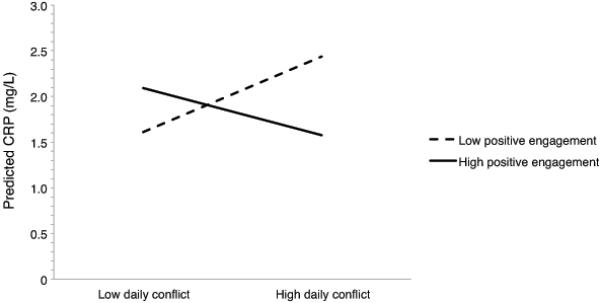
In regression analyses adjusted for age, sex, race, body mass index, smoking, and socioeconomic status, there were no significant associations between stress and CRP, but significant interactions between stress and coping emerged. For adolescents reporting more unpleasant stressful life events in the past 12 months, positive engagement coping was inversely associated with CRP (β= -.19, p < .05), whereas coping was not significantly associated with CRP for adolescents reporting fewer stressful life events. Positive engagement coping was significantly and inversely associated with CRP in the context of interpersonal stress, whether measured as stressful life events reflecting interpersonal conflict (e.g., arguments with parents or siblings, conflict between adults in the home, and friendship ended) or frequency of arguments with others reported in daily diaries. Disengagement coping was unrelated to CRP.
Findings suggest that positive engagement coping is associated with lower levels of inflammation, but only when adolescents are challenged by significant stress.
心理压力会促进炎症过程并增加患病风险。在压力环境下,个体应对压力的方式的差异可能对健康有影响。本研究的目的是评估在非裔美国人和白人青少年样本中,压力、应对方式和炎症之间的关系。
青少年(n=245)完成了关于生活压力事件和应对方式的自我报告,连续 7 天记录人际冲突的日常日记,并提供空腹血样以评估 C 反应蛋白(CRP)。
在调整年龄、性别、种族、体重指数、吸烟和社会经济地位后,压力与 CRP 之间没有显著关联,但压力与应对方式之间存在显著的交互作用。对于过去 12 个月报告更多不愉快生活压力事件的青少年,积极应对与 CRP 呈负相关(β=-.19,p<.05),而对于报告较少生活压力事件的青少年,应对方式与 CRP 无显著关联。在人际压力的情况下,积极参与应对与 CRP 显著负相关,无论是通过反映人际冲突的生活压力事件(例如,与父母或兄弟姐妹争吵、家庭中成年人之间的冲突和友谊结束)来衡量,还是通过日常日记中报告的与他人争吵的频率来衡量。回避应对与 CRP 无关。
研究结果表明,积极参与应对与较低的炎症水平有关,但仅在青少年受到重大压力挑战时才有关联。