Department of Primatology, Max-Planck Institute for Evolutionary Anthropology, Deutscher Platz 6, Leipzig 04103, Germany.
BMC Evol Biol. 2013 Apr 12;13:82. doi: 10.1186/1471-2148-13-82.
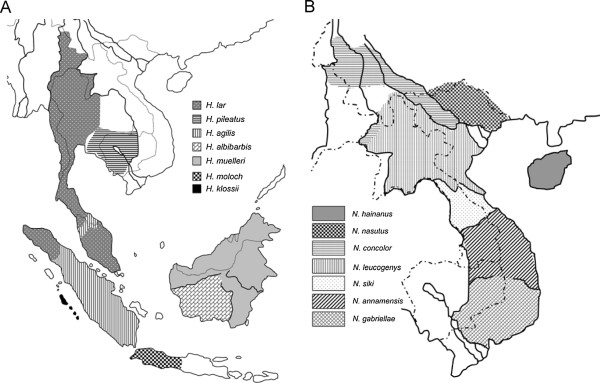
Gibbons (Hylobatidae) are the most diverse group of living apes. They exist as geographically-contiguous species which diverged more rapidly than did their close relatives, the great apes (Hominidae). Of the four extant gibbon genera, the evolutionary histories of two polyspecific genera, Hylobates and Nomascus, have been the particular focus of research but the DNA sequence data used was largely derived from the maternally inherited mitochondrial DNA (mtDNA) locus.
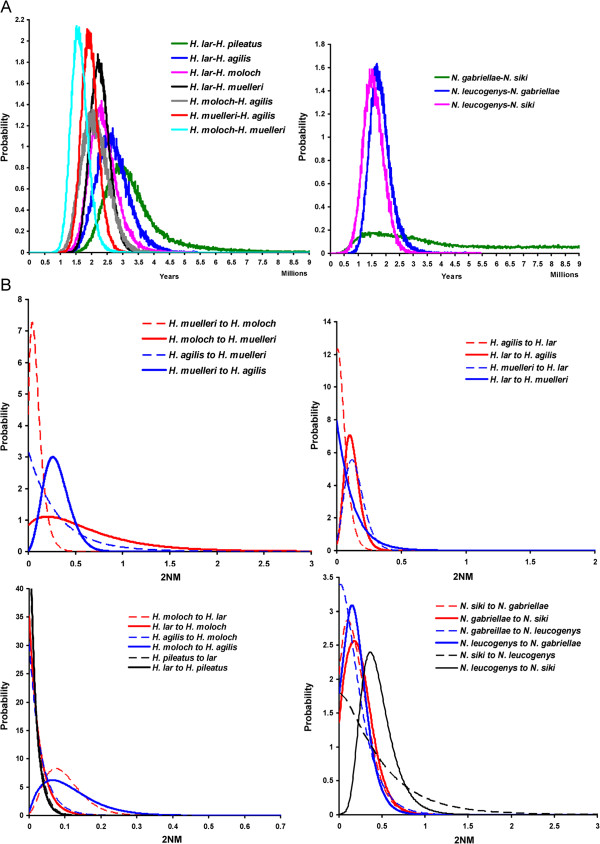
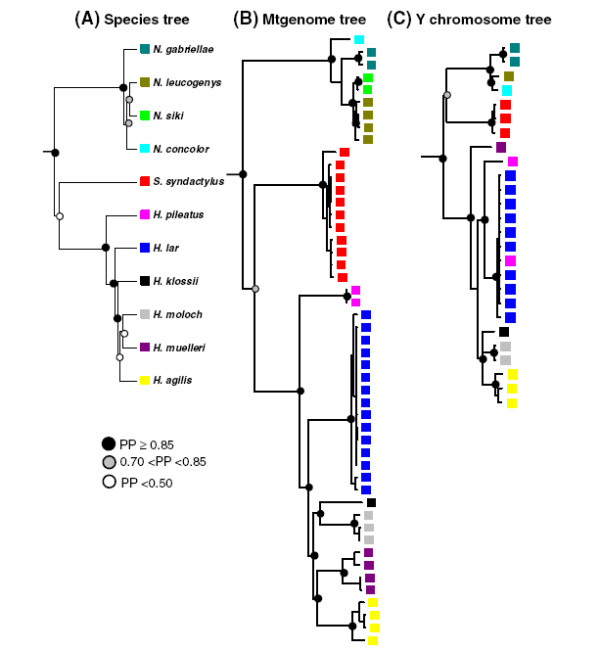
To investigate the evolutionary relationships and divergence processes of gibbon species, particularly those of the Hylobates genus, we produced and analyzed a total of 11.5 kb DNA of sequence at 14 biparentally inherited autosomal loci. We find that on average gibbon genera have a high average sequence diversity but a lower degree of genetic differentiation as compared to great ape genera. Our multilocus species tree features H. pileatus in a basal position and a grouping of the four Sundaic island species (H. agilis, H. klossii, H. moloch and H. muelleri). We conducted pairwise comparisons based on an isolation-with-migration (IM) model and detect signals of asymmetric gene flow between H. lar and H. moloch, between H. agilis and H. muelleri, and between N. leucogenys and N. siki.
Our multilocus analyses provide inferences of gibbon evolutionary histories complementary to those based on single gene data. The results of IM analyses suggest that the divergence processes of gibbons may be accompanied by gene flow. Future studies using analyses of multi-population model with samples of known provenance for Hylobates and Nomascus species would expand the understanding of histories of gene flow during divergences for these two gibbon genera.
长臂猿(Hylobatidae)是现存灵长类动物中种类最多的一个类群。它们是地理上连续分布的物种,与亲缘关系较近的大猿(Hominidae)相比,这些物种的分化速度更快。在现存的四种长臂猿属中,两种多态属(Hylobates 和 Nomascus)的进化历史一直是研究的重点,但所使用的 DNA 序列数据主要来自于母系遗传的线粒体 DNA(mtDNA)基因座。
为了研究长臂猿物种的进化关系和分化过程,特别是 Hylobates 属的进化关系,我们总共产生和分析了 14 个常染色体上的 11.5kb 双等位基因序列。我们发现,与大猿属相比,长臂猿属的平均序列多样性较高,但遗传分化程度较低。我们的多基因物种树以 H. pileatus 为基础,并将四个巽他群岛物种(H. agilis、H. klossii、H. moloch 和 H. muelleri)归为一组。我们根据隔离-迁移(IM)模型进行了成对比较,并检测到 H. lar 和 H. moloch 之间、H. agilis 和 H. muelleri 之间以及 N. leucogenys 和 N. siki 之间存在不对称基因流的信号。
我们的多基因分析为基于单基因数据的长臂猿进化历史提供了补充推断。IM 分析的结果表明,长臂猿的分化过程可能伴随着基因流。未来对 Hylobates 和 Nomascus 物种的多群体模型分析和具有已知来源的样本的研究,将有助于扩大对这两个长臂猿属在分化过程中基因流历史的理解。