Department of Psychological Medicine, Institute of Psychiatry, Weston Education Centre, Cutcombe Road, London SE5 9RJ, UK.
BMC Psychiatry. 2013 Apr 15;13:115. doi: 10.1186/1471-244X-13-115.
The Mental Capacity Act 2005 (MCA) was introduced in 2007 to protect vulnerable individuals who lack capacity to make decisions for themselves and to provide a legal framework for professionals to assess incapacity. The impact of the MCA on clinical practice is not known. This study aims to evaluate how frequently mental capacity is assessed in psychiatric inpatients, whether the criteria for determining capacity set out in the MCA are used in practice, and whether this has increased with the introduction of the MCA.
A retrospective cohort study was carried out using a case register of South East London mental health service users. The Case Register Interactive Search (CRIS) system enabled searching and retrieval of anonymised information on patients admitted to the South London and Maudsley NHS Foundation Trust since 2006. The presence and outcomes of documented mental capacity assessments in psychiatric admissions between May 2006 and February 2010 were identified and demographic information on all admissions was retrieved.
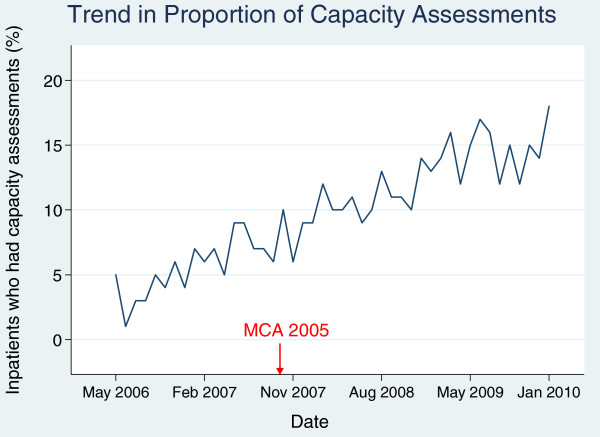
Capacity assessments were documented in 1,732/17,744 admissions (9.8%). There was a significant increase in the frequency of capacity assessments carried out over the study period of 0.3 percentage points per month (95% CI 0.26-0.36, p < 0.00001). In only 14.7% of capacity assessments were the MCA criteria for assessing capacity explicitly used.
Over the period of the introduction of the MCA there has been a significant increase in the number of mental capacity assessments carried out on psychiatric inpatients. Although mental health services are considering the issue of capacity more frequently, mental capacity assessments are inconsistently applied and do not make adequate use of MCA criteria.
2005 年《精神能力法案》(MCA)于 2007 年出台,旨在保护那些缺乏为自己做决定能力的弱势群体,并为专业人员评估能力缺失提供法律框架。MCA 对临床实践的影响尚不清楚。本研究旨在评估精神科住院患者中评估能力的频率,实践中是否使用 MCA 中规定的确定能力的标准,以及随着 MCA 的引入,这种情况是否有所增加。
使用东南伦敦心理健康服务使用者的病例登记进行回顾性队列研究。病例登记互动搜索(CRIS)系统能够搜索和检索自 2006 年以来南伦敦和莫兹利国民保健信托基金会收治的患者的匿名信息。确定 2006 年 5 月至 2010 年 2 月期间精神病住院患者中记录的有能力评估的存在和结果,并检索所有入院患者的人口统计学信息。
在 17744 次入院中,有 1732 次记录了能力评估(9.8%)。在研究期间,每月进行能力评估的频率增加了 0.3 个百分点(95%CI 0.26-0.36,p<0.00001)。在只有 14.7%的能力评估中,明确使用了 MCA 评估能力的标准。
在 MCA 出台期间,对精神科住院患者进行的能力评估数量显著增加。尽管精神卫生服务部门更频繁地考虑能力问题,但能力评估的应用不一致,并且没有充分利用 MCA 标准。