Institute of Primary Care & Public Health, School of Medicine, Cardiff University, Cardiff, UK.
BMJ Open. 2013 Apr 15;3(4). doi: 10.1136/bmjopen-2012-002337. Print 2013.
The influence of neighbourhood deprivation on the risk of harmful alcohol consumption, measured by the separate categories of excess consumption and binge drinking, has not been studied. The study objective was to investigate the effect of neighbourhood deprivation with age, gender and socioeconomic status (SES) on (1) excess alcohol consumption and (2) binge drinking, in a representative population survey.
Cross-sectional study: multilevel analysis.
Wales, UK, adult population ∼2.2 million.
58 282 respondents aged 18 years and over to four successive annual Welsh Health Surveys (2003/2004-2007), nested within 32 692 households, 1839 census lower super output areas and the 22 unitary authority areas in Wales.
Maximal daily alcohol consumption during the past week was categorised using the UK Department of Health definition of 'none/never drinks', 'within guidelines', 'excess consumption but less than binge' and 'binge'. The data were analysed using continuation ratio ordinal multilevel models with multiple imputation for missing covariates.
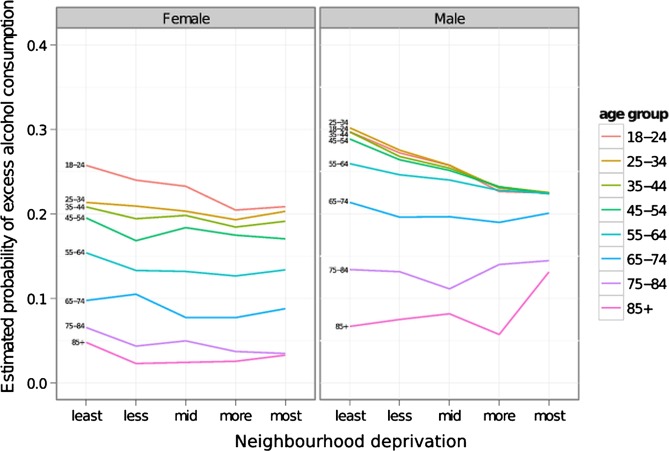
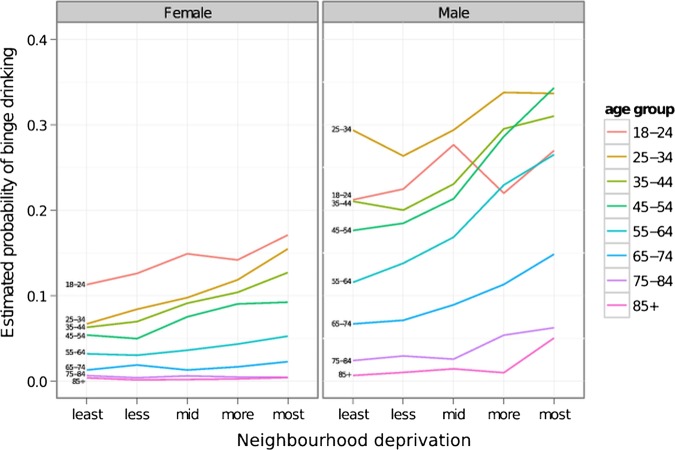
Respondents in the most deprived neighbourhoods were more likely to binge drink than in the least deprived (adjusted estimates: 17.5% vs 10.6%; difference=6.9%, 95% CI 6.0 to 7.8), but were less likely to report excess consumption (17.6% vs 21.3%; difference=3.7%, 95% CI 2.6 to 4.8). The effect of deprivation varied significantly with age and gender, but not with SES. Younger men in deprived neighbourhoods were most likely to binge drink. Men aged 35-64 showed the steepest increase in binge drinking in deprived neighbourhoods, but men aged 18-24 showed a smaller increase with deprivation.
This large-scale population study is the first to show that neighbourhood deprivation acts differentially on the risk of binge drinking between men and women at different age groups. Understanding the socioeconomic patterns of harmful alcohol consumption is important for public health policy development.
尚未研究邻里贫困对过量饮酒和 binge drinking 这两种不同的有害饮酒风险的影响。本研究旨在调查年龄、性别和社会经济地位(SES)与邻里贫困程度共同作用下,对(1)过量饮酒和(2) binge drinking 的影响,该研究基于代表性人群调查。
横断面研究:多层次分析。
威尔士,英国,约 220 万成年人。
对连续 4 年的威尔士健康调查(2003/2004-2007 年)中的 58282 名 18 岁及以上的受访者进行嵌套分析,该调查涉及 32692 户家庭、1839 个英国普查的下层超区和威尔士的 22 个单一管理区。
使用英国卫生部对“无/从不饮酒”、“在指导范围内”、“过量饮酒但未达到 binge”和“ binge”的定义,对过去一周内最大日饮酒量进行分类。使用带有缺失协变量的连续比序贯多水平模型对数据进行分析。
处于最贫困邻里的受访者 binge drinking 的可能性高于处于最不贫困邻里的受访者(调整后的估计值:17.5%对 10.6%;差值=6.9%,95%置信区间 6.0 至 7.8),但过量饮酒的可能性低于处于最不贫困邻里的受访者(17.6%对 21.3%;差值=3.7%,95%置信区间 2.6 至 4.8)。贫困程度的影响随年龄和性别而显著变化,但与 SES 无关。处于贫困邻里的年轻男性最有可能 binge drinking。处于 35-64 岁的男性在贫困邻里中 binge drinking 的风险急剧增加,但 18-24 岁的男性随着贫困程度的增加 binge drinking 的风险增加幅度较小。
本大规模人群研究首次表明,邻里贫困对不同年龄组男女 binge drinking 的风险具有不同的作用。了解有害饮酒的社会经济模式对于制定公共卫生政策非常重要。