Urban Health Collaborative, Drexel University, Philadelphia, Pennsylvania, United States of America.
Department of Agricultural and Applied Economics, University of Georgia, Athens, Georgia, United States of America.
PLoS One. 2022 May 19;17(5):e0268068. doi: 10.1371/journal.pone.0268068. eCollection 2022.
The COVID-19 pandemic has increased mental stress among the population and, at the same time, has lowered consumer income. Alcohol, non-alcoholic beverages, and tobacco consumption are associated with multiple health conditions but the information on how the consumption pattern of these goods shifted during the pandemic remains limited.
To examine the consumer spending on alcohol, non-alcoholic beverages, and tobacco products during the COVID-19 pandemic compared to the pre-pandemic period.
An observational study utilizing the expenditures data on alcohol, non-alcoholic beverages, and tobacco between 2017 and 2020 obtained from the US Consumer Expenditure Diary Survey.
18,808 respondents aged ≥ 21 years who answered the Consumer Expenditure Diary Survey. Main Outcome Measure(s): Bi-weekly expenditure on alcohol, non-alcoholic beverages, and tobacco products.
Multivariable linear regression models.
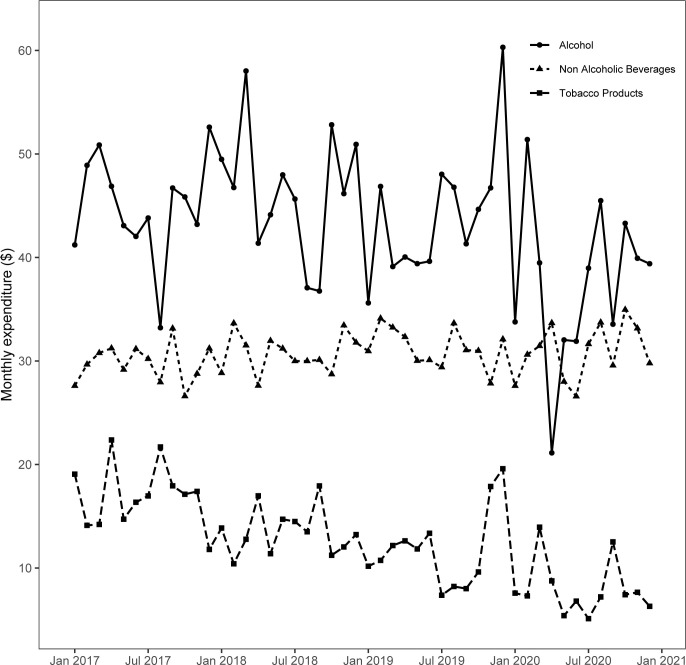
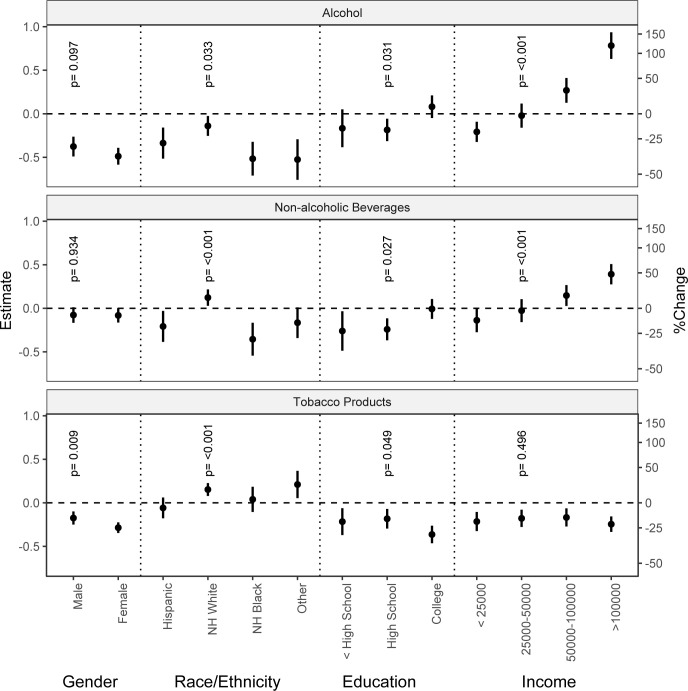
A total of 18,808 respondents (mean [SD] age = 52.5[16.9] years; 53.8% females) were included. Compared to the pre-pandemic levels, household expenditures on alcohol, non-alcoholic beverages, and tobacco products significantly decreased during the pandemic period by 28.6%, 7.9%, and 15.5%, respectively, after controlling for the state-, individual-, and household-level characteristics. Individual age, race/ethnicity, income, and education were significant predictors of spending. Heterogeneities in expenditures were evident across subgroups, with less educated and low-income households cutting their alcohol expenses while the wealthy and more educated consumers spent more during the pandemic.
Household expenditures on alcohol, non-alcoholic beverages, and tobacco products significantly decreased. The results might be beneficial in understanding consumer spending habits concerning risky health behaviors during the period of economic disruption.
COVID-19 大流行增加了民众的精神压力,同时降低了消费者收入。酒精、非酒精饮料和烟草的消费与多种健康状况有关,但有关这些商品消费模式在大流行期间如何变化的信息仍然有限。
检查 COVID-19 大流行期间与大流行前相比,人们在酒精、非酒精饮料和烟草产品上的消费支出。
利用美国消费者支出日记调查中 2017 年至 2020 年获得的酒精、非酒精饮料和烟草支出数据进行的观察性研究。
18808 名年龄≥21 岁的回答消费者支出日记调查的受访者。主要观察指标:酒精、非酒精饮料和烟草产品的双周支出。
多变量线性回归模型。
共纳入 18808 名受访者(平均[SD]年龄=52.5[16.9]岁;53.8%为女性)。与大流行前水平相比,在控制了州、个体和家庭层面的特征后,家庭在酒精、非酒精饮料和烟草产品上的支出在大流行期间分别显著下降了 28.6%、7.9%和 15.5%。个体年龄、种族/族裔、收入和教育程度是支出的重要预测因素。支出的异质性在各个亚组中明显存在,受教育程度较低和收入较低的家庭减少了酒精支出,而富裕和受教育程度较高的消费者在大流行期间支出更多。
家庭在酒精、非酒精饮料和烟草产品上的支出显著减少。这些结果有助于了解在经济动荡时期与危险健康行为有关的消费者消费习惯。