Institute of General Practice and Health Services Research, University of Zurich, Zurich, Switzerland.
Int J Gen Med. 2013 Apr 9;6:209-20. doi: 10.2147/IJGM.S43454. Print 2013.
Participation and performance trends for athletes by age group have been investigated for marathoners and ultramarathoners competing in races up to 161 km, but not for longer distances of more than 200 km.
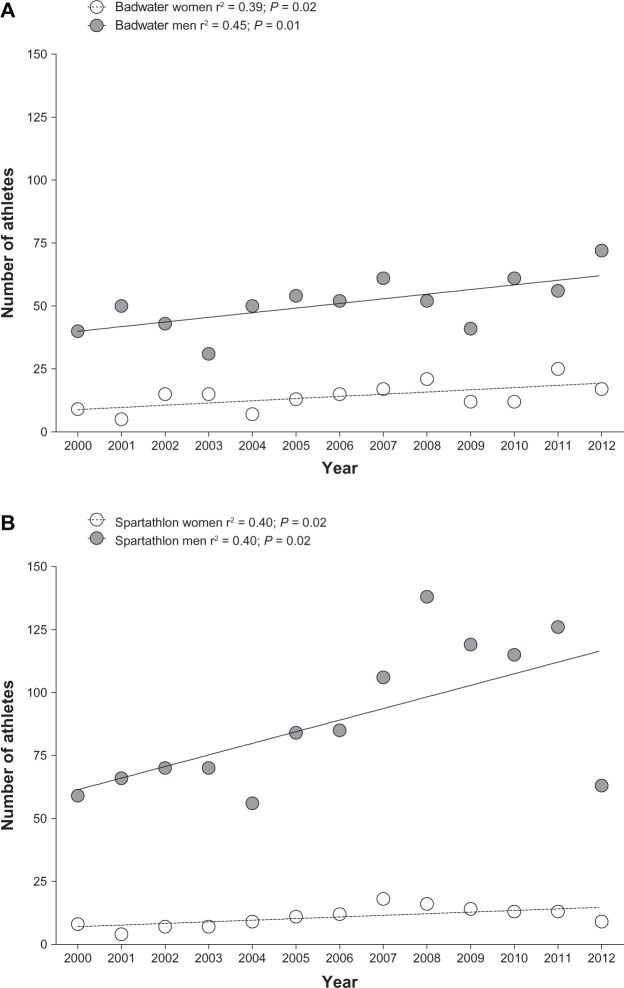
Participation and performance trends in athletes by age group in the Badwater (217 km) and Spartathlon (246 km) races were compared from 2000 to 2012.
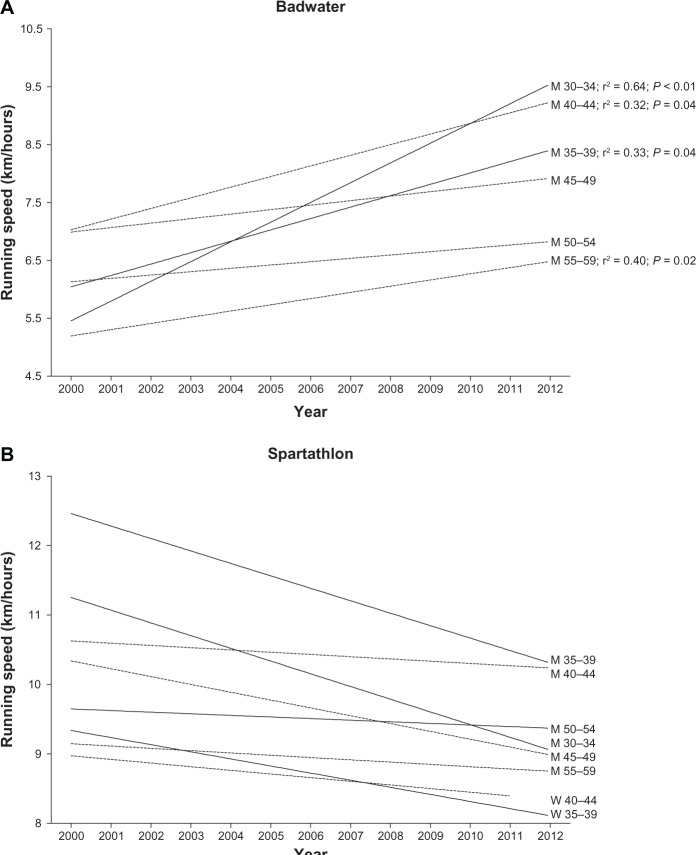
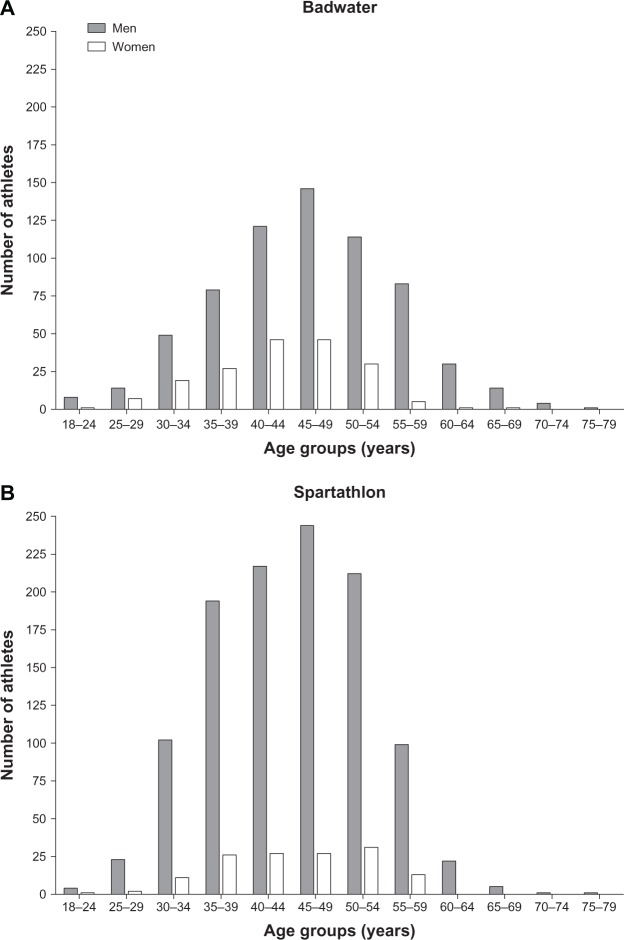
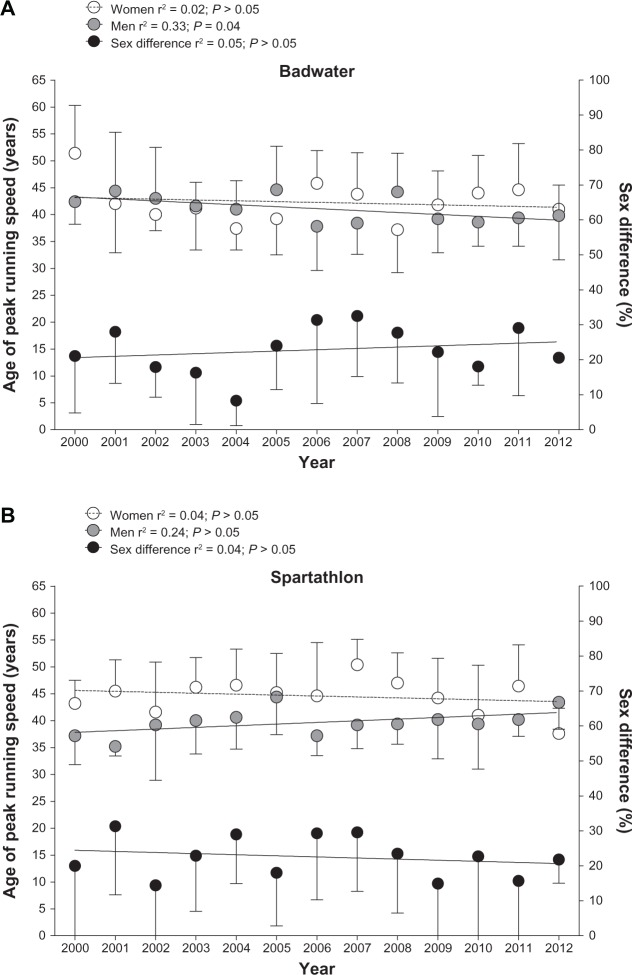
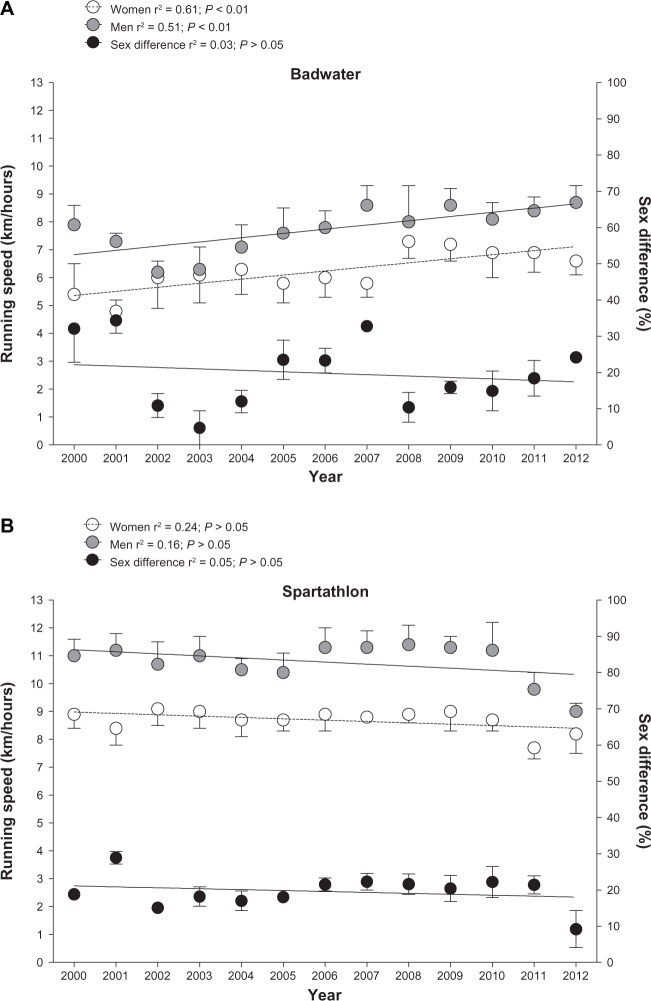
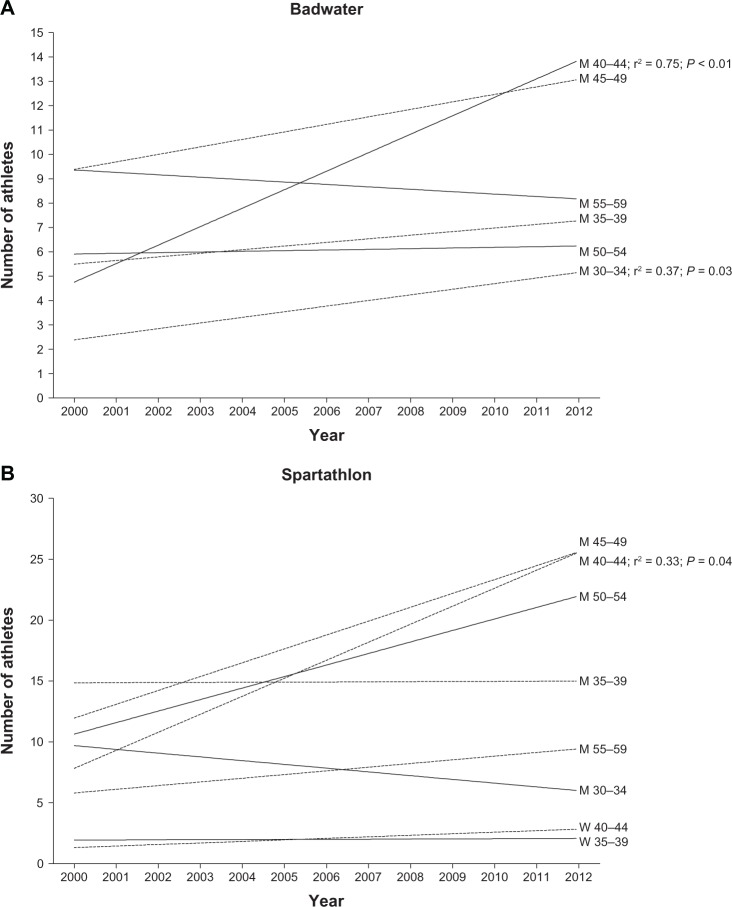
The number of female and male finishers increased in both races across years (P < 0.05). The age of the annual five fastest men decreased in Badwater from 42.4 ± 4.2 years to 39.8 ± 5.7 years (r(2) = 0.33, P = 0.04). For women, the age remained unchanged at 42.3 ± 3.8 years in Badwater (P > 0.05). In Spartathlon, the age of the annual five fastest finishers was unchanged at 39.7 ± 2.4 years for men and 44.6 ± 3.2 years for women (P > 0.05). In Badwater, running speed increased in men from 7.9 ± 0.7 km/hour to 8.7 ± 0.6 km/hour (r(2) = 0.51, P < 0.01) and in women from 5.4 ± 1.1 km/hour to 6.6 ± 0.5 km/hour (r(2) = 0.61, P < 0.01). In Spartathlon, running speed remained unchanged at 10.8 ± 0.7 km/hour in men and 8.7 ± 0.5 km/hour in women (P > 0.05). In Badwater, the number of men in age groups 30-34 years (r(2) = 0.37, P = 0.03) and 40-44 years (r(2) = 0.75, P < 0.01) increased. In Spartathlon, the number of men increased in the age group 40-44 years (r(2) = 0.33, P = 0.04). Men in age groups 30-34 (r(2) = 0.64, P < 0.01), 35-39 (r(2) = 0.33, P = 0.04), 40-44 (r(2) = 0.34, P = 0.04), and 55-59 years (r(2) = 0.40, P = 0.02) improved running speed in Badwater. In Spartathlon, no change in running speed was observed.
The fastest finishers in ultramarathons more than 200 km in distance were 40-45 years old and have to be classified as "master runners" by definition. In contrast to reports of marathoners and ultramarathoners competing in races of 161 km in distance, the increase in participation and the improvement in performance by age group were less pronounced in ultramarathoners competing in races of more than 200 km.
马拉松运动员和超长马拉松运动员在长达 161 公里的比赛中按年龄组进行参赛和表现趋势的研究已经很深入,但对于超过 200 公里的更长距离比赛则没有进行研究。
对 2000 年至 2012 年 Badwater(217 公里)和 Spartathlon(246 公里)比赛中运动员的年龄组参赛和表现趋势进行了比较。
在这两项比赛中,男女完赛者的数量都逐年增加(P<0.05)。Badwater 比赛中,年度前 5 名最快的男性年龄从 42.4±4.2 岁降至 39.8±5.7 岁(r²=0.33,P=0.04)。对于女性,年龄保持不变,仍为 42.3±3.8 岁(P>0.05)。在 Spartathlon 比赛中,年度前 5 名最快完赛者的年龄,男性保持在 39.7±2.4 岁,女性保持在 44.6±3.2 岁(P>0.05)。在 Badwater 比赛中,男性的跑步速度从 7.9±0.7 公里/小时提高到 8.7±0.6 公里/小时(r²=0.51,P<0.01),女性从 5.4±1.1 公里/小时提高到 6.6±0.5 公里/小时(r²=0.61,P<0.01)。在 Spartathlon 比赛中,男性的跑步速度保持在 10.8±0.7 公里/小时,女性保持在 8.7±0.5 公里/小时(P>0.05)。在 Badwater 比赛中,30-34 岁年龄组(r²=0.37,P=0.03)和 40-44 岁年龄组(r²=0.75,P<0.01)的男性人数增加。在 Spartathlon 比赛中,40-44 岁年龄组的男性人数增加(r²=0.33,P=0.04)。30-34 岁年龄组(r²=0.64,P<0.01)、35-39 岁年龄组(r²=0.33,P=0.04)、40-44 岁年龄组(r²=0.34,P=0.04)、55-59 岁年龄组(r²=0.40,P=0.02)的男性在 Badwater 比赛中提高了跑步速度。在 Spartathlon 比赛中,跑步速度没有变化。
在 200 公里以上的超长马拉松比赛中,最快的完赛者年龄在 40-45 岁之间,按照定义必须被归类为“大师跑者”。与马拉松运动员和超长马拉松运动员参加 161 公里比赛的报告不同,参加 200 公里以上比赛的运动员的参赛人数增加和按年龄组表现的提高程度不太明显。