Department of Environmental Toxicology, University of California, Davis, Davis, California 95616-5270, USA.
Environ Health Perspect. 2013 May;121(5):594-9. doi: 10.1289/ehp.1205921. Epub 2013 Mar 12.
Elevated levels of the pesticide DDT (dichlorodiphenyltrichloroethane) have been positively associated with blood pressure and hypertension in studies among adults. Accumulating epidemiologic and toxicologic evidence suggests that hypertension during adulthood may also be affected by earlier life and possibly the prenatal environment.
We assessed whether prenatal exposure to the pesticide DDT increases risk of adult hypertension.
We examined concentrations of DDT (p,p´- and o,p´-) and its metabolite p,p´-DDE (dichlorodiphenyldichloroethylene) in prenatal serum samples from a subset of women (n = 527) who had participated in the prospective Child Health and Development Studies birth cohort in the San Francisco Bay area while they were pregnant between 1959 and 1967. We surveyed daughters 39-47 years of age by telephone interview from 2005 to 2008 to obtain information on self-reported physician-diagnosed hypertension and use of hypertensive medication. We used multivariable regression analysis of time to hypertension based on the Cox proportional hazards model to estimate relative rates for the association between prenatal DDT exposures and hypertension treated with medication in adulthood, with adjustment for potential confounding by maternal, early-life, and adult exposures.
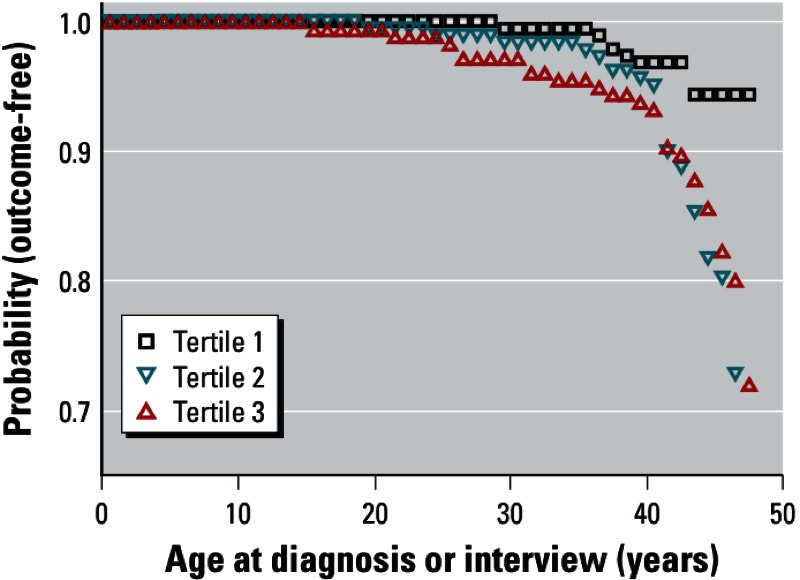
Prenatal p,p´-DDT exposure was associated with hypertension [adjusted hazard ratio (aHR) = 3.6; 95% CI: 1.8, 7.2 and aHR = 2.5; 95% CI: 1.2, 5.3 for middle and high tertiles of p,p´-DDT relative to the lowest tertile, respectively]. These associations between p,p´-DDT and hypertension were robust to adjustment for independent hypertension risk factors as well as sensitivity analyses.
These findings suggest that the association between DDT exposure and hypertension may have its origins early in development.
研究表明,成年人血液中滴滴涕(二氯二苯三氯乙烷)水平升高与血压升高和高血压呈正相关。越来越多的流行病学和毒理学证据表明,成年人时期的高血压也可能受到生命早期甚至产前环境的影响。
我们评估了产前接触滴滴涕是否会增加成人高血压的风险。
我们检测了产前血清样本中滴滴涕(p,p´-和 o,p´-)及其代谢物 p,p´-DDE(二氯二苯二氯乙烯)的浓度,这些样本来自于参与前瞻性儿童健康与发展研究出生队列的女性亚组(n=527),这些女性于 1959 年至 1967 年期间在旧金山湾区怀孕。我们于 2005 年至 2008 年通过电话访谈调查了这些女性的女儿,以获得关于自我报告的医生诊断的高血压和使用抗高血压药物的信息。我们使用基于 Cox 比例风险模型的高血压时间的多变量回归分析来估计产前滴滴涕暴露与成年后用药物治疗的高血压之间的关联的相对风险,同时调整了母亲、生命早期和成年期暴露的潜在混杂因素。
产前 p,p´-DDT 暴露与高血压相关[调整后的危险比(aHR)=3.6;95%可信区间:1.8,7.2 和 aHR=2.5;95%可信区间:1.2,5.3,分别为 p,p´-DDT 的中间和高三分位与最低三分位相比]。这些 p,p´-DDT 与高血压之间的关联在调整了独立的高血压危险因素以及敏感性分析后仍然稳健。
这些发现表明,滴滴涕暴露与高血压之间的关联可能起源于发育早期。